

Feature
Black Diamond is named for a coal seam in California. The town that mined it is a ghost town now.
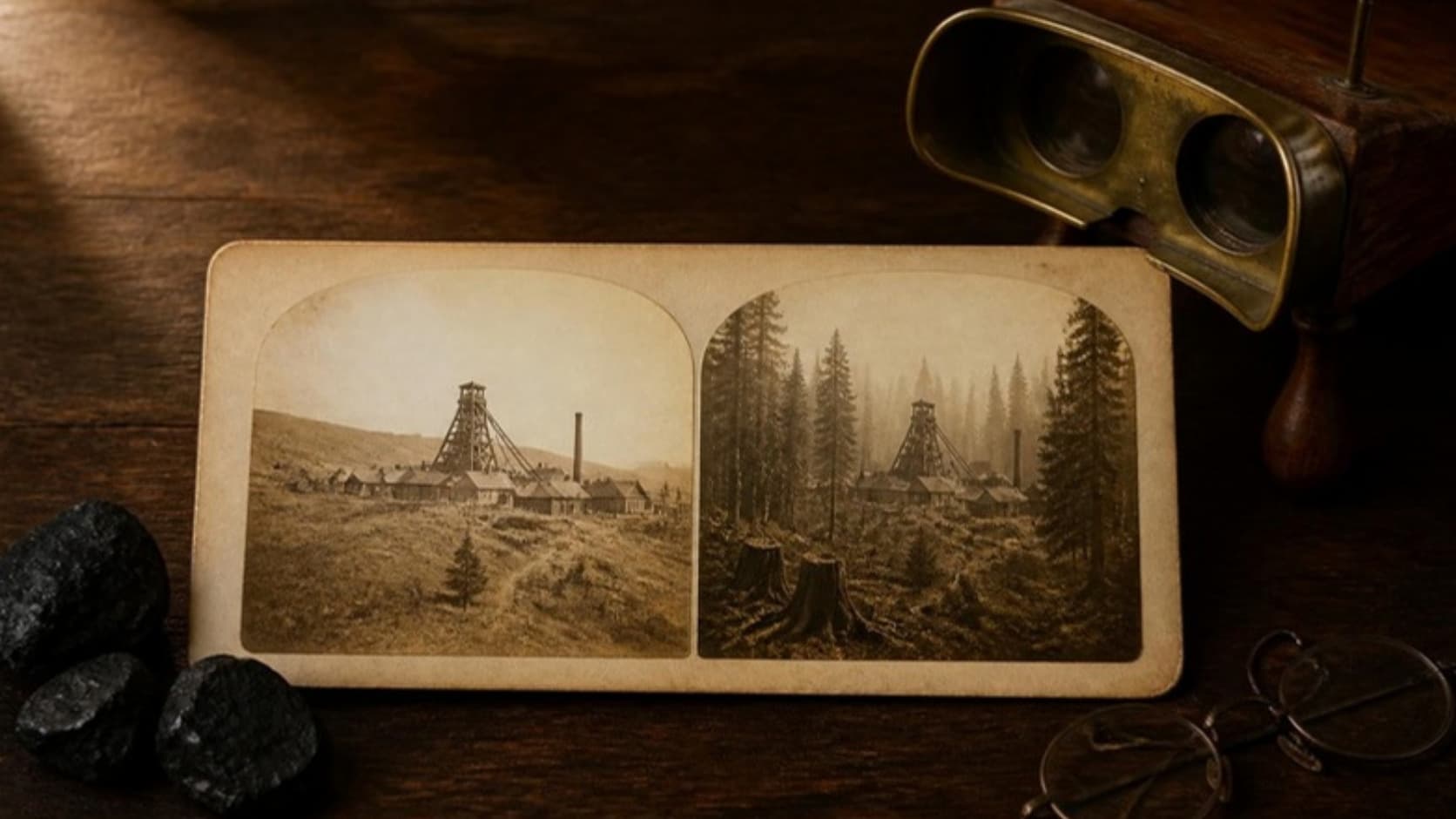
Black Diamond, Washington, took its name and first families from Nortonville, California, a coal town that emptied to build it. Only ours kept the name.
On Railroad Avenue in Black Diamond, a short drive up SR 169 from Enumclaw, the bakery still bakes in a wood-fired brick oven that its own history dates to 1902, and down the street the old railroad depot has been the historical society's museum since 1982. Nobody here ever dug up a diamond. The name is secondhand, and so, for the most part, were the first families. Both came from a town in California that no longer exists.
The historical society says it plainly: "Black Diamond's name came from the Black Diamond Coal Mining Company of Nortonville, California." What it takes a little digging to learn is where the company got the name, and what became of the place it left behind.
Three days before Christmas
In 1859, as Donald H. Clark told the story in the Seattle Times in 1949, two prospectors named Francis Somers and James Cruikshank got off a river steamer at New York Landing, east of San Francisco, and walked south into the brown hills below Mount Diablo. "Three days before Christmas they found coal," Clark wrote. Wikipedia's account gives the date as December 22, 1859. "They called their vein 'Black Diamond.'"
A mine opened on the vein. Noah Norton built the first house beside it in 1861, according to the East Bay Regional Park District, and the town took his name. The Black Diamond Coal Mining Company was organized the same year. Its coal went down a railroad to the river at New York Landing, and the landing took the name Black Diamond too.
Nortonville became the largest town on the Mount Diablo coal field. The park district's signs say the Black Diamond Mine employed as many as 300 men and boys, sank a shaft 750 feet deep, and produced more than 1.5 million tons by 1885. Clark put the population at 900; the park's sign says more than 1,000 at the peak. A great many were Welsh. Nortonville had a Welsh choir by about 1875, and of Rose Hill, the hillside cemetery the coal towns shared, the park district says "many of the people buried here were Welsh."
The man who came to run the mines was one of them. Morgan Morgans was born in Wales, came to America at 16, settled first in the Pennsylvania anthracite country and then went to California, arriving at Nortonville in 1868, according to Bill Kombol of the Palmer Coking Coal Company, writing for HistoryLink. The trouble was the coal. "California coal was of an inferior quality," Kombol writes. It was lignite, soft and crumbly, and San Francisco wanted better.
The scout and the letter
In the spring of 1880 the company sent a man named Victor Tull north to look. That July he found high-grade coal showing along the Green River in Washington Territory. The historical society places his find just above Jones Lake, also called Lake 14, "just east of the Black Diamond Bakery." A crew followed, men and one woman, whom the society names as Clarissa Davies; the log cabin the crew built was given to her.
On June 7, 1882, the company's president, Pierre B. Cornwall, and Morgans left San Francisco by steamer to see for themselves. From Seattle they went by wagon to Renton and on horseback the rest of the way, since there was no road. In a letter, Morgans described the new mine beside a small lake "which was surrounded by a forest of as fine timber as a man would wish to see." Nortonville's hills had few trees. Here, the historical society notes, was timber for mine buildings and homes.
The Columbia & Puget Sound Railroad reached Black Diamond on December 12, 1884. Kombol has the California mines closing later that month; the park district's signs say they closed in 1885.
The town that moved
Then Nortonville packed. Morgans closed the company's California affairs in March 1885 and came north the same month. Clark, writing in 1949, put it simply: "Virtually all of Nortonville's people came to Black Diamond between 1883 and 1885." Most, he wrote, sailed on the steamer Queen of the Pacific, paying their own way, $20 for a cabin or $10 in steerage, then went by rail to Renton and walked the last stretch, their baggage on packhorses.
JoAnne Matsumura, the historical society's archivist, drew on the 1885 territorial census and a 1980 thesis by Jacqueline Byer Dial to count the Welsh who came between 1882 and 1885: 194 people, 124 of them known to be from Nortonville. "They brought not only themselves, but the town as well," she wrote. Clark adds particulars. Henry Thomas, Nortonville's shoemaker, built the first proper house in the new town, with his shop downstairs. Lizzie Jones taught the first school in her mother's living room.
Dial's list of first households has Italian names as well as Welsh ones, and one that matters to Enumclaw: Alex Turnbull. An Alexander Turnbull, a Scottish mine mechanic from Black Diamond, was a partner in buying Enumclaw's burned sawmill in 1897, the future White River Lumber Company. Whether they are the same man, the records found for this piece do not say.
Behind them, Clark wrote, "Nortonville became a place of empty streets and untenanted buildings." The shafts flooded, and "cattle wandered among the headstones of the lonesome cemetery."
The name that stayed
In California the company's name had also gone to a town: the river landing, which incorporated as the city of Black Diamond in 1903, according to the Pittsburg Historical Museum. With the coal gone and a steel plant newly opened, it became Pittsburg in 1911, after the steel city in Pennsylvania.
Nortonville itself is an empty townsite now, inside the park district's Black Diamond Mines Regional Preserve, nearly 8,533 acres of hills south of Antioch. The park's sign at the site ends with a sentence that could hang in the depot on Railroad Avenue: "The town of Black Diamond, located near Seattle, was established as a result of this move."
So the town up SR 169 carries the name of a vein in California and a company from California, and of the two towns that took that name, it is the one that kept it.
After the Welsh
The company sold the mines and the town to the Pacific Coast Company in May 1904. Morgans retired to Spokane and died there on December 9, 1905; the mines closed, Kombol writes, and a special train with free fare took Black Diamond people to his funeral in Seattle. After the sale, Clark wrote, many of the original Nortonville miners drifted away, and the old community scattered.
The names changed. On November 6, 1910, an explosion in the Pacific Coast Company's Lawson Mine killed 16 men, five of them never recovered. HistoryLink's list of the dead is Italian, Belgian, Polish, Austrian and Finnish, without a single Welsh name. The 1921 fight cost families the dollar-a-month leases on company land and produced Morganville, about 200 houses the union built west of town on land from Tim Morgan, "no relation to Morgan Morgans," the society notes. Carbonado's strike years and Selleck's company-town life have their own stories on this site.
The historical society's Welsh Heritage Day, held each June since 1998, sums up where that left things: "Although few descendants remain in Black Diamond, the town was founded primarily by Welsh miners."
The mirror
Each has a coal-town cemetery full of Welsh names; Matsumura notes that more than 217 Welsh family names appear in the 1982 Black Diamond Cemetery book. Rose Hill's plot list includes a Wilhelm C. Habenicht; Dial's list of Black Diamond's first households includes a Henry, an August and an Albert Habenicht. Each has a Railroad Avenue where the coal trains ran.
And each had a hand in the other's decline, with hydroelectric power a factor both times. In 1880, Clark wrote, Nortonville's market was threatened by "the competition of high-grade coal from newly developed mines in Washington State." Half a century later, the historical society says, Black Diamond's coal was being displaced by "more convenient fuel oil from California."
If you go
The Black Diamond Historical Society Museum is at 32627 Railroad Avenue, open Thursdays 9 a.m. to 2 p.m. and Saturdays and Sundays 11 a.m. to 3 p.m., free; call (360) 886-2142. Its home page lists Italian Heritage Day on Saturday, October 10, 1 to 2 p.m., free. Welsh Heritage Day is the first Saturday in June. The bakery, at 32805 Railroad Avenue, lists hours of 7 a.m. to 8 p.m. daily.
Nortonville is at Black Diamond Mines Regional Preserve, 5175 Somersville Road, Antioch, California. The Greathouse Visitor Center is open Fridays 10 a.m. to 2 p.m. and weekends 10 a.m. to 4 p.m.; parking is $5 when the kiosk is staffed, and weekend underground Coal Mine Experience tours take reservations, ages seven and up. Walk up to Rose Hill and read the stones. Many of the people under them were Welsh, and most of their neighbors went north.
Story label: Original Story or Guide
Originally published: