

Feature
The ditch that outfishes the river: a field guide to Boise Creek's salmon
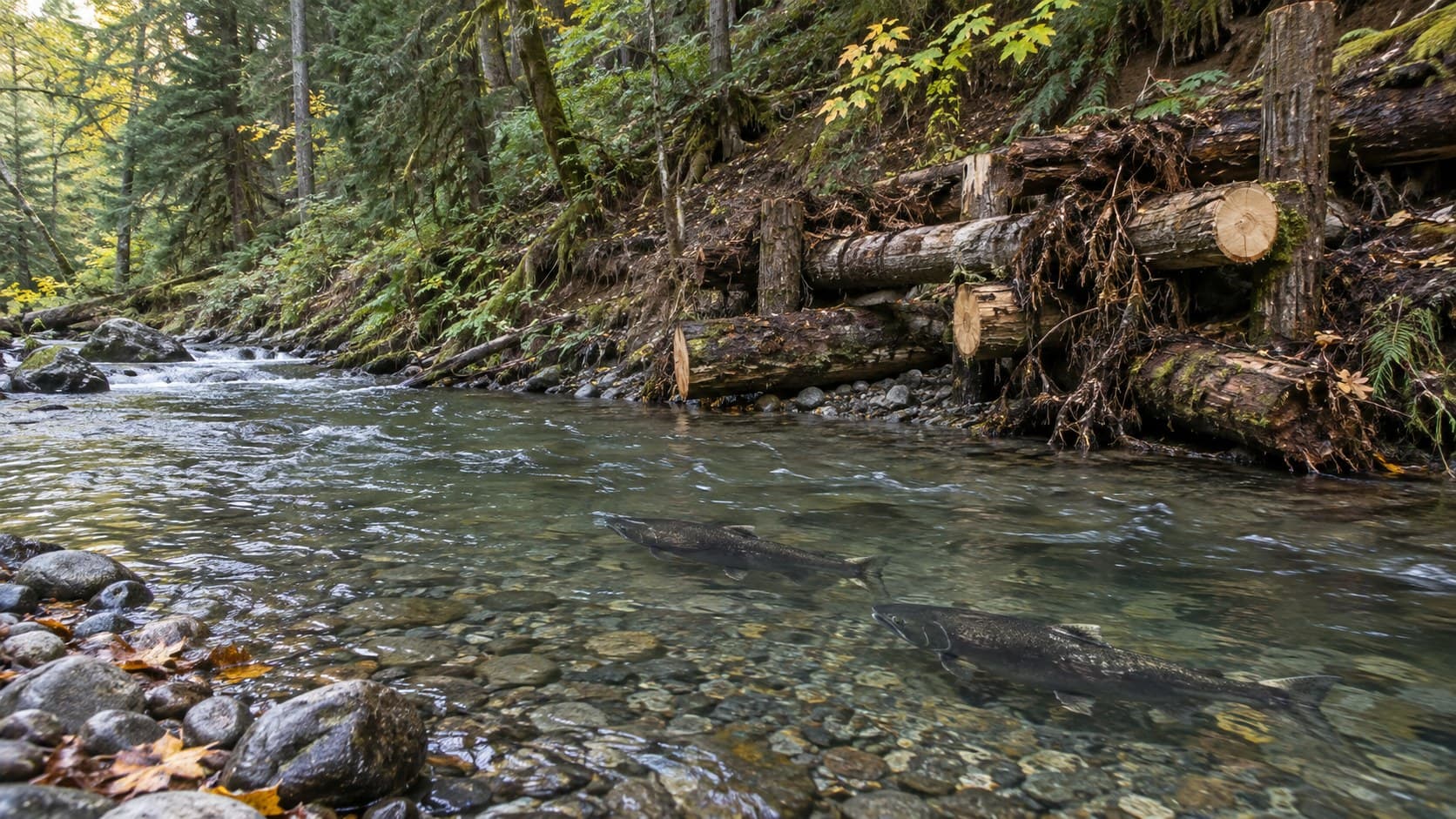
A straightened farm stream south of town holds the densest wild Chinook and steelhead spawning in the thousand square mile Puyallup watershed. Here is who comes back, when, and where to stand without wrecking it.
Boise Creek is not much to look at for most of its length. It drains 15.4 square miles of foothill and plateau and joins the White River just upstream of the State Route 410 bridge to Buckley. Through the farm country it runs in a trapezoid, a channel King County's own engineers describe as "constructed and maintained through most of the 1900's to accommodate farming, improve agricultural drainage, and convey sediment across the low gradient Enumclaw plateau." An 1881 land survey shows it farther north, before somebody moved it.
And yet. When the City of Enumclaw applied for state salmon money in 2022, it put the case in one sentence: "Boise Creek annually hosts the highest wild steelhead and Chinook spawning densities found anywhere within the 1000 square mile Puyallup river watershed." The Puyallup Tribe's fisheries director, Russ Ladley, has said the same to the Courier-Herald. Density, not headcount: fish per mile. By that measure a ditch behind the golf course beats the glacier rivers it feeds.
Who comes back, and when
Boise Creek is designated critical habitat for spring Chinook, fall Chinook, coho, pink, fall chum and sockeye salmon, plus steelhead and coastal cutthroat trout. Chinook and steelhead are both listed as threatened under the Endangered Species Act. The prize is the White River spring Chinook, which the state's watershed plan calls "the only remaining spring Chinook salmon stock found in the South Puget Sound." In 1986 six came back to the river. The Muckleshoot Indian Tribe opened a White River hatchery in 1989, and by 2017 the count at the Buckley trap was 16,271 Chinook, the best in 71 years. Some of those fish turn left into Boise Creek.
The calendar, using King County's spawn timing for its streams, runs like this. Pinks first, August into October, only in odd numbered years; 2026 is even, so wait for 2027. Chinook from September through mid December. Coho from mid October into early January. Chum from November to late December. Steelhead are the outlier: they spawn in spring, late March into early June, and King County counted nearly a dozen pairs on its restored reach at the mouth in the spring of 2011. Go after a rain, when the water is up and the fish move.
Where to stand
Most of the creek crosses private farms and a golf course, so the public places are few.
The Foothills Trail is the one that works. From the trailhead at 252nd Avenue South, the paved trail follows the old railroad grade toward Buckley and crosses Boise Creek on the century old Boise Creek Arch Bridge, retrofitted by King County Parks in 2021, then carries on over the White River on the bridge that opened in October 2024. The arch is near the mouth. Stand on it and look down.
Boise Creek Park, at 1300 SE 469th Street, is named for the creek and is not about the creek: the city's parks plan describes a 19 acre softball complex with four lighted fields on school district land. Take the kids for the playground, not the fish. The golf course is private; ask at the clubhouse.
What $3 million bought
Enumclaw Golf Course was built in the 1940s and the creek was pushed into the fairways as a water feature. The city's grant application says what that did: riprapped banks, turf to the edge, "routine stranding of salmon (including redds) and other fish on golf course fairways which provide no habitat or refuge from predators," and golfers walking through spawning Chinook all fall. Puyallup Tribe surveys from 2012 to 2019 found Chinook redds "noticeably absent" wherever the channel was open and exposed.
The tribe began designing a fix in 2008 with a $126,000 grant, and the Enumclaw City Council backed the plan 7 to 0 in March 2012. Money took another decade: about $1.74 million from the state Salmon Recovery Funding Board in two rounds, more than $750,000 from the King County Flood Control District, and shares from Ecology and the Legislature, for a total the Courier-Herald put at about $3 million.
Construction ran from June 2023 to the fall of 2024. The work moved 1,800 feet of creek (river mile 3.7 to 4.2) out of the fairways into its historic channel against the forested hillside, dug a 475 foot side channel, built 17 log structures from 204 logs, raised an embankment between course and creek, and daylighted 900 feet of Chappel Springs, a tributary that had run through a pipe. At the ribbon cutting Ladley said, "The fish are going to be very happy." The tribe is counting redds to see if he was right.
Upstream and down
King County went first, at the mouth, on a 15 acre parcel at the confluence, finishing a new channel and floodplain in August 2010. By July 2011 county staff counted 5,000 juvenile salmonids on the site, 25 times more than an unrestored reach upstream, and that September "tens of thousands" of salmon moved through. The county's underwater cameras have since filmed Chinook and pinks spawning there.
Then the county worked up the plateau, fencing cattle off about a mile of bank and adding a side channel on a farm in 2018 to 2019. The next one starts this year: on 5.19 acres at river mile 3.1, where Beaver Creek comes in off 284th Avenue SE, the county will build 2.6 acres of wetland and side channel.
WSDOT's SR 164 and SR 410 fish passage project, one answer to the 2013 federal culvert injunction, will replace two of the three culverts where an unnamed tributary of Boise Creek snakes under SR 410 south of town; the middle pipe already passes fish, and WSDOT will keep it as it is. The package, four culverts in all, would open more than three miles of stream by WSDOT's count, is priced at $35.24 million and still needs money from the Legislature.
The creek through town
The creek gave its name to a town before Enumclaw had one. George Vanderbeck settled near the confluence in 1870 and platted a townsite; at its peak Boise Creek had a school, two general stores, a hotel, a sawmill, a shingle mill, a saloon and a flag station where the train stopped if you waved. Elijah Goss, whose White River Lumber and Shingle Company started Enumclaw's mill era in 1889, floated rough lumber down a three mile flume fed by Boise Creek to his planing mill in town.
The flooding is older than the town and as new as last winter. On December 10 and 11, 2025, city gauges put Boise Creek above 2,500 cubic feet per second, against a recent high of 1,000. Warner Avenue went under when the creek overtopped its banks, and the creek took the eastbound lanes of SR 410 at milepost 26.6 until December 23. City Administrator Chris Searcy told the Courier-Herald the city had "fared well." The highway had not. Boise Creek lies outside city jurisdiction, and the King County Flood Control District restarted its floodplain mapping study this year. No fix can be designed until the map exists.
The rules
No fishing. As of the 2026 to 2027 pamphlet, WDFW lists Boise Creek in King County, from the mouth to the SR 410 crossing, as closed waters for all species. Not catch and release. Closed. Above the highway the creek runs through private farms and the golf course, which settles the question a different way.
Stay out of the water. WDFW's guidance is short: do not enter the stream, because "walking in streams while salmon are spawning may damage salmon nests with eggs (redds)"; approach slowly. Leave dead fish where they lie. The carcasses feed next year's fry.
Keep the dog out. WDFW asks that you "maintain control of pets so they do not catch or scare salmon." A leash on the Foothills Trail is the whole of it.
Report a fish kill to Washington Emergency Management at 800-258-5990, a spill or sheen to Ecology at 1-800-OILS-911, and poaching to WDFW at 1-877-933-9847.
Then go stand on the arch bridge in October and look down at a ditch doing the best work in the watershed.
Story label: Original Story or Guide
Originally published: