

Feature
Two gunmen robbed the State Bank of Buckley in 1925 and died in the street. An earlier Buckley bank had reportedly been emptied by its own officers.
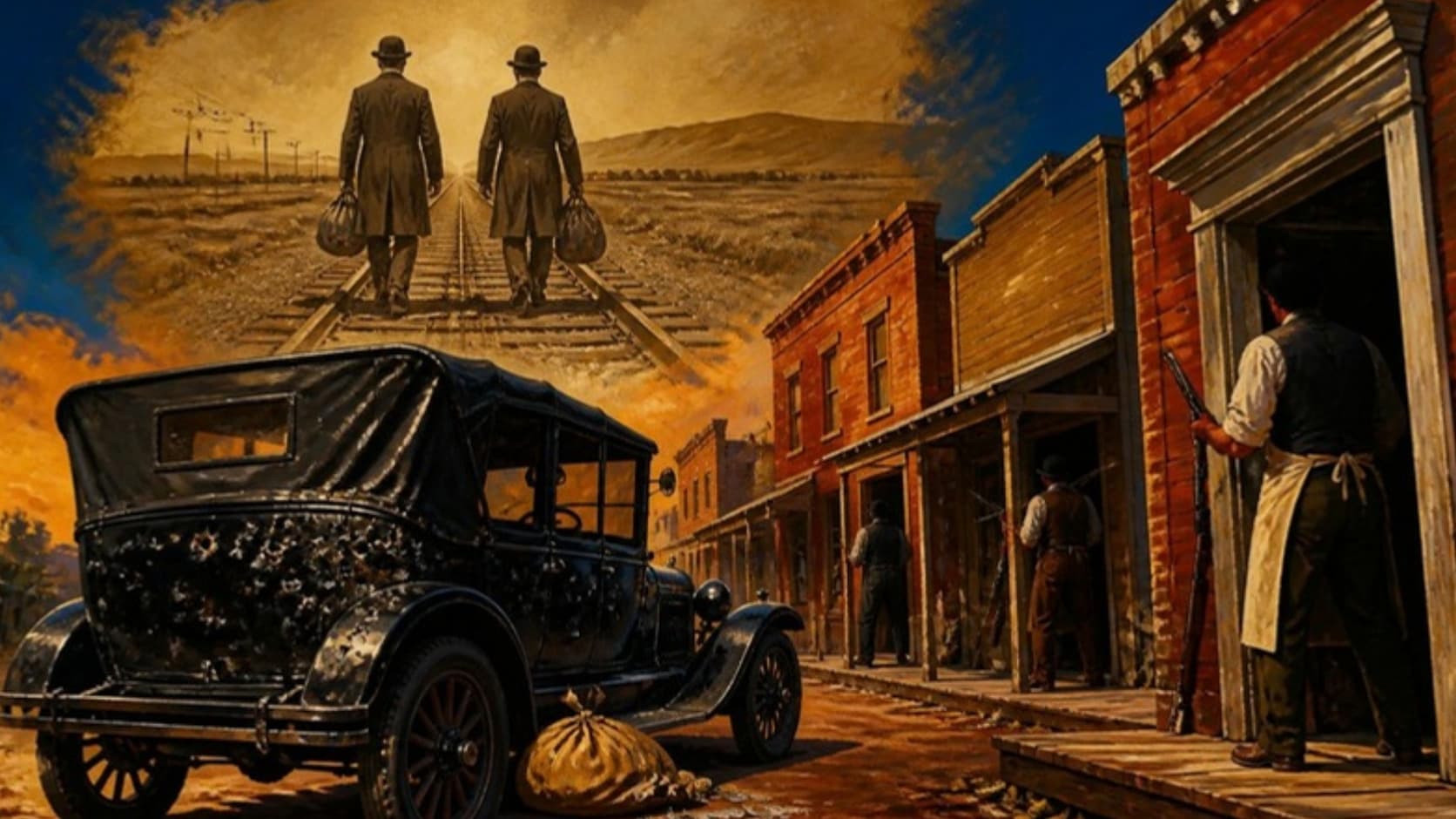
In 1925 Buckley's marshal and merchants shot two bank robbers dead on Main Street. The town had a tip; an earlier bank was reportedly emptied by its officers.
At ten minutes to three on the afternoon of July 1, 1925, two men walked into the State Bank of Buckley on Main Street, loitered until a customer left, and drew revolvers. Within five minutes both of them had been shot down within half a block of the bank, and a Buckley businessman had been shot in the fight.
The Seattle Daily Times ran the story the next day with the relish of a paper that had been handed a western. It called the holdup "the first bank robbery in the history of the town of Buckley," said the two "unmasked, unidentified desperadoes" had died with their boots on, and credited "a hastily organized posse of merchants."
That is the version the newspapers left behind. Two parts of it deserve a second look.
Ten minutes before closing
The bank had three officers on duty: C. O. Steberg, the president, in his office at the front; A. E. Hovey, the cashier; and C. A. Stewart, the assistant cashier. The older of the two robbers, about 30, stepped up to the first window and told the cashiers to put up their hands. The younger one pushed a revolver at Steberg and walked him back to the vault. The inner safe was locked, and the robber had Steberg work the combination.
What followed was a small masterpiece of banking under pressure. According to the Times, the safe held "decoy" packets of $1 and $2 bills for exactly this occasion, and Steberg threw those into the robber's cloth sack first while he "purposely overlooked other packets of currency of greater value." Then he added a small sack of silver dollars, "which the bandit apparently believed to be gold coin." When a few coins spilled on the floor, the robber said he didn't want to bother with small change.
"Through it all the bandit was excited," the Times reported, "and the arm with which he brandished the weapon was shaking." The sack held about $2,600 by the paper's count.
The gong on Main Street
While the robbers were busy with the vault, the cashier stepped on a patent alarm in the floor of his cage, and a gong outside the building went off. Marshal Ed Nelson came through the door with a rifle and a revolver and walked straight into the lookout's gun. He was marched to a room at the back with the three bankers and W. A. Evans, a farmer who had also come in, and all five were made to sit on the floor with their backs to the wall.
As the second robber went out the front door, Nelson stood up and fired twice. The robber fired back and ran for the corner, where a 1923 Chevrolet touring car was waiting with its motor running.
He reached the running board. Aaron Haydon, a grocer whose store was a block from the bank and who had been Buckley's marshal until a month before, shot him off it. The Tacoma Daily Index, retelling the story in 2010 from the Tacoma Daily Ledger and the Buckley Banner, says Haydon used a shotgun and hit the man through the left eye.
The driver took off down a side street. Then he drove around the block and came back for his partner, pulled up by the body, pointed a revolver at the crowd that had gathered around it, and ordered them to lift his partner into the car. Before anyone could, Marshal Nelson came out of the bank and put three shots into the car and killed the driver. One of the two lived a few minutes longer, in Dr. C. E. Whitney's office across the street from the bank. By the Index's count, one body had 11 bullet holes in it and the other eight.
The man from the card room
Parked cars were riddled. A painter named T. Pagen was grazed. Haydon commandeered a passing car driven by William F. Jones, the furniture dealer, and traded shots with the returning driver; one bullet came through the windshield and buried itself in the seat between the two men.
William Rose was hit harder. The Times says he was 54, had lived in Buckley for about twenty years, and was shot early in the fight "as he came out of his card room and soft drink place." The Index's 2010 account, which cites the Ledger and the Banner, describes him as a shopkeeper who had taken up a position outside the bank to shoot at the robbers himself. Dr. C. E. Martin of Enumclaw, driving through town, carried him to the Taylor-Lacey Hospital in Auburn. He died there at 8:15 the next morning, leaving a wife and four children. The bullet had passed through the metal trade checks in his trouser pocket. The Index says he was hit while trading shots with the robbers; the Times does not say who fired the bullet, and no inquest finding was found.
Two men with no names
The dead robbers were laid out at J. F. Jones's undertaking parlor, and nobody could say who they were. Searchers found a quantity of chloral hydrate on them, the old knockout drops, and a stick of lunar caustic. The younger man had red hair, gold upper teeth and a thumb that had been amputated. The license plate on the back of the Chevrolet had been stolen that day from a Buckley logger's truck, one corner bent over to hide a letter; the front plate was mounted upside down.
A mine carpenter from Fairfax said he was positive he had seen the dark-haired one at Kanaskat and Burnett, and that around Elk Mine the man was held to be the one who had robbed a poolroom there of $800 about two months earlier. The poolroom's owner, now living in Buckley, viewed the body and agreed. Nobody could test the claim; the accused was in a morgue. Pierce County Sheriff Desmond was trying fingerprints.
The tip from the roadhouse
Here is the first thing the headline version leaves out, though the Times printed it further down. The posse was not as hasty as the paper made it sound. The man who fired the first fatal shot had been warned in May and had told his neighbors to arm themselves.
Haydon told the Times the next afternoon that he had known for two months. "A conversation was overheard by a friend of mine in a roadhouse between Seattle and Black Diamond about the first of May," he said. "According to this information the bandits planned the robbery for May 20, so we took steps to take care of them."
Haydon advised his fellow townsmen to arm themselves for an emergency, and the Times wrote that "it is to his foresight that the failure of the bandits is being attributed." He had been marshal the previous November when bandits hit the Orting State Bank, and had ridden with the posse that failed to catch them. His term ran out on June 1. The robbers were six weeks late, and walked into a town where at least some of the merchants had been told to expect them. A child who was in the bank that day told the Index 85 years later that the shopkeepers all seemed to keep firearms in their shops.
The first bank
The second thing the legend leaves out is older, and it is the better story.
Buckley became a town in 1890. In 1891, according to research by the architectural historian Susan Johnson reported by the Tacoma Daily Index, Samuel Hart and F. A. Dinsmore opened the Buckley State Bank, Hart as president and Dinsmore as cashier. Johnson's research says the town woke up one morning to find that both men had left, and the bank's money with them. "Buckley was swindled," the Index put it.
The historian J. Kingston Pierce, writing about the Panic of 1893 in Columbia magazine, gives a date and a sum for a bank of the same name: "At the end of November the president and cashier at Buckley State Bank in Tacoma skipped town with $30,000." HistoryLink's essay on the Panic says the same. Neither account names the men or says whether they were ever caught, and this site could not find a record that they were. Both also place that bank in Tacoma, not Buckley, and neither says when it opened; Johnson's research puts it in Buckley and does not date the flight. This site treats them as one bank because the name and the fleeing president and cashier match, but no source consulted here ties the two accounts together.
If the two accounts describe the same bank, the 1925 gunmen were not the first to make off with a Buckley bank's money. They were only the first to try it with revolvers. The bankers who went before them fled with the money, more than ten times as much if the $30,000 figure is theirs, and left no gunfire on the record. What became of them is not known. Johnson called it "classic Wild West crime," though no one on the record drew a gun.
What's left on Main Street
Buckley tried again. In 1903 Anthon Eckern of Portland and John Morris of the Buckley Hardware Company started the Bank of Buckley and hired Steberg as cashier. Nobody ran off with the deposits. Steberg rose to president, and by 1925 he was the man at the vault handing a nervous robber the one-dollar bills.
The building still stands at 766 Main Street, but not the way the robbers saw it. In 1930 the bank hired the Tacoma architect E. J. Bresemann to replace the columns and portico with a cast-stone Art Deco front, with STATE BANK OF BUCKLEY carved above the door. Anyone pointing to a chip in that stone as a bullet mark from 1925 is pointing at a wall that was put up five years after the shooting. The corner of Main and Cottage Avenue, where the car came back for the body, lies west along Main from the bank.
Story label: Original Story or Guide
Originally published: