

Local Color
Carbonado Outlived Its Coal, and Every Other Town on the River
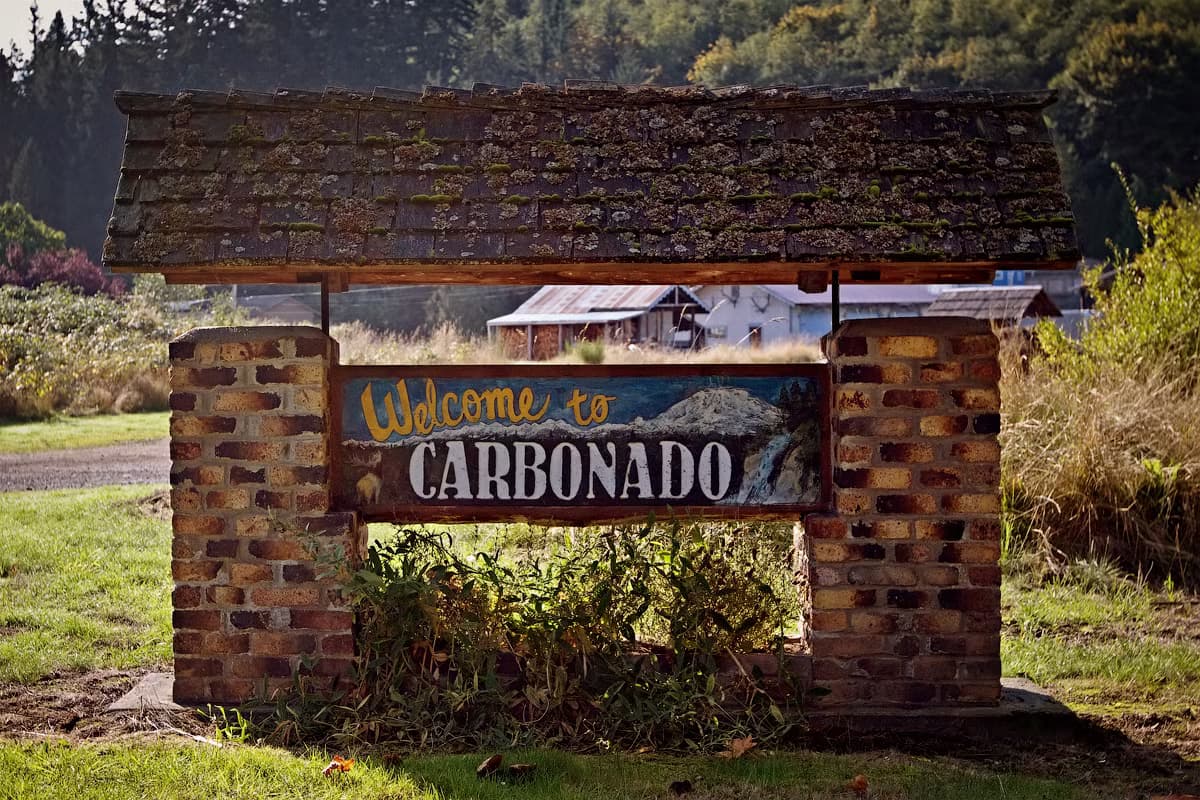
Follow the Carbon River up toward Mount Rainier and you pass through a string of towns that no longer exist, Fairfax, Melmont, Montezuma. Carbonado is the one still standing. Here's how the little "black diamond" town outlived its coal, its railroad baron, and every neighbor it had.
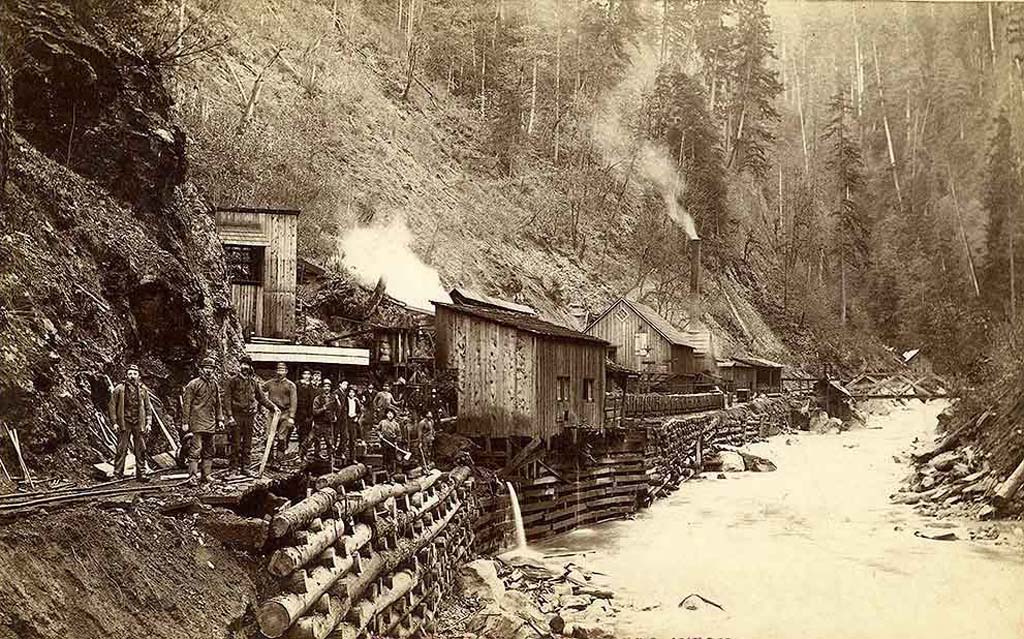
Before it was Carbonado, the town spent a few months as Carbondale, a name borrowed from a place in Pennsylvania. Someone thought better of it and renamed it after a Spanish word, carbonado, which means "black diamond." Which is a generous way to describe coal.
That's the first thing to understand about this little town southeast of Enumclaw. Everything up its valley is named after the same black element. The Carbon River. The Carbon Hill Coal Company. Carbonado itself. And, at the very head of the watershed, the Carbon Glacier. Coal at the bottom, ice at the top, one river running the whole length of it. The valley is a monument to carbon, and it didn't even mean to be.
A serious town, for a while.
The mines opened in 1880, and the Carbon Hill Coal Company put up simple cottages along unpaved streets for the men who came to work them. In 1882 the company was bought by Charles Crocker, one of the "Big Four" railroad barons who built the Central Pacific, and his partners, who came to hold 4,600 acres of mineral rights in Pierce County.
For a stretch, Carbonado ran the largest coal mine in the county and dug close to half of all the coal Pierce County produced. This was not a hamlet. It was an industrial engine with a railroad baron's name on the deed.
The river of ghost towns.
Here's where it turns.
Carbonado was not alone up there. Follow the Carbon River upstream and you passed through a whole chain of company towns, each with its own school, depot, saloon, and rows of miner cottages:
- Fairfax, platted in the late 1890s when the railroad pushed its line up past Carbonado, burning coke and coal into the 1920s.
- Melmont, founded in 1900, complete with a schoolhouse, a depot, a hotel that held the post office and a butcher shop, and street after street of cottages.
- Montezuma, and the Manley-Moore lumber camps beyond.
Go looking for them now and you'll find concrete foundations in the moss, a dynamite bunker, a staircase climbing to a house that isn't there. Melmont burned in the early 1920s and never came back. One by one, the towns on the Carbon River went quiet, then went missing. The road up the valley is basically a row of headstones.
All except one.
The one that kept its lights on.
Carbonado is still there. Still incorporated. People still live in the old company cottages, on the same streets the coal company laid out for men who've been dead for a century. The mines shut in 1937, the coal economy collapsed, every neighboring town dissolved back into the trees, and Carbonado just stayed.
It even kept its school. The Carbonado Historical School District, No. 19, still teaches kindergarten through eighth grade to roughly 180 kids in a brick building the town has held onto for generations. A town built to pull coal out of the ground outlived the coal, outlived the company, outlived the railroad baron, and outlived every other town that shared its river.
What it cost.
None of this was free. In December 1899, an explosion tore through the Carbon Hill No. 7 mine just after eleven in the morning. Rescuers found no one alive. Thirty-three men died in a single blast, one of the worst mine disasters in Washington's history.
The survivor town is also a town that buried a great many of the people who built it. The streets that are still standing were paid for underground.
![Melmont ghost-town ruins — concrete foundations and the old dynamite bunker in mossy second-growth (WTA / Visit Rainier).]](https://upload.wikimedia.org/wikipedia/commons/thumb/b/be/Carbon_Glacier%2C_Hanging_Glacier_and_Valley_Rock_Glacier%2C_October_1%2C_1958_%28GLACIERS_1638%29.jpg/960px-Carbon_Glacier%2C_Hanging_Glacier_and_Valley_Rock_Glacier%2C_October_1%2C_1958_%28GLACIERS_1638%29.jpg)
Follow the river to the ice.
Keep going, past the ghosts, past the park boundary, into Mount Rainier's quietest corner, the Carbon River entrance, the one most visitors never use, and the valley delivers its last surprise. The Carbon Glacier ends here, its snout reaching down to around 3,500 feet. That makes it the lowest-elevation glacier in the contiguous United States, and the longest, thickest, and largest by volume of any glacier in the country outside Alaska.
So the same river that carried coal money down out of these hills is fed, at its source, by the biggest low-elevation river of ice in the Lower 48. Carbon at the bottom. Carbon at the top. Same name, same water, both slowly leaving.
It's a strange, quiet stretch of country, this valley named for a black rock. The coal ran out. The towns burned or emptied. The great glacier at the top pulls back a little more every year. Almost everything up the Carbon River is in the middle of disappearing.
And then there's Carbonado, a few hundred people, a K-8 school, and a grid of old cottages that has simply declined to become a ghost. It's the one that stayed to see what happened next.
Consider it.
Story label: Enumclaw.com Brief