

Feature
The coal town that forgot to disappear
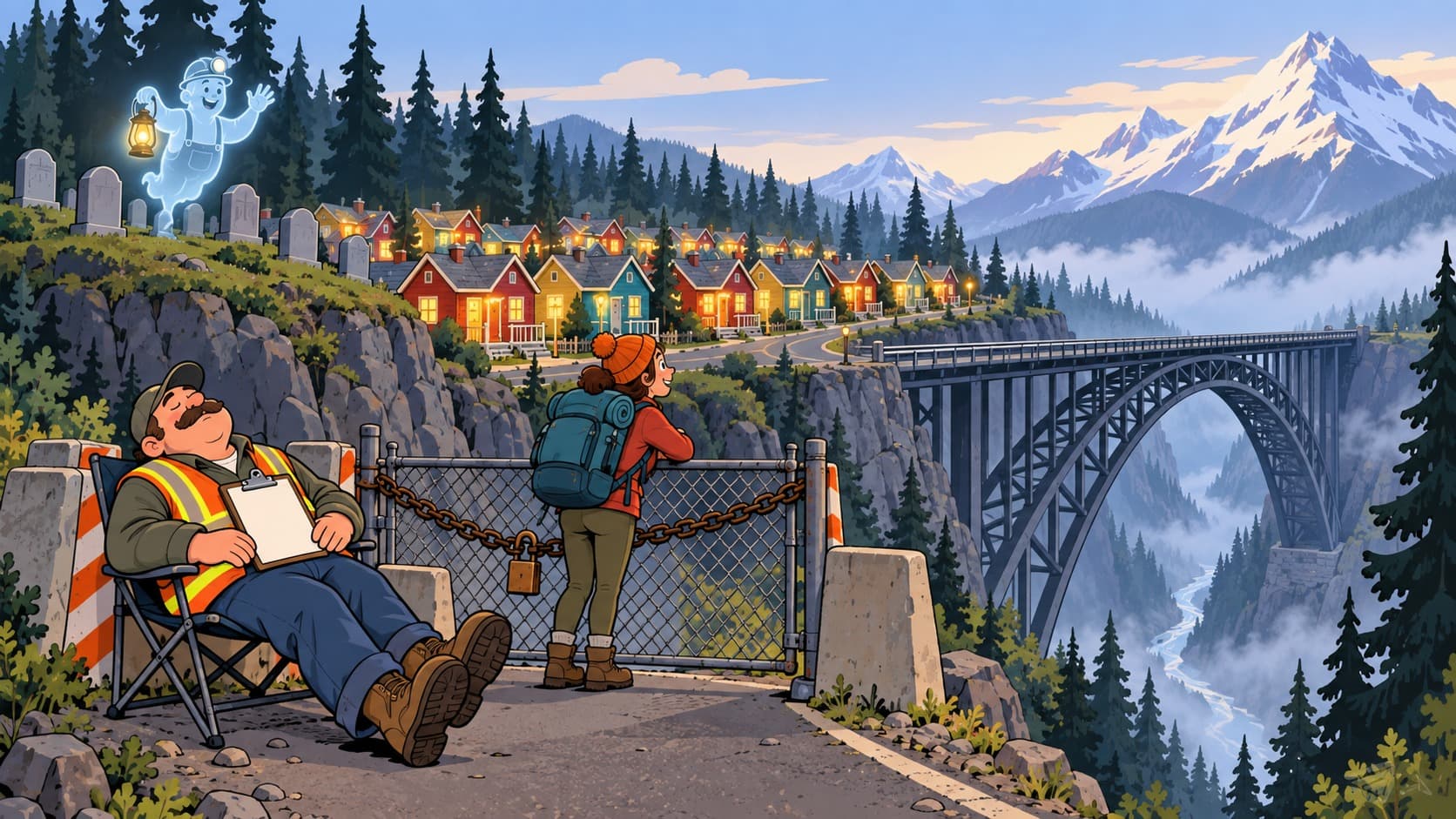
Carbonado, 20 minutes south of Enumclaw, lost 130 miners, sold its company houses for $250 and is still there. Its history, cemetery, saloon and the closed bridge.
Coal towns on the plateau follow a script. The seam plays out, the company leaves, the houses get hauled away or burn, and forty years later someone finds a cemetery in the alders and writes a wistful paragraph about it. Carbonado skipped the last two steps. The company left in 1937. The houses are all still there, in rows, with people in them.
To get there, take 410 to Buckley, turn south on Highway 165 and follow the Carbon River through Wilkeson until the road runs out of reasons to continue. It now does this twice. First at Carbonado, 755 people on a bench above the river, then three miles on, at a fence where the state has parked a 104 year old bridge it no longer trusts. Beyond the fence lie the Carbon River corner of Mount Rainier National Park and the ghost town of Fairfax, neither of which you can drive to. Carbonado used to be the town before the end of the road. Now it is the end.
A railroad man buys a town
A survey party found coal on the river in 1871, which is why it is called the Carbon River and not something nicer. In 1879 a Tacoma businessman named Richard Chandler sent a Scottish mine boss, Robert Wingate, up the canyon to see if it was worth the trouble. It was. The Carbon Hill Coal Company incorporated in 1880, crews went underground that July, rails arrived in December, and a post office opened as Carbondale, which lasted a few months before someone decided Carbonado sounded less like a warehouse.
By the fall of 1881 the operation belonged to Charles Crocker of the Central Pacific Railroad. The company built the houses, and it built one kind: a front room with a bedroom or two on either side and a kitchen behind, no plumbing, no electricity, a shared tap every few streets. It also ran the store, and after 1882, HistoryLink's Edward Echtle writes, the store ran the workers. Wages came as scrip good only there, discounted if spent before payday, and a family that fell behind could not leave town with the debt.
February 1886
Carbonado never had many Chinese workers, sixty at most by Echtle's count. What it had was neighbors. On February 10, 1886, the winter Seattle and Tacoma were driving out their Chinese residents, a mob from Black Diamond, Franklin and the other coal towns arrived to demand the company fire its Chinese employees. The superintendent wired San Francisco for orders; none came in time. The company paid the men off and let the mob march them to Tacoma and a steamer south.
The morning of December 9, 1899
The mines killed men in ones and twos through the 1880s and 1890s. Then, just after 11 in the morning on December 9, 1899, 75 men were on shift in Mine No. 7 on Wingate Hill. Investigators concluded that one of them opened his safety lamp to light a pipe. The flame found methane, the methane found a dynamite charge, and the blast and black damp killed 31 men, or 32, or 33, depending on who did the counting: the monument, the newspapers or the historians. Howell Meredith, one of the mine's longest serving hands, died in the gas going back for his son Daniel. The back row of the cemetery filled with headstones bearing one date and three words: Killed in the explosion.
In 1927 mud blew in from under the river and killed seven. In 1930 a charge lit coal dust and killed seventeen. By Echtle's tally the mines took more than 130 lives in 57 years. The town kept mining. It was that or leave.
The company town that stopped being one
Carbonado's mines were lit by electricity in the 1890s, the first in Washington, and the company added a hospital, coke ovens, a high school and 130 new houses with water and lights. The population passed 700 in 1890 and a thousand by 1900. The town website says it once rivaled Tacoma in size. Tacoma has not been asked.
A strike over wage cuts ran from June 1921 to its defeat in 1923, after which the company stopped recognizing the union. The Pacific Coast Coal Company, which also ran Black Diamond, took the lease in 1924, shut the coke ovens in 1926 to save money and, on March 17, 1937, with coal prices flat on the floor of the Depression, closed for good.
Here the script should have kicked in. Instead the company sold the houses to the people living in them for $250 to $340 each and kept the mineral rights. The residents incorporated on September 13, 1948, bought the water and sewer lines off the company, and in 1966 got the mineral rights too, once Pierce County assessed them at $50,000 and the company, which had wanted $250,000, declined to pay taxes on the difference.
What is left, which is most of it
Carbonado today covers 0.42 square miles and had, by the state's count this April, 755 residents. Town hall is at 250 Coal Avenue. It runs its own school district, one of the state's smallest: Carbonado Historical School 19, one K through 8 building on O'Ferrell Drive, about 180 students, and a 1929 gymnasium on the state Heritage Register. One business survives from the boom, the Carbonado Saloon at 91 Pershing Avenue, in an 1889 building that has also been a post office, barbershop and dentist's office. A marker went up out front in 2012, courtesy of E Clampus Vitus, a fraternal order that commemorates places nobody else got around to.
Then there are the houses. They line both sides of Pershing, many still owned by descendants of the men who dug the coal. Above town, concrete caps mark the old shafts and the slag pile has grown a forest. The cemetery, established in 1880, keeps its explosion row intact, and since 2002 a two and a half ton block of Wilkeson sandstone has stood at the entrance, for the men who died in the mines. The Wilkeson Eagles put it there; the Carbonado lodge had merged into theirs in 1924, so it was the town burying its own.
The bridge
Three miles south of town the highway reaches the Carbon River gorge and, since April 2025, stops. The Fairfax Bridge opened on December 17, 1921, a 494 foot steel arch 250 feet above the river, built for $80,000 to give Fairfax, the coke camp beyond the canyon, a road. Fairfax died after the First World War anyway, and the bridge spent a century as the road to Mowich Lake, the Carbon River entrance and the Wonderland Trail.
In April 2025 inspectors found a support column, in WSDOT's words, "bent in two directions and starting to buckle." It closed to everything, feet included, on April 22. "Bridges are designed for a 75-year life," the department's blog noted, which is a polite way of saying this one had been on borrowed time since the Nixon administration.
As of September 2026 the position is this. On January 8, 2026, WSDOT narrowed the choice to two: a new bridge just north of the old one, or a closed highway and a demolition. The study's rough figures ran from $35 to $50 million to remove it to $60 to $130 million to replace it. The state has put $7 million toward drilling, surveying and environmental review, its own timeline for a new bridge is six years, and no money for design or construction has been identified. The Park Service's page for Carbon River and Mowich Lake now says, in capital letters, that there is no access from Highway 165, and offers the determined a 27 mile walk in from the Westside Road.
So the town built to be passed through on the way to the coal is again the last stop on the way to nothing, which is roughly how it started. Carbonado does not seem to mind. It has outlasted the company, the union, the railroad, the scrip store, three counts of one explosion and, as of last spring, the bridge. The plateau's coal past is mostly holes and cemeteries. Here it is a street of small identical houses with the porch lights on, waiting, with no particular urgency, for the state to get around to it.
Story label: Original Story or Guide
Originally published: