

Feature
The plateau's other herd: Enumclaw is a cow pasture that a town happened to
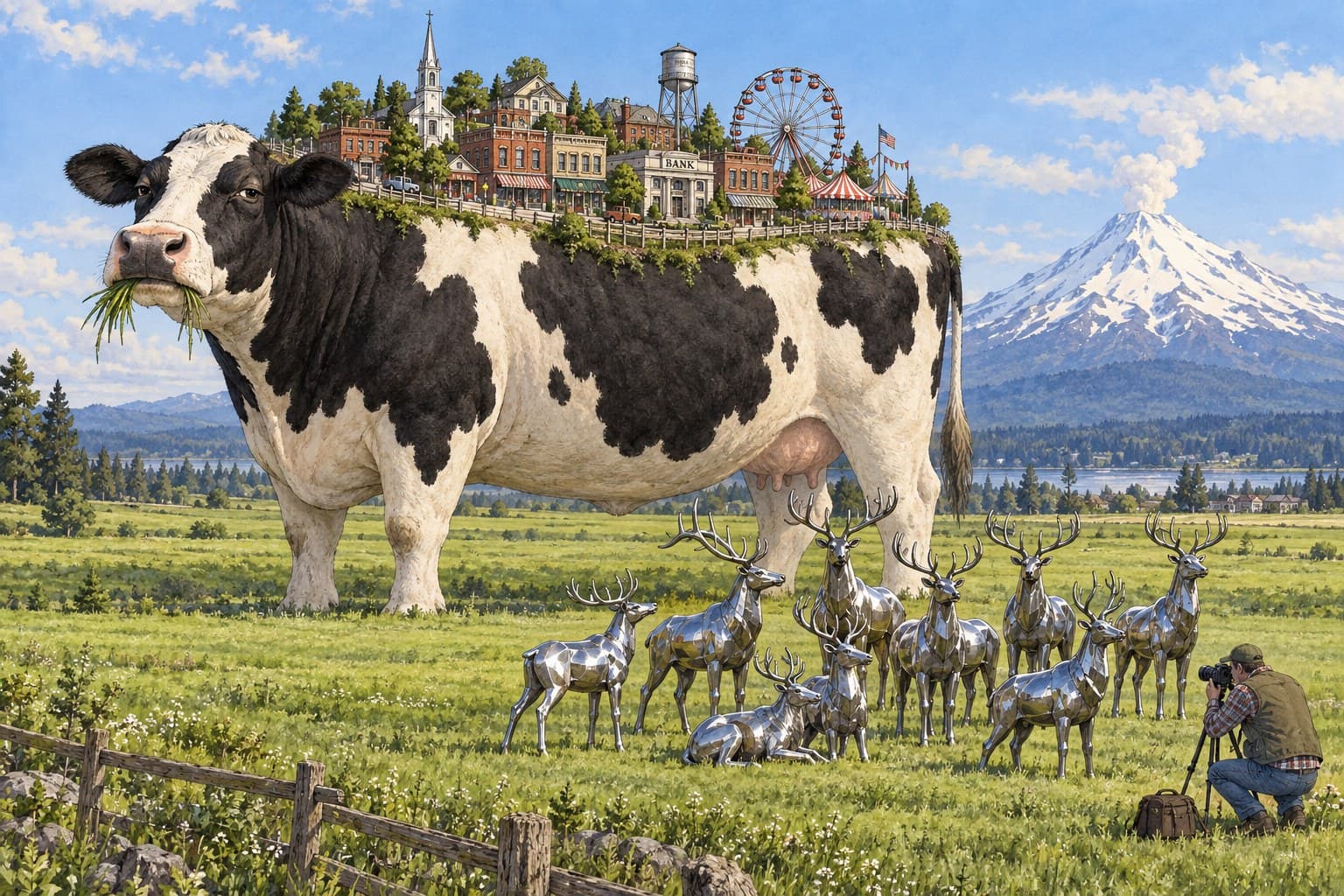
Three thousand cows paid for the bank, the insurer and the store. Six dairies are left, the county is still buying the fields, and the soil has not changed its mind.
Two herds arrived on the Enumclaw plateau in 1912. Eighty elk from Yellowstone came in two Northern Pacific cattle cars on New Year's Eve, and a century later got nine steel statues on the Foothills Trail and an article here. Twelve Holsteins came with a Black Diamond coal miner named Charles Krainick and 80 acres, and their successors, about 1,250 of them, are still milked twice a day on 236th Avenue. The elk have a monument. The cows have a feed store.
The cows were here first, they paid for most of the town, and they are the reason the ground under your house is flat.
The mountain made a pasture
About 5,600 years ago the top of Mount Rainier let go. The Osceola Mudflow carried roughly seven tenths of a cubic mile off the summit, took 2,000 feet off the peak, and ran down the White River, burying 212 square miles from here to Kent.
What it left was clay: thick, nearly waterproof, flat. Once drained, King County's own history notes, it made pasture. Grass grows on drained clay where it rains eight months a year, and the only machine that turns grass into money is a cow. Settlers argued anyway. The 1880s brought a hop craze; hop lice arrived in 1890, the price collapsed, and the farmers turned to milk and never turned back.
Denmark, with rain
The people who did the turning had been trained for it. The first Danes reached the plateau in 1884 laying railroad track for three or four dollars a day, by the Enumclaw Danish Sisterhood's account. Dutch and Swiss dairy families came later and stayed, which is why the plateau's mailboxes read Van Hoof, Lanting, DeGroot, Van Dam and Gwerder.
What the Scandinavians brought, besides a tolerance for gray, was the cooperative. They organized the Farmers' Mutual Insurance Company in 1898, now Mutual of Enumclaw; the Cooperative Creamery in 1899; the Rochdale store in 1905; the Grange in 1909. The historian Clarence Bagley wrote that no town in the Northwest had organized more of them. Enumclaw had 2,000 people in 1914 and the civic skeleton of a Danish parish, set down on volcanic mud.
Butter paid for the bank
In 1899 George Bruhn, Danish born, organized 60 farmers into a cooperative at two dollars a share per cow. The Ranch's 1914 survey is the best snapshot of the plateau at its height: more than 3,000 dairy cows and 250 patrons, most milking Jerseys at 5 percent butterfat, the rest Holsteins and Guernseys. Cream was separated on the farm and hauled to town by wagon, 650 gallons a day. In 1915 its butter won a gold medal at the Panama Exposition in San Francisco. In 1929, when the Naches Pass highway opened, Enumclaw and Yakima celebrated at the summit with a mock wedding. The bride was Yakima Peaches. The groom was Enumclaw Cream. The cream was the town's idea of an eligible bachelor.
By 1949, per Richard Elfers in the Courier-Herald, a fleet of trucks fed plants in Enumclaw and Yelm, the co-op counted about 1,100 farmers, and it did $2.5 million a year. On milk trains the record is thinner than the legend: every account I found has cream moving by wagon, then by truck. If your grandfather loaded cans at the depot, the historical society would like his photograph.
The creamery did not survive the truck. On December 6, 1951, citing "ever-increasing operating costs," it sold its retail routes and closed under its last president, Ira Baker, and the members shipped to Darigold and Carnation. You will read that Enumclaw helped found Darigold; HistoryLink calls the creamery "now Darigold Farms." Darigold's own timeline starts in 1918 with the United Dairymen's Association, adds Consolidated Dairy Products as broker in 1920 and picks the name in 1925, with no Enumclaw in it. The farmers joined in 1951. Anything earlier is a claim I could not source, and I am not going to be the one who invents it.
The princess
Dairy needed selling too, and the plateau's answer was a girl in a sash. The state Dairy Princess contest began in 1955; by 2009 the King-Pierce County Dairy Ambassador program was crowning its 54th, and the outgoing ambassador, Elizabeth Birklid, was a fourth-generation dairy farmer and a second-generation princess. The job took in the fairs, the schools, the banks and, every June, welcoming the "dairy baby," the first child born that month at Enumclaw Regional Hospital. The state contest ended in 2019; the cattle are still shown for the King County Fair.
Expand or sell
After 1960, the county's planners wrote, dairies everywhere had to expand to stay competitive. On the plateau most chose the other option. About 140 dairies in King County a few decades ago and 32 by 2011; 22 on the plateau in 2012, when Ryan and Haylee Mensonides started their organic herd, and six by 2023. Nobody counts the same way; the direction is not in doubt.
The reasons: hay trucked over the Cascades, milk consumption down 26 percent in twenty years, Walmart bottling its own since 2017, and farmers averaging 62 whose cows go east of the mountains to pay off the loan. A former dairyman told the Seattle Times in 2007 that a farm needs a hundred cows to break even and three or four hundred if it pays anyone. "There's no money in it," he said. "And you don't get weekends off."
The county bought the view
Much of the pasture is still pasture because King County voters bought the right to keep it that way. The Farmland Preservation Program took three tries; on November 6, 1979, a $50 million bond passed, 181,872 to 104,138, the first public vote in the country to buy development rights off farms. The plateau came in after a 1985 court ruling; the program now covers more than 16,400 acres, and the county's Enumclaw Plateau Agricultural Production District is its largest at more than 20,000.
It worked the way a tourniquet works. A 2009 report found only 24 percent of the district formally preserved and 26 percent owned by the people farming it; the rest was leased, or cut into ten- and 35-acre lots with a house, a barn, some horses and a view. On September 11, 2026, Executive Girmay Zahilay announced $100 million for 57 conservation projects, including about $1.5 million to buy the rights on eight farms around Enumclaw. Forty-seven years in, the county is still paying the plateau to remain a pasture.
Who is still milking
Krainick Dairy, first. From 12 Holsteins in 1912 to 68 Jerseys in 1956 to 200 cows in 1980, and today Mike and Leann Krainick milk about 1,250 on 1,400 acres, ship to Darigold daily, and feed the herd spent grain hauled from about 20 breweries and distilleries. The Mensonides herd sells to Organic Valley and bottles some of its milk in glass at Mount Rainier Creamery on SR 410 in Buckley. Paul Fantello makes raw-milk alpine cheese from registered Jerseys on the 236th Avenue farm his grandmother took on in 1918. The Thomasson dairy sells pumpkins in October. Each found a second thing to sell so it could keep selling the first.
The rest of the herd economy lives on SE 436th Street: Country Farm & Feed, and at 22712 the Enumclaw Sales Pavilion, which says it has been supporting local farmers since 1938 (the present company dates from 1993), where every Saturday poultry sells in the morning and the livestock go at one o'clock in the same order: calves, cattle, horses, sheep, goats, pigs.
The cow you can see
There is a cow in town made of something harder than a cow. Our July photographs found it on a lawn beside a roofed information kiosk, life size, dark, with a bright bronze band across its back. Dan Snider's Logging Legacy oxen at the library are hauling a log; this animal is doing what plateau cows do, which is nothing in particular, with great patience. The elk got a garden club, a sculptor and a ribbon cutting. The cow got a kiosk.
The town did not build the pasture. The mountain did, 5,600 years ago; the Danes noticed; the cows arrived; the butter paid for the bank and the insurer and the store; and the county has paid ever since to keep the arrangement. Enumclaw is a cow pasture that a town happened to. It is still standing on the pasture's terms.
Story label: Original Story or Guide
Originally published: