

Feature
The elk came by cattle car: a field guide to Enumclaw's herd
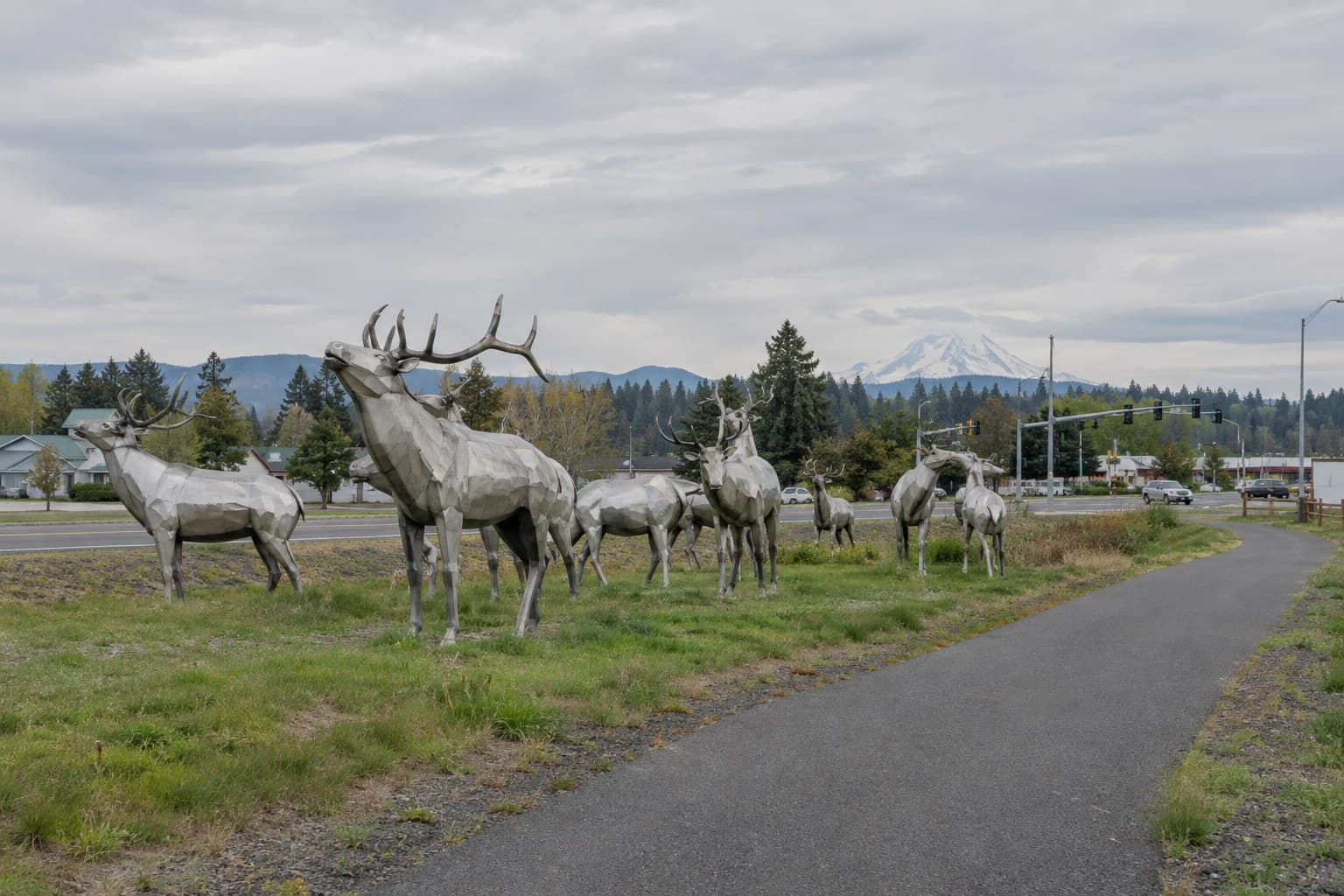
Eighty animals arrived from Yellowstone on New Year's Eve, 1912. Their descendants are in the fields between SR 164 and SR 410 every winter, if you know when to look.
Nine stainless steel elk stand on the Foothills Trail where State Route 410 meets Warner Avenue. The Enumclaw Garden Club raised about $40,000 for them, a Black Diamond artist named Michael Gould built them life size, and the ribbon was cut in 2019. The club chose elk, its chairwoman told the Courier-Herald, because Enumclaw is home to at least two herds. Which raises the obvious question for anyone who has driven past them a hundred times: where are the real ones?
The short answer is that they are here from roughly the first snow to the last one, gone for most of the summer, and owned by nobody in town. The longer answer starts with two railroad cattle cars.
Two cattle cars from Yellowstone
When Mount Rainier National Park was created in 1899, there were no elk living in it. The native Roosevelt elk were, by the state's own account, nearly gone: hunted hard, and thinly spread through an old growth forest that fed them poorly. So on December 25, 1912, a King County game warden named Henry Reif took delivery of 80 Rocky Mountain elk at Gardiner, Montana, and loaded them into two Northern Pacific cattle cars. One broke its back during loading. The rest arrived at the White River Lumber Company in Enumclaw on December 31, 1912. Forty went into a corral near the mill at the base of Grass Mountain. Thirty-nine went on to Meadowbrook Farm at Snoqualmie. The county paid $18 a head.
In March 1913, 36 elk were released from each corral. The Snoqualmie band, in the words of the 1967 state report, "was in trouble right from the start": it stayed half tame around the farm, farmers and poachers whittled it away, and by 1946 the last of it was gone. The Enumclaw band multiplied under protection, and by 1967 the state put the "Enumclaw herd" at 1,500 animals. The Washington Department of Fish and Wildlife calls the release near Enumclaw "a significant catalyst" for everything that came after. Every elk on the plateau today descends, in whole or in part, from the corral by the mill.
Why they leave, and why they come back
The state now manages these animals as the North Rainier elk herd, one of ten elk herds in Washington. Its largest piece lives in the White River unit, between Enumclaw and the park boundary, and that piece migrates. The 2002 herd plan put it plainly: about two thirds of the White River elk spend early spring to late fall in the park's subalpine meadows at 4,500 to 6,000 feet, then, "following the rut and generally initiated by the first snowfall," move north and downhill along the West Fork White River, Buck Creek, Haller Pass and Huckleberry Creek to winter range in the valley. In late spring they follow the melting snow back up.
Radio collars have since complicated that picture. Muckleshoot Indian Tribe biologists, who have tracked collared elk in the White River country since 1998, found three kinds of animal sharing one valley: long migrators that go all the way to the park or Crystal Mountain (57 percent), short migrators that climb the nearest ridge for the summer (23 percent), and stay-at-homes that never leave (20 percent). Most elk north of Highway 410 between the western edge of the unit and Slippery Creek, the 2020 plan says, are residents. That last group is the one Enumclaw actually lives with.
The rut is the exception to the calendar. In late September and October, WDFW notes, bulls are "battling each other over females and are not as concerned about being seen," and their bugles carry at dawn and dusk. Breeding is over by mid October, so the window for hearing it is late September and October.
Where to look, and when
Winter and early spring, the first hour after dawn or the last before dark, on open ground with timber behind it. That is the whole trick.
The state's boundary for its Enumclaw area elk management zone, Elk Area 6014, is drawn with State Route 164, State Route 410 and the White River, which is where WDFW expects the elk, and the complaints: the farm ground south and west of town toward Buckley and Auburn. WDFW conflict staff counted as many as 75 elk in a single group near Enumclaw in the winters of 2015 and 2016, and a tribal spring survey of the lower White River between Highway 410 and Auburn found up to 100 animals living on the floodplain year round.
East of town, SR 410 runs straight through winter range, and Federation Forest and the Greenwater flats are where the migrating animals turn up as the snow pushes them down. Residents around Greenwater and Crystal Village grew so used to elk, the plan notes, that they fed them through the winter (now illegal; see below). Forty of them in a hayfield at dusk look, from the road, like a line of fence posts that has decided to move.
Whose elk they are
Legally nobody's, practically everybody's. The Muckleshoot Indian Tribe signed both the Medicine Creek and Point Elliott treaties, and its Wildlife Program exists, in its own words, to "sustain this region's deer, elk, and mountain goat herds and protect our Treaty Rights and traditional way of life." Between 1996 and 2017 the tribe spent more than $1.5 million studying these elk; much of what WDFW's 2020 plan knows came from that work. The state and the Point Elliott treaty tribes formalized hunting co-management in 2014.
In the deep snow winter of 2008, by the Northwest Indian Fisheries Commission's account, the White River herd had fallen from about 1,700 animals to 550. The Muckleshoot hauled 66 tons of alfalfa to more than a dozen remote sites over four weeks, closed their own ceremonial hunt, and the herd came through at about 700. Since then the whole North Rainier herd has climbed from 1,845 around 2000 to 4,480 in 2018, against a 2020 plan target of 4,850, give or take ten percent. The number moves every year; WDFW publishes the current estimate.
The road
The highway that carries skiers to Crystal Mountain runs through the elk's winter dining room. In the tribe's studies, 16 of 93 collared elk that died in the White River unit were road deaths, and some collared animals were hit, walked off and died unrecorded. The tribe and WSDOT have since put up elk warning signs near Greenwater. Closer in, the Enumclaw police blotter for December 15, 2021 records a car hitting an elk on Enumclaw Black Diamond Road at 7:30 in the morning; the animal was too heavy for officers to move. Dawn, dusk, winter, fog: slow down.
What to do about them
Do not feed them. Since May 17, 2025, it has been illegal in Washington to feed deer, elk or moose. Feeding bunches animals up where disease spreads, and elk digest corn and apples badly.
Keep the dog leashed. Under state law, negligently letting a dog chase or harass an elk is a misdemeanor, and fish and wildlife officers may take the dog.
Keep your distance. Mount Rainier's rule of thumb is 50 yards from any wild animal. A cow with a calf, or a bull in October, will make the point for you.
Report a limping elk. Treponeme-associated hoof disease has been confirmed in three King County game units as of WDFW's September 2026 district report. It does not affect people or the meat, but WDFW wants sightings through its online reporting tool.
If they are eating your pasture, WDFW's wildlife conflict staff cover the Enumclaw and Buckley plateau, and the Mount Rainier Elk Foundation, a local nonprofit, builds fence and hazes elk off farms.
And go look. The steel elk on the trail will still be there when you get back.
Story label: Original Story or Guide
Originally published: