

Feature
King County handed off its fairgrounds. A town of twelve thousand kept them open.
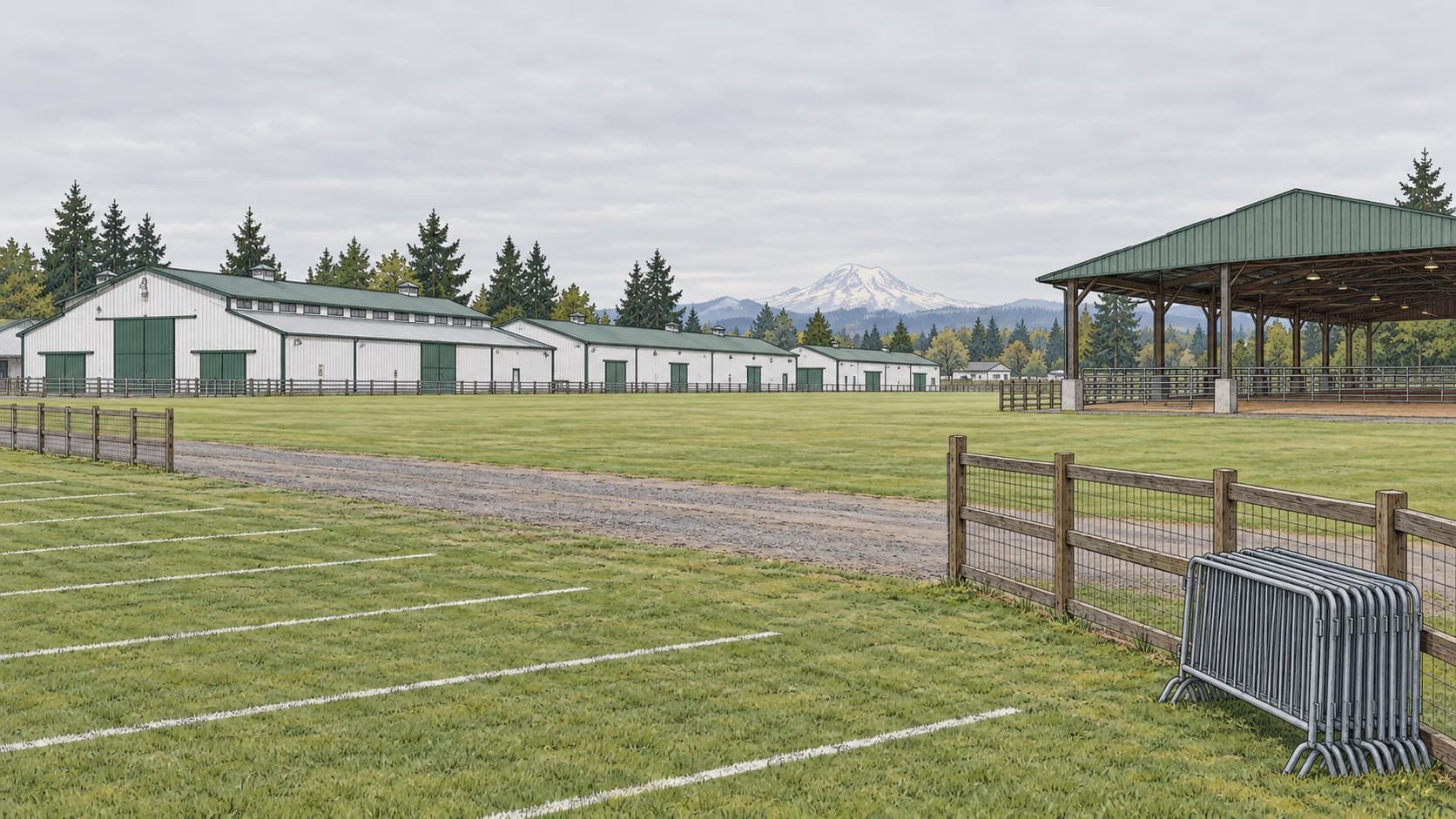
The King County Fairgrounds went to the City of Enumclaw in 2006 and to a non-profit in 2015. How 72 acres and 180,000 visitors a year changed hands twice.
Seventy-two acres sit on 284th Avenue Southeast with grass midways, arenas, parking and a row of multi-use buildings, and roughly 180,000 people pass through them in a year. Dog shows, a wine and chocolate festival, Highland games, a rodeo, weddings, motorcycle rallies, concerts, and the county fair.
It is the largest event ground on the plateau, and King County does not own it.
Two handoffs
The place used to be the King County Fairgrounds, which is exactly what it sounds like: the county's fair, on the county's land, run by the county.
In 2006 the county transferred it to the City of Enumclaw.
On July 1, 2015, the city transferred it again, to a newly formed non-profit, the Enumclaw Expo and Events Association, which runs it now.
Nine years, two owners, and at the end of it the county fair of a region of more than two million people is staged by a non-profit in a town of about twelve thousand.
What that sentence actually means
Counties across the country have spent the last thirty years working out that a fairground is a magnificent thing to have and a miserable thing to own.
The economics are brutal and simple. A fairground earns on a handful of days and costs on all of them. The barns need roofs whether or not anyone shows a heifer. The parking needs grading. The arenas need footing. The insurance does not care that the midway is empty in February. Set that against a county budget containing a jail, a health department and a transit system, and the line item that loses every year is the one with the livestock barns.
So, presumably, the county did the arithmetic and let it go. That is not villainy. It is a budget.
What is remarkable is the other half. Somebody caught it.
The catching is the story
Enumclaw took on 72 acres of aging event infrastructure with a fair attached, and then, nine years later, handed it to a body built for the purpose rather than leaving it inside a municipal budget where it would compete with streets and water.
That second move is the interesting one. It is easy to read as the city shedding a headache. It is at least as easy to read as the city recognizing that a general purpose government is a poor operator of a specialist venue, and moving it to where the people who actually book dog shows could run it.
Either way the outcome is the same, and it is not nothing. The fair still happens, the grounds are still open, and the plateau still has somewhere to put 180,000 people a year.
Why it matters to a town this size
Because an event ground is one of the few pieces of infrastructure a small town has that brings in people who were not otherwise coming.
A restaurant serves the people who live here, and so, mostly, does a trail. A weekend that fills 72 acres fills the motels down the hill, the fuel stations on 410, the diners on Cole Street and the tills of every business that happens to be open on a Saturday in August when several thousand strangers are looking for lunch.
It is also why the plateau still has a fair at all, at a time when county fairs elsewhere have been closing. The fair here outlasted the county's ownership of it, which is a strange sentence and a true one.
What is worth watching
Three things, none of them dramatic.
The buildings. Seventy-two acres of aging event infrastructure does not get younger, and a non-profit does not have a county's borrowing power. Capital is the permanent question for any venue in this position.
The calendar. A venue like this lives or dies on its non-fair days. The fair is the identity. The dog shows and the weddings pay the bills.
And the land. Seventy-two acres inside a growing town, on a plateau where houses are being approved by the thousand, is the sort of thing that eventually attracts a proposal. Nothing suggests one is coming. It is probably the largest single parcel inside the city limits, and that is always worth an eye.
In one breath
The county treated a fairground as a liability. A small town decided it was an asset. Twenty years later the town is still right.
Story label: Original Story or Guide
Originally published: