

Feature
Call 911 in Enumclaw and the truck that comes is not the city's
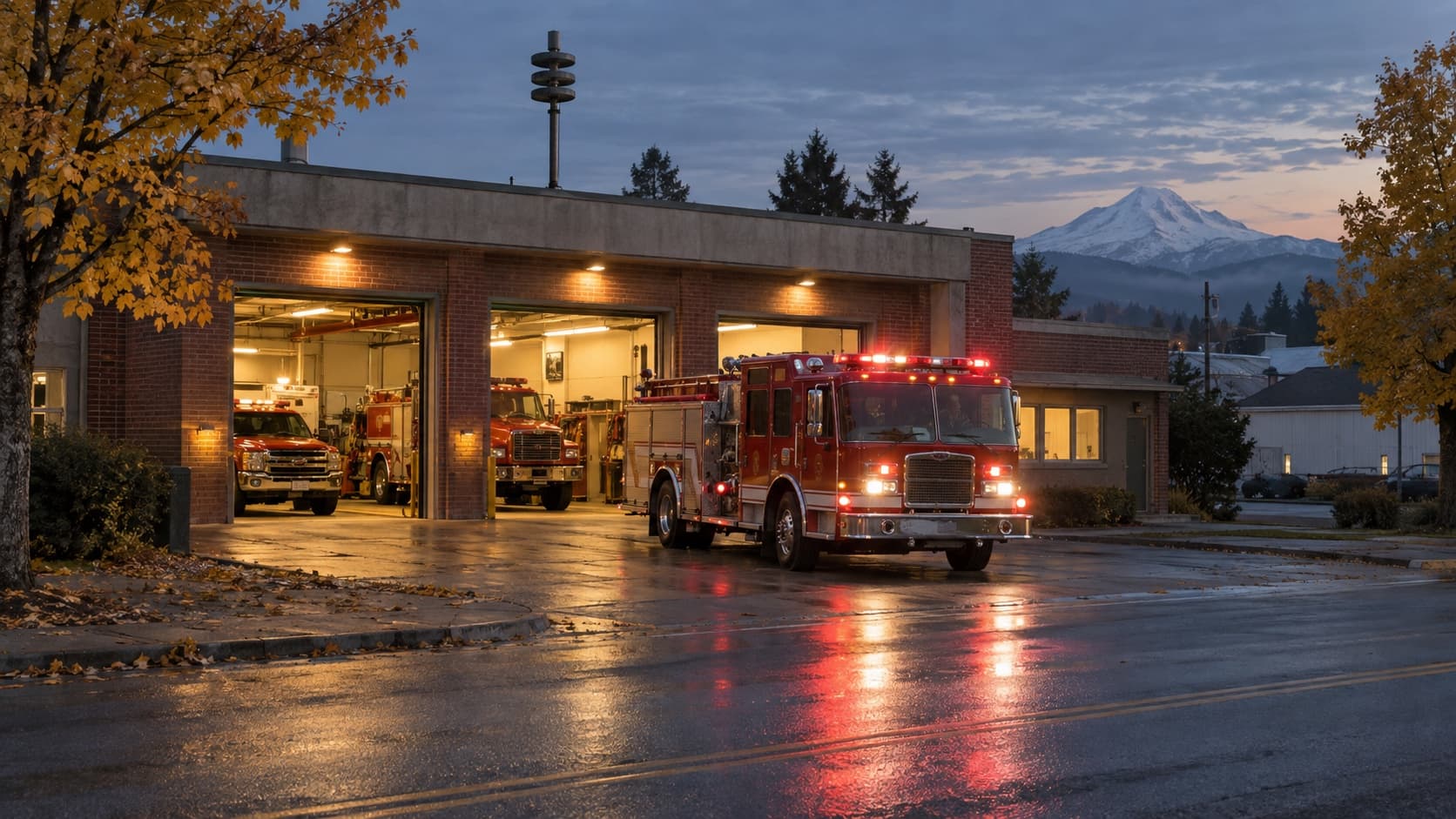
Enumclaw's fire department is a separate county district with its own levy and one staffed station, built in 1968. Who answers 911, what it costs, what is next.
In November 2010 the voters of Enumclaw, by 86 to 14, handed their fire department to a county fire district that, by its board chair's later account, most voters already called the fire department anyway. Since then the truck has said Enumclaw Fire Department on the door and the city has not owned it, staffed it or set its budget.
That vote is the reason your property tax statement has a line the city does not control, and the reason the fire commissioners meet in a leased office on Griffin Avenue rather than at City Hall.
The call
More than 80 percent of 911 calls come from cell phones, the department said in 2017. Those are answered first by the King County Sheriff's dispatch center, which routes fire and medical calls for Enumclaw to Valley Communications Center, the south county dispatch agency. Valley Com has dispatched Enumclaw Fire since the morning of April 3, 2017, when it took over from the city's own communications center at about $40 a call. A landline call from inside the city still reaches the Enumclaw center first, which transfers it. The city's center keeps the police calls, and covers Mount Rainier National Park after the park's dispatchers go home.
Two departments, one number
Enumclaw organized a fire department on November 17, 1903, after a fire that year tore through businesses and homes, with Samuel Lafromboise as chief and L. A. Dibley, who a decade later sat on the first city council, as his first assistant. The merchants bought 500 feet of hose for two hand carts. An alarm bell called the Sentinel was dedicated in 1905, a Model T fire truck with a forty-gallon chemical tank arrived in 1921 for $2,390, and a siren in 1923 for $650. In 1918 the department was turned over to the city council.
The county side started in 1946, when King County Fire District 28 was formed for the area outside the city limits, with three commissioners. For decades the two funded one department together: the city held operational control, the district's board gave input. The station on Wells Street was built in the fall of 1968 for $169,000 and named for a former chief, Guy Lafromboise.
By 2010 the arrangement was a study project. An annexation study found the city's general fund faced a gap of more than $300,000, and the ballot measure that November asked both the city and the district to approve the city's annexation into District 28. The district's voters said yes by 84 percent, the city's by 86. Six more firefighters were hired the next year to keep four on duty around the clock. In 2016 the district's board voted to change its name, the county council passed the ordinance in early 2017, and the district became, on paper, what the board's chair, Stan McCall, said most voters already called it: the Enumclaw Fire Department. "In an emergency," Chief Randy Fehr said, "there shouldn't be any confusion about who to call for help."
What a district is
A fire protection district is a junior taxing district under state law. It has its own elected board, its own levy and its own budget, and answers to no one at City Hall. Enumclaw's has five commissioners, as of this month: Jenny Jones, Scott Percival, Eric Heintzinger, Tony Mills and Lane Walthers, with terms ending between 2027 and 2031. They meet on the third Wednesday of each month at six in the evening at 2884 Griffin Avenue, Suite A, an office the district has leased since February 2023, through January 2028, at a base rent that starts near $3,800 a month and rises to about $4,300 in the last year.
The levy is the statutory maximum, $1.50 per thousand dollars of assessed value. It had drifted down to $1.36 by 2022, and a lid lift on the August 2, 2022 ballot restored it, passing with about 62 percent. There has been no fire measure on an Enumclaw ballot since. The 2026 operating budget, adopted last November, is $9,554,112, of which $7,712,790 is property tax and $6,944,582 is wages and benefits, with $450,000 moved to the capital fund.
Who shows up
Station 41, 1330 Wells Street, is staffed around the clock by career firefighters who are also EMTs. Station 42, the Cumberland station on Veazie-Cumberland Road, is a 1928 schoolhouse and is not staffed. The department's own page counts about 28 employees, 24 of them in uniform; the Courier-Herald counted 21 line firefighters in both 2023 and 2025, and seven, soon eight, administrators in 2023. Minimum staffing is five per 24-hour shift. The district held no volunteer academy in 2024 and publishes no volunteer count.
The apparatus page lists a 2013 Rosenbauer engine, a reserve engine it dates to 2000 or 2001, tenders from 1997 and 1998, a 2004 rescue truck and a 2019 aid unit now in reserve; the two front-line aid cars bought in 2025 at $526,000 each are not on the page. The department runs its own aid car transports, which began in July 2011 and grew from a Ford van bought in 1979 for one dollar; the 2026 transport fee is $1,170.37 plus $21.28 a mile, and the district's funding page says residents of the district carried in its own aid cars should have no out-of-pocket cost. Paramedics come from King County Medic One, a county program rather than a district one.
The calls: 2,634 in 2025, 2,741 in 2024, 2,798 in 2023, against 1,785 in 2010 and 1,119 in 1990. About 78 percent are medical, by the board chair's 2023 figure, and one call in five in 2021 came in while another was already running. The district holds automatic-aid agreements with Buckley (since 2000), Mountain View Fire and Rescue, Maple Valley, East Pierce and King County, plus water tender deals with Kangley-Palmer and Orting. At a house fire in April 2025 the chief's report lists Enumclaw, Puget Sound Fire, Valley Regional, Buckley, East Pierce, King County Medic One and a sheriff's investigator all on scene.
The chief is Ben Hayman, who ran daily operations after Randy Fehr retired at the end of 2024, was due to take the title in June 2025, the Courier-Herald reported, and signs the district's agreements as fire chief.
The station that cannot grow
The Wells Street building is 7,883 square feet. It got additions in 1983 and 1999 and has nowhere left to go, on a half-acre lot, in a city that grew from 9,300 people in 1999 to 12,600 in 2024. The district's 2016 capital plan, now being revised, called for a 20,000-square-foot station downtown at 185 Roosevelt Avenue and an 8,000-square-foot satellite along SR 164, at a cost the Courier-Herald reported as more than $20 million in 2020, about $23.5 million for 2025, and over $27 million by 2030. A station needs a bond, and a bond needs 60 percent of the vote.
None is scheduled. In May 2025 the Puget Sound Regional Fire Authority, which had been handling some administrative duties for the district under a one-year contract, declined to take it on, citing staffing that would have to rise from 21 to 33 and revenue that showed a deficit by 2030 and up to a $6 million shortfall by 2035. Angie Stubblefield, a commissioner at the time, put her own reaction in one line: "We are not an urban fire department. We're suburban." The board accepted the authority's advice to freeze most hiring, hold reserves at 30 percent and cap overtime at nine percent, and one commissioner suggested waiting on a deputy chief until the 2026 budget. The 2026 capital list includes defibrillators, protective gear, a kitchen repair and a decontamination washer, after a 2025 list that carried two aid cars at $526,000 each and an engine at $1.26 million.
Hayman said in January 2025, before he had the job: "Right now, the staffing that we have is not enough to keep up with what we need to be doing."
Sixty percent
Yours, in the plainest sense. The people who decide whether Enumclaw gets a second staffed station are five commissioners you elect, and the money they have is the $1.50 you pay. The third Wednesday is a public meeting. The budget is on the district's website. And the next time a bond appears on the ballot, the number to remember is 60 percent, not the cost.
Story label: Original Story or Guide
Originally published: