

Feature
Eight cameras now read plates on the way into Enumclaw. Here is what the rules say.
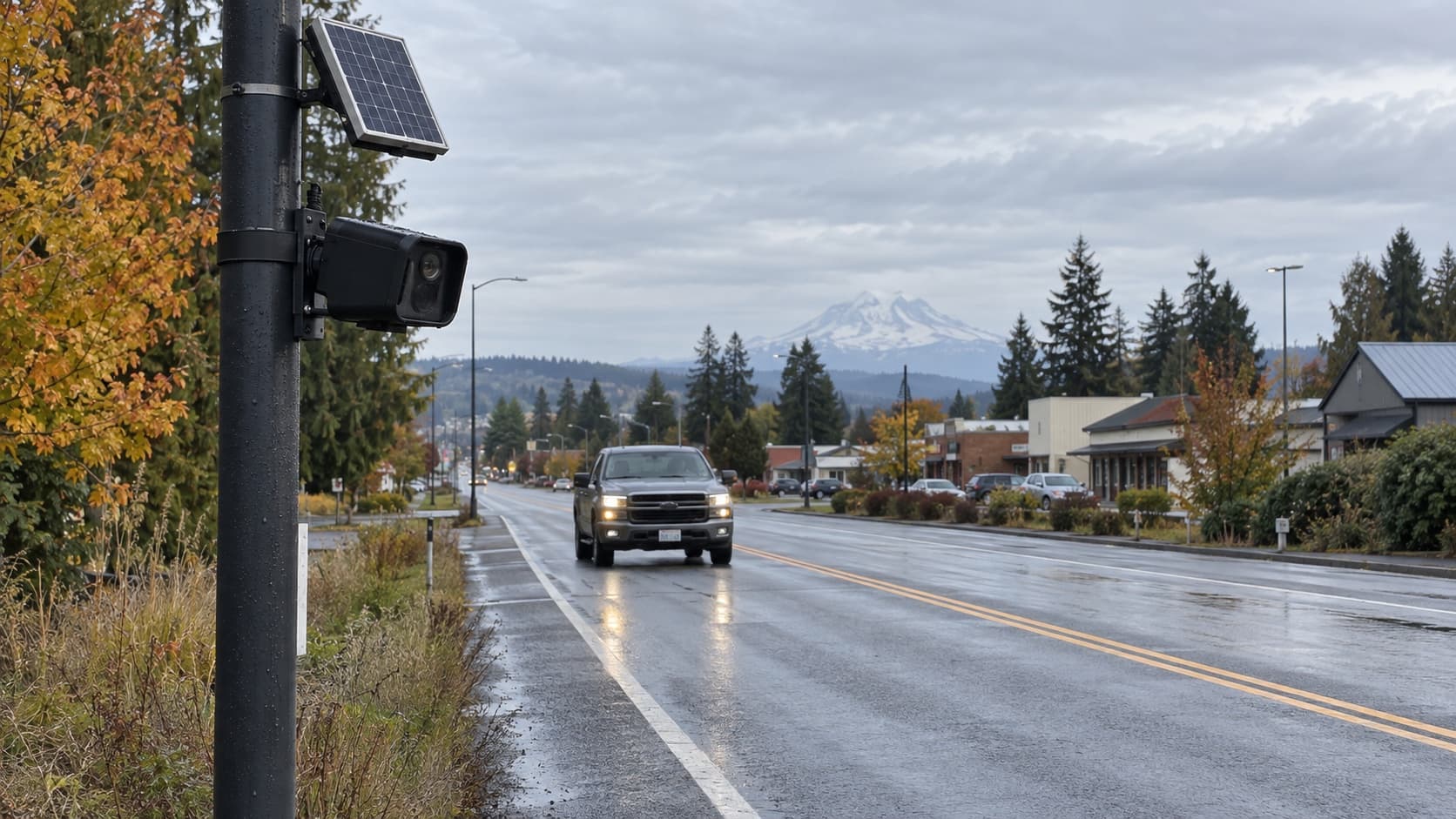
Enumclaw's eight Flock license plate readers went up in 2026 after a 5 to 2 council vote. Locations, policy, cost, and the audit due in 2027.
Drive into Enumclaw on 410, 169 or Porter Street and, since this summer, a camera on a pole has photographed your license plate, read it, noted the make, model and color of your car, and filed the picture for up to three weeks.
That is not a rumor. It is a contract the city council approved 5 to 2 on August 25, 2025, with a policy attached, and the policy is the part worth reading, because it is the only thing standing between the tool the department described and the one its critics described.
What was bought
Eight Flock Safety automatic license plate readers, for $30,000 in the first year including installation and $24,000 a year after, with a 60-day free trial up front.
The first went up in June 2026 on Porter Street at 427th, reading southbound traffic. The plan for the other seven, as the Courier-Herald reported it: one more on Porter for northbound traffic, making two there, two at SR 169 and 416th Street covering both directions, and four on 410 at Semanski Street and at Farman Street. All eight were to be in by mid-July, and the system was not to switch on until they were. By September, the Center Square reported, the chief was crediting all eight with results, so the switch has been thrown.
The cameras read plates and describe vehicles. They do not measure speed, and under the policy they cannot be used to find out whether you ran a light.
What the policy says
The council adopted the rules on July 28, 2025, a month before the contract. In summary:
Pictures are kept for thirty days and then deleted, unless an officer flags one for a case. The June 2026 report notes that state law now caps retention at 21 days, so the shorter figure governs.
Every search requires a case number and an officer's own user ID, so the audit trail names who looked and why. Two operations commanders, Tony Ryan and Josh Hong, audit the searches every quarter, and elected officials are invited to sit in.
Under state law the system may be used only for gross misdemeanors and felonies, and under the policy not for traffic infractions or civil matters. A camera hit alone does not justify a stop; the officer needs independent reasonable suspicion or a visual confirmation first.
No access from personal devices. No sharing with private third parties. Sharing with other law enforcement is limited to agencies inside Washington, and the data is not public.
An online transparency portal, of the kind Flock hosts for other departments, is to list which agencies Enumclaw shares with, how long data is kept, and monthly counts of plates read, searches run and hits returned. And by December 2027 the department must publish its first annual audit: hits that led to stops, arrests or prosecutions, stolen vehicles recovered, total reads and searches, every instance of data sharing, and where the cameras are.
Who voted how, and why
For the contract: Corre Koopman Frazier, Jan Martinell and Chance LaFleur, joined by Thomas Sauvageau and Anthony Wright. Against it: Bobby Martinez and Chris Gruner.
Chief Tim Floyd made the case beginning in the spring of 2025. By the chief's account, almost all of incorporated South King County already ran the cameras; Black Diamond had five since the summer of 2023. Everett, which switched them on in 2024, saw a 76 percent drop in car theft that year, according to the chief. Floyd pointed to an Auburn armed robbery in which Flock cameras tracked the suspects' vehicle, and described the system as like having officers on duty all day, every day, with a particular use in Amber and Silver alerts. Sauvageau said he had watched a stolen vehicle recovered on a ride-along and believed the technology made the town safer.
Gruner said he was not interested in expanding a surveillance dragnet into Enumclaw. Martinez called it privatized mass surveillance with too little government oversight. Residents objected on social media, and a council candidate, Brodie Smith, raised the possibility of abuse. The ACLU's published recommendation for systems like this is a retention period of 72 hours at most, and as little as three minutes.
The Courier-Herald's own reporting in 2025 listed the reasons for caution: a former Kansas police chief found in 2024 to have used the system to track an ex-girlfriend 228 times, after which Flock cut off his department, and two wrongful arrests in North Carolina, one over a similar-looking vehicle and one over a name typed wrong, that cost those cities $60,000 and $10,000 in settlements.
What happened elsewhere since
The picture changed while Enumclaw's poles were going in. The Center Square reported on September 8 that at least eight Washington cities had canceled or suspended their Flock contracts: Olympia, Auburn, Shoreline, Redmond, Mountlake Terrace, Lynnwood, Edmonds and Snohomish. The reason, in most cases, was sharing. Eight Washington agencies shared camera data with U.S. Border Patrol in 2025, and federal agents were found to have had some form of network access to at least eighteen agencies, in some cases through approved-user lists nobody had authorized. Auburn was among them.
The legislature responded with a Driver Privacy Act that bars immigration enforcement uses and surveillance near schools and reproductive clinics, and requires every agency to report to the Attorney General starting in December 2027. Flock hired an outside security firm to audit the platform.
The other side of the ledger is real too. Redmond said cases closed 38 percent faster. Everett reported stolen vehicles down 68 percent in 2026 against its three-year average. Spokane County credited the cameras with 88 stolen vehicles, nine missing persons and 150 arrests in seventeen months. Yakima counted 688 investigations helped, eleven of them homicides.
Where that leaves it
Enumclaw's policy addresses the sharing problem that got other cities in trouble. In-state sharing only, case numbers, quarterly audits, no infractions, a public portal and a public annual report answer the main objections in part; the ACLU asked for far shorter retention, and the two dissenting council members opposed the cameras outright.
What is in writing so far, on results, is one sentence. The Center Square reported this month that Chief Floyd gives the eight cameras credit in three major cases, one of them the tracking of a suspect sought for five Oregon murders. That is the chief's account, and there is no reason to doubt it, but the first audited count of hits, stops and arrests is fifteen months away. Until it lands, the only checked numbers about Enumclaw's cameras are $30,000, $24,000 and eight, and the only way to know whether the portal exists and is being updated is to go and look.
Three things to check
Read the policy. It is a council document from July 2025.
Find the portal. The policy promises one online, with monthly statistics. If it is there, note the numbers. If it is not, that is a question for the council, because the promise was part of the vote.
Mark December 2027. That is when the department owes the town its first accounting of what eight cameras actually did, and it is the first date on which the argument can be had with evidence.
Story label: Original Story or Guide
Originally published: