

Feature
A mile of Enumclaw, one building at a time
Seven stops on foot: three King County landmarks, one National Register storefront, a museum that is not a courthouse, and the corner where a bank was carried across the street.
Enumclaw is flat. That is the first thing to know, and the reason the town's whole civic history fits inside a loop you can finish before lunch. The second is that nearly every building on the route was paid for by the same few dozen people, mostly Danes, who kept founding things: a mill, an insurer, a bank, a lodge, a city. Most still do what they were built for.
The loop runs about a mile, from Marion Street at the north end to the library.
Stop 1. The museum on Marion Street, which was never a courthouse
Enumclaw Plateau Historical Society Museum, 1837 Marion Street, at Washington Avenue.
Local shorthand calls this the old courthouse. It was not one; the municipal court sits in City Hall, and no record we can find puts a county courthouse in town. This is the Enumclaw Masonic Hall, built by the Masons in 1909 from local timber, which the state's Revisiting Washington heritage site calls the only fraternal hall in town still looking the way it did.
The Masons sold it in 1970 to St. Catherine's Episcopal Church. The historical society, chartered in 1995, bought it that year, and in the early 2000s the whole building was jacked up and moved forward seven feet to make room for a basement. It went on the Washington Heritage Register in 2003 and became a King County landmark in 2018.
From the sidewalk: four white columns and a plain clapboard box. Open Thursday and Sunday, 1 to 4, free, as of September 2026.
Walk south on Marion Street, three blocks, to Griffin Avenue.
Stop 2. The Hill, and the mill owners' houses
Louis and Ellen Olson House, 1513 Griffin Avenue, at Marion Street. Private residence.
The big green house on the corner is the reason this stretch of Griffin exists. Louis Olson was one of six men, with Carl M. Hanson, Hanson's sons Axel, Charles and Frank, and a Scot named Alexander Turnbull, who bought a burned-out mill in 1897 and made it the White River Lumber Company, the plateau's largest employer within a decade. Olson was company president by 1920.
The house went on the National Register in 1984; the Park Service gives its significant dates as 1905 and 1925, built for Olson and his bride, then heavily remodeled in the twenties. Look for the hipped roof, the squared porch columns, the leaded diamond panes upstairs, and the number 1513 on the porch beam.
Nobody has written down where "The Hill" got its name; Enumclaw has no hill in it. But HistoryLink notes that the Hansons and Olsons kept Enumclaw from becoming a company town by pushing workers to buy their own houses, which is why the blocks behind the mansions are full of bungalows and gabled cottages. The owners built big on Griffin and the crews built modest behind it, out of the same lumber.
Walk east on Griffin to the columns.
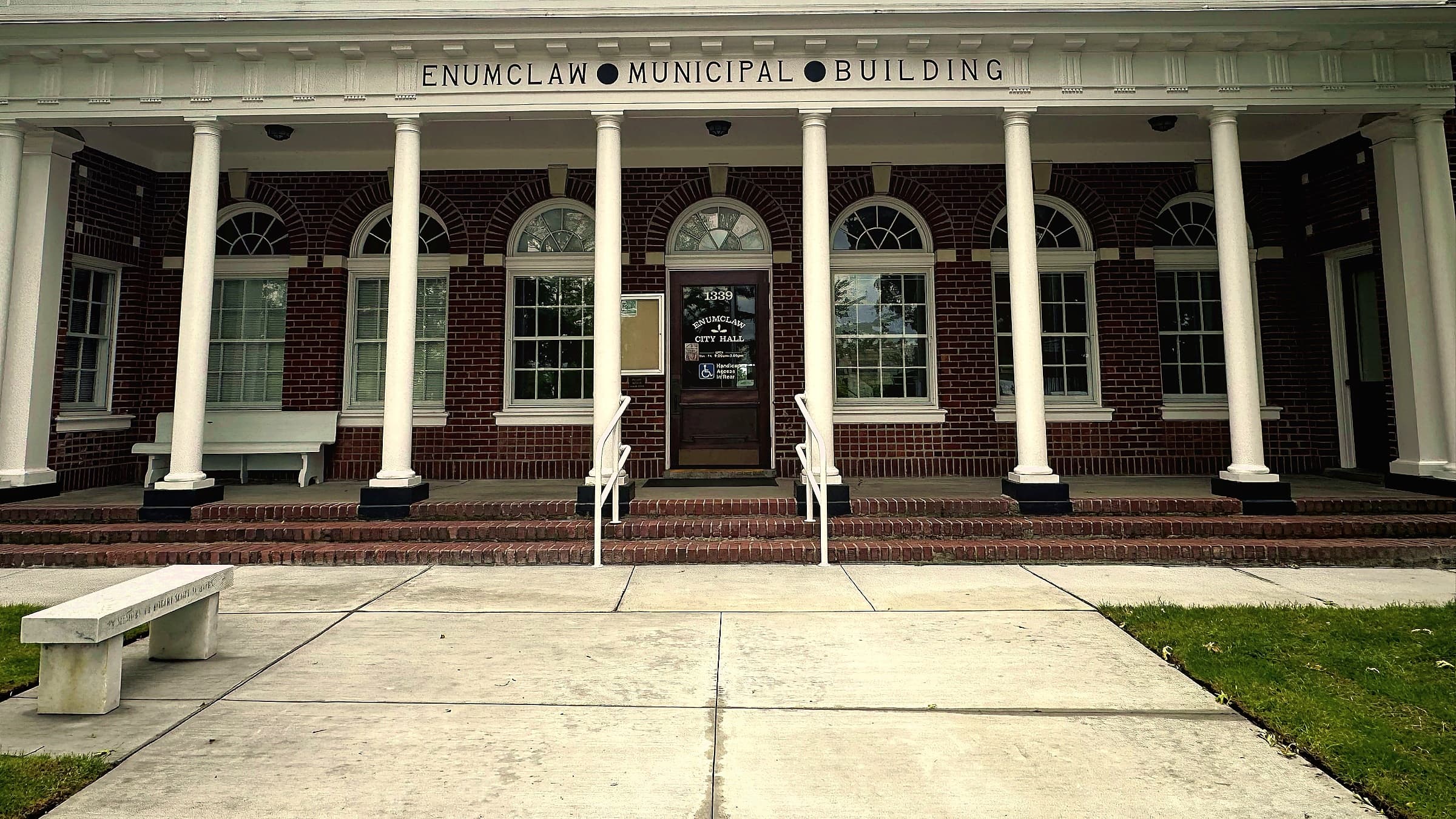
Stop 3. Enumclaw Municipal Building
1339 Griffin Avenue, between Porter and Wells streets. King County landmark, 2022.
Enumclaw incorporated on February 1, 1913, and governed from nowhere in particular for eight years. In 1921 voters approved a bond, 137 to 56, and on July 19 the council went through fourteen bids and approved $12,000 for the building, $1,330 for plumbing and $212 for wiring. The Courier-Herald reports the council hired Harlan Thomas, the Seattle architect then finishing the new high school; the first council meeting inside was November 1, 1921.
The Enumclaw Courier approved of "an imposing row of pillars" facing Griffin. There are eight, white, under a frieze that still reads ENUMCLAW MUNICIPAL BUILDING. Behind them is dark red brick with fanlight arches over the windows. In 1923 one room became Enumclaw's first public library, with a librarian, Agnes Christensen, paid $16 a month.
A west wing went on in the 1940s. For the 2021 centennial the city spent about $215,000 restoring this south face; the step bricks are no longer made and the replacements came from salvage yards, and you will have trouble finding the seam.
Walk west to Wells Street and turn south, two blocks.
Stop 4. Mutual of Enumclaw
1460 Wells Street, near Initial Avenue.
On February 17, 1898, a group of plateau farmers filed articles of incorporation for the Farmers Mutual Insurance Company. The idea was fire insurance with nobody in the middle: when a barn burned, every member paid a share. The founding president was George Bruhn, a Dane; the first agent, S. L. Sorensen, was another, and you will meet him again at Stop 6.
It insured only farms until the late 1940s and on May 1, 1966 became Mutual of Enumclaw. HistoryLink calls it the oldest mutual insurer in Washington; the members still own it, one vote each.
This is the one stop with a thin paper trail: the company's history page says nothing about its home office, and the only construction date we found, 1960, comes from a property listing, not a record we would print. What you can see is a three-story block of speckled aggregate and dark glass and a granite sign reading "A Century of Service," which dates the sign to about 1998.
Walk east on Initial Avenue to Cole Street and turn north.
Stop 5. The Trommald Building
1523 to 1525 Cole Street, east side, between Initial and Griffin. National Register of Historic Places, listed August 24, 2000.
Erick G. Trommald, a Tacoma dry goods merchant, spent $30,000 on this two-story storefront and hired Heath and Gove to design it; Frederick Heath also did Tacoma's Stadium High School and the Paradise Inn at Mount Rainier, so Cole Street got a serious hand. The Register calls the style early commercial with Chicago School influence: big glass below, a grid of windows above, and masonry meant to be fireproof, part of a 1910s and 1920s push to replace the wooden town with brick.
On the date the record splits: the Park Service, the state heritage site and the city's centennial tour say 1920, Wikipedia says 1915. Trust the Register. Later tenants included the People's Cash Store, a co-op for miners and loggers, and for decades the Mity Nice Bakery.
Keep walking north to the corner.
Stop 6. The corner where the money crossed the street
Enumclaw National Bank Building, 1602 Cole Street, northwest corner of Cole and Griffin. King County landmark, 2016.
Sam Lafromboise kept the town's first safe in his saloon. A real bank came in 1904, and in 1910 a rival, People's State Bank, opened by Byron Kibler, J. W. Davis, Chris Borgaard and S. L. Sorensen, the insurance man from Stop 4. People's became Enumclaw National Bank in 1922, and in 1923 it built this corner for $20,600.
In 1932 it failed, as about 9,000 American banks did, and there was no deposit insurance. The rival First National Bank of Enumclaw, on the opposite corner, agreed to take on all the failed bank's assets and liabilities, and the cash, bonds and records were carried by hand across the intersection under the eye of Sheriff Tom Smith. Depositors got about 80 cents on the dollar; elsewhere people got nothing.
After that a cobbler, Steve Polenus, had the ground floor for decades, with doctors and dentists upstairs. A coal stoker in the basement heated the place into the 1970s, on a street once spelled Coal before somebody made it Cole. A gift shop took the corner in 2001, a publisher in 2022, and when we photographed it this summer a leasing sign hung in the Griffin Avenue window.
From the sidewalk: pale piers, tall plate glass, a plain cornice, a building meant to reassure people about their money.
Turn east on Griffin and walk two blocks to Railroad Street.
Stop 7. The library
Enumclaw Library, King County Library System, 1700 1st Street, at Railroad Street.
You have already seen where this library started: a room in City Hall in 1923. In 1928 the town's founder, Mary Stevenson Yerxa, died and left it her house; a 5,000-square-foot building replaced the house in 1954. Two bond votes failed before a $1.25 million measure passed on November 7, 1989.
This building, 10,541 square feet by Lewis/Nelson Architects, was dedicated on September 28, 1991, with Mayor Keith Blackburn speaking. City voters handed it to the King County Library System in 2012, and it turned a hundred on November 8, 2023.
It is the newest building on the walk by sixty years, low brick under a wide roof. It is also the only stop that grew out of another stop, which is the point of walking them in order.
What the mile adds up to
Three of the seven buildings are King County landmarks. Two are on the National Register. All were built with money and timber from within a few miles of where you are standing, by people whose names repeat from stop to stop: Lafromboise, Sorensen, Hanson, Olson. The town did not get these buildings from anyone. It built them, then kept them, which is the harder part.
Story label: Original Story or Guide
Originally published: