

Feature
Enumclaw became a city on the second try, by a close vote, in the middle of winter
Enumclaw's first incorporation vote failed in 1912 over boundaries. In January 1913 a town of a thousand said yes and John Blake became mayor.
Enumclaw has been a city for 113 years, and for the first 27 of its existence it was not one. It was a railroad siding with a hotel, a store and a saloon, platted by a couple who wanted the train to stop, and it grew into a town of a thousand people without anyone having the power to pave a street.
The vote that changed that was close, it was the second attempt, and it happened in January.
Before
Frank and Mary Fell Stevenson offered the Northern Pacific cleared land for a siding and filed their plat with the county auditor on October 1, 1885. They built the hotel and gave away lots for the saloon and the general store, the three-building recipe for every town in the West that ever worked.
By the 1900 census there were 483 people. By 1910 there were 1,129. In between, the plateau's habit of doing things collectively had produced a farmers' mutual insurance company in 1898, a cooperative creamery in 1899, a Rochdale cooperative store in 1905 and a Grange in 1909. Enumclaw could insure a barn, churn butter and sell dry goods by committee. What it could not do was tax itself, pass an ordinance, or buy a water supply, because it was not a municipality.
The first vote
The business owners wanted that to change. Their argument, as HistoryLink's account summarizes it, was that incorporation would let local businesses use the legal and financial tools of a real town to provide services.
On March 15, 1912 the question went to a vote and failed. The sticking point was the map. Property owners who had supported the idea withdrew when they saw the proposed boundaries, and enough of them withdrew to sink it.
The second
A store owner named John Blake spent the rest of 1912 in meetings with the other business people, working on how to bring the question back.
On January 24, 1913 the citizens of Enumclaw voted to incorporate. The margin was close. On February 1 the incorporation became official and the first city council was elected: Blake as mayor, R. S. Miles as treasurer, and five councilmen: L. A. Dibley and A. C. Johnansen, then R. D. Taylor and Archie Smith, with N. C. Christensen the fifth. They held their first meeting on February 7, 1913.
The town they took charge of had just over a thousand people, a lumber mill and a creamery.
What a city does first
Two things the new city did in its first year explain more about Enumclaw than any speech.
It bought a spring. The White River Lumber Company owned a fresh water source, and the city purchased it. That purchase is the origin of the arrangement this site described on Tuesday: a town that drinks from four sources it owns, east of town, uphill, kept.
And it replaced the coal-gas lanterns in the streets with electric lights, in 1913, the same year. A place that had been lit by gas made from the same rock it dug out of the hills at Bayne and Black Diamond switched to the new thing the moment it was allowed to decide.
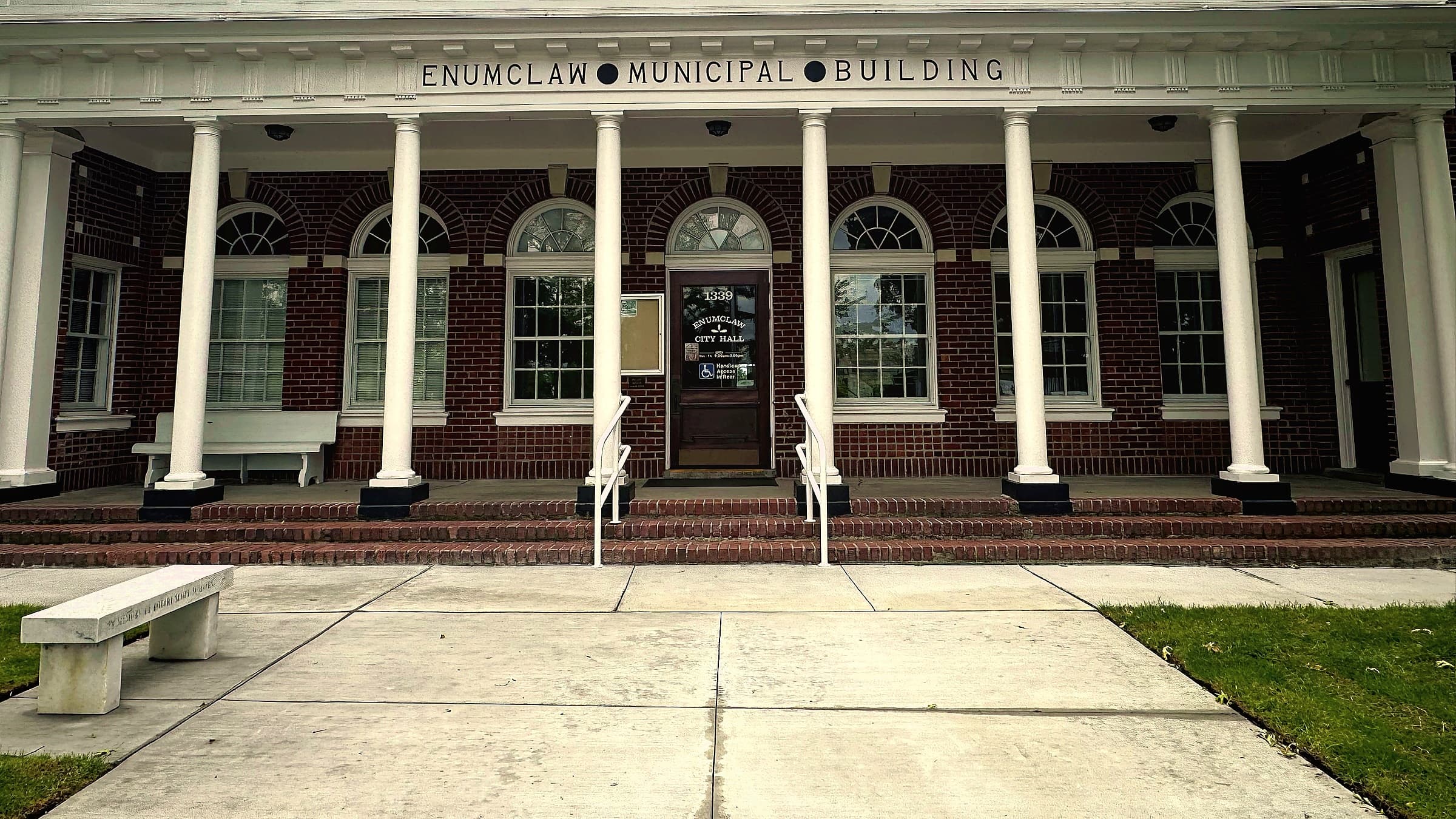
The Municipal Building came within a decade, designed by the architect Harlan Thomas, with its row of white pillars facing Griffin Avenue; the sources date it to 1921, 1922 and 1923, and this site's walking tour, which stops there, goes with 1921. It is still City Hall.
Why the vote was close
The tally does not appear in the sources available for this piece, only that the vote was close, and only that the first one failed over boundaries. But the shape of the objection is recognizable to anyone who has watched a plateau land-use hearing.
Incorporation meant taxes on the people inside the line and none on the people outside it, and it meant that a farmer whose land fell inside would pay for streetlights he could not see from his barn. The likeliest reading is that the 1912 boundaries reached too far and the 1913 ones did not, and that Blake's year of meetings was, in part, a year of redrawing a map. The sources do not say so in as many words.
That is the founding argument of every town on the plateau, and it has never ended. It is being had this year over impact fees and school seats and water capacity, by a city a dozen times the size, inside lines that began with the ones drawn in 1912.
Where to stand
Go to City Hall on Griffin and look at the pillars; the 1913 council met somewhere else, and none of the sources for this piece say where. Read HistoryLink's essay on the incorporation. It is short and cites Clarence Bagley's 1929 county history and Louise Poppleton's town history. And when the next boundary argument comes to a council meeting, remember that the city exists because somebody was willing to go back and try again.
Story label: Original Story or Guide
Originally published: