

Feature
The last two one-room schools in King County were both on the road to Enumclaw, and one had a television in 1959
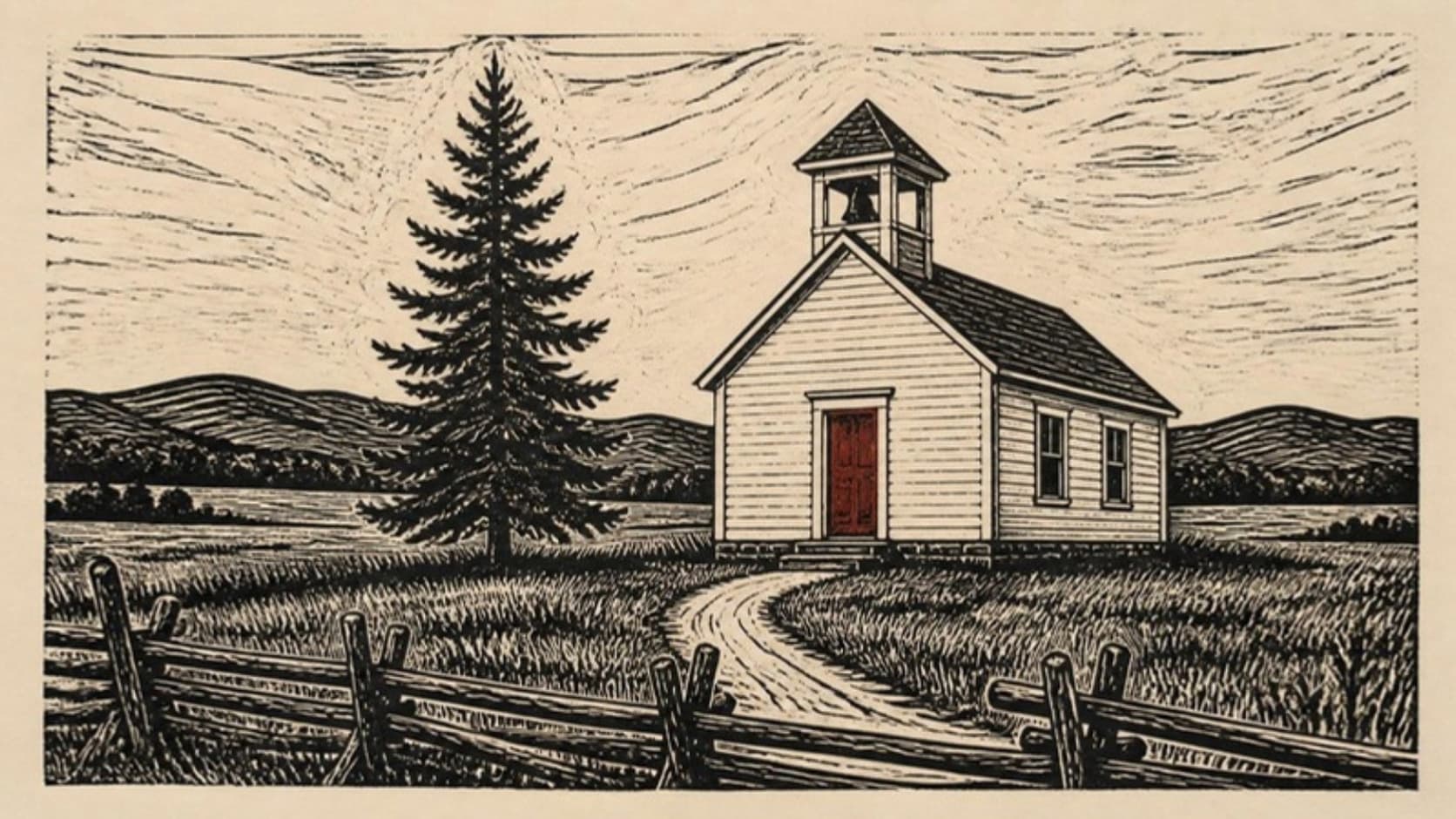
The plateau once had more than a dozen tiny school districts. The last two one-room schools in King County were near Enumclaw in 1959. How they were folded in.
In March 1959 a Seattle Times reporter went looking for the last two one-room schools in King County. He found them both near Enumclaw. At Cumberland, eight pupils and a 71-year-old teacher. At Newaukum, twenty-seven pupils, a teacher named Lulu Fant, and a television set she had been using in class ever since Channel 9 came on the air. The school boards of both districts gave him the same answer: "We think small schools are better than big ones."
They were the tail end of something the plateau used to be full of.
A school every few miles
Before there was an Enumclaw school, there were kitchens. The earliest classes on the plateau, according to the local history compiled by John and Doreen Anderson from three town histories, were held in settlers' homes: Mrs. Edwin White's living room on Porter's Prairie, the Osceola country, from about 1875; the Canfield home at Krain in the early 1880s; a French-speaking teacher hired for the French district, later called Firgrove, in 1881. By 1885 there were schoolhouses at Osceola, Krain and Veazie. The Northern Pacific gave Krain its land, and the families supplied the materials.
Over the following decades the plateau and the country around it filled with little districts, each with its own board, its own building and usually its own teacher: Osceola, Boise Creek, Krain, Flensted, Coal Creek at Veazie, Mud Mountain, Mountain View, Kangley, Selleck, Palmer, Cumberland, Newaukum and Wabash, among others. Washington as a whole reached its peak in 1910 with 2,710 school districts, according to a 2002 Washington Trust for Historic Preservation report hosted by the state historic preservation office.
The terms were short and the pay was thin. An Osceola pupil from the 1890s, Emma Ekman, remembered for the town's 1941 history that "The teachers in those days received only $30 to $40 a month pay," and that one of them walked out from Enumclaw every day. Teachers swept the room and lit the stove. Krain children did not start school until October, so they could pick hops first. When Kangley opened its school in 1904, it hired an Enumclaw teacher for $65 a month to teach grades one through nine in one room.
The buses
Consolidation came in on wheels. As early as 1909, when the White River Lumber Company's Ellenson village closed its little school, the children were hauled to Enumclaw by horse-drawn wagon. By 1920, a state education journal reported, King County ran 80 school transportation routes, and the largest of them all started at Selleck: "The largest route originates in Selleck and runs to Enumclaw, a distance of 16 miles, and carries all high pupils living at Selleck, Durham, Palmer, Bayne, Cumberland, and Veazie to the Enumclaw high school."
The little districts kept their grade schools and sent their teenagers down the road. Then, one at a time, they were folded into Enumclaw. The dates that survive in the record are scattered: Mud Mountain joined Enumclaw in 1935, Osceola in 1937, with a class photograph captioned as "the last class before consolidation." Statewide, the one-room school collapsed in a decade; between 1937 and 1946 about 78 percent of them closed.
Not every merger passed. In March 1945, voters rejected a plan to fold Enumclaw, Selleck, Palmer, Cumberland, Black Diamond and Newaukum into one district, and that same week the governor signed a change to the state law requiring a majority in each district, not just in the area as a whole. The small districts now had a veto, and several of them outlasted the 1945 plan by decades.
The holdouts
Cumberland was School District No. 66. In the fall of 1957, parents of 16 of its 21 pupils petitioned the Enumclaw board to take their children, the Courier-Herald reported, accusing their own board of failing to provide enough teachers. The teacher, Laura Massey, told the Seattle Times in 1959: "I didn't take sides, and I'm still teaching here." Newaukum, off the road to Auburn, had turned down two merger attempts in six years. Its board secretary, Martha Swain, whose whole family had gone there, told the same reporter, "We're very proud of our school."
Newaukum closed in June 1961 and joined Enumclaw. The last district to go was the biggest: Black Diamond, whose high schoolers had been riding to Enumclaw for more than twenty-five years. In the spring of 1975 a consolidation vote failed, and the Black Diamond board then ran its school for 178 days, two short of the state's 180-day minimum, which gave the county committee the grounds to dissolve the district. It was annexed to Enumclaw that July.
Enumclaw once tried the opposite direction too. From 1949 into the early 1950s, Enumclaw and Buckley merged their school districts, with one high school, as the White River district. When the marriage ended, both towns kept the colors and the mascot, which is why both schools are still maroon-and-gold Hornets. They split, a retired Enumclaw athletic director told the Seattle Times, "because neither town wanted to give up its identity," and going back to the old colors was judged too expensive.
The number
The Enumclaw School District says it was established in 1887, when the town drew its own district lines from Auburn to the Cascade crest. Its number today is 216. But a 1908 notice about the new Enumclaw school, found by the Black Diamond Historical Society, calls it District No. 156. King County handed out new numbers when districts were reorganized: Black Diamond alone went through four, 43, 132, 160 and 190, between 1885 and 1916. So the 216 on the buses and letterheads was almost certainly assigned later, at one of the consolidations, not in 1887. This site has not found the date, and the county's own history of its school districts, compiled in 1960, is the document that would settle it.
That makes the district number something like a tree ring. The little schools of the plateau did not disappear into Enumclaw. They are inside its name.
What is still standing
The 1890 one-room Osceola schoolhouse still stands on 220th Avenue SE; as of 2015 it was the Plateau Community Players' clubhouse. The third Osceola school, built in 1914, is a private home nearby, and both sit inside the Osceola Loop Heritage Corridor that King County designated in 2009. The 1930 Selleck school, vacant since 1981, stands in the Selleck historic district, which this site writes about separately today. The Krain school was torn down around the early 1960s.
One teacher the Seattle Times did write up was Lulu Kombol, who taught 44 years, 13 of them at Cumberland and 19 at Selleck, after starting out in Centralia and Ravensdale, and was honored at Selleck School in May 1962 as she neared the end of her 44th year. "The children I've taught have all been a part of me," she said. "I wouldn't want to have done anything else."
Story label: Original Story or Guide
Originally published: