

Feature
The backup valve has not been opened since 2003
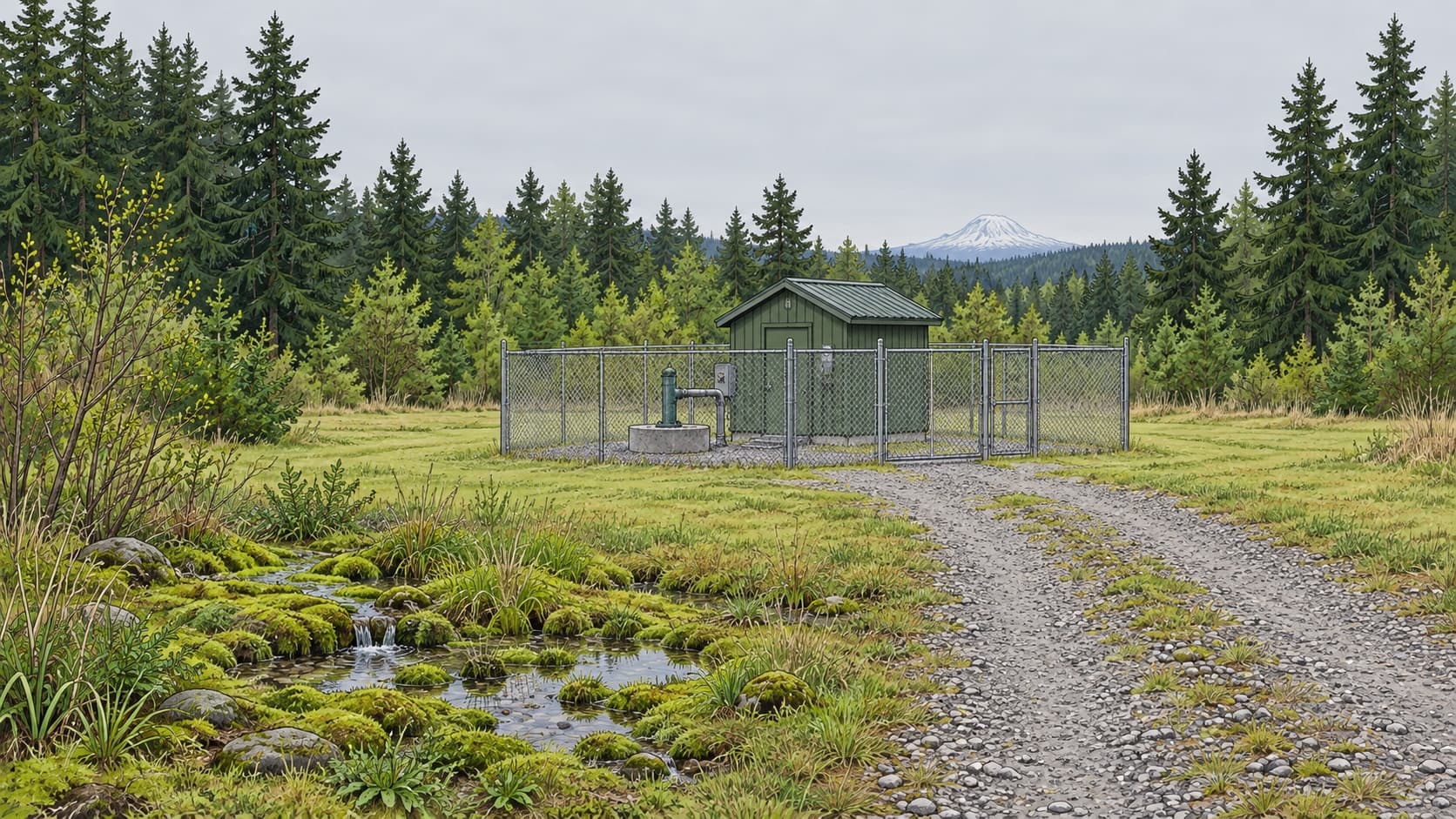
Enumclaw draws its water from four sites east of town. Two are rated highly susceptible, none is fluoridated, and the Tacoma backup has sat unused since 2003.
Turn on a tap anywhere in Enumclaw and the water in the glass came from one of four places, all of them east of town, all of them within a short drive of somebody's pasture.
The city says so itself, once a year, in a document almost nobody opens. The Drinking Water Quality Report for calendar year 2025 runs four pages, and the interesting part is on page one.
The four
Boise Springs. Watercress Spring and Well. The PC Johnson Wellfield. The Golf Course Well.
That is the entire list: four sites, six sources by the utility's own count, feeding 6,415 connections through 155 miles of main. The city owns and operates all of them, and every one sits east of the city, which is to say uphill, on the side where the plateau climbs toward the mountain. Boise and Watercress are springs, where water that has been underground comes back out on its own, though Watercress has a well beside it. The others are wells, where it has to be lifted.
There is a fifth pipe, and it is the one worth knowing about.
The pipe nobody has opened
A Tacoma Water pipeline runs through Enumclaw on its way somewhere else. The city holds an emergency intertie to it, which means a valve exists that would let Tacoma's water into Enumclaw's mains if the town ever needed it.
The report gives the status of that valve in eight words: this connection has not been used since 2003.
Twenty-three years. Through the floods, through every summer drought since, through the wildfire smoke seasons, the town has never once borrowed water from anybody. Four holes in the ground east of town have covered it every single day.
That is either a very good piece of site selection or a very long run of luck, and the honest answer is mostly the first. Towns that grew up beside a mountain tend to have water. Towns that grew up beside a mountain and then kept the land around their springs tend to keep it.
What the state thinks of the four
Here the report stops congratulating anybody.
The Washington State Department of Health rates each source for how exposed it is to contamination. Boise and Watercress are rated high susceptibility. The PC Johnson Wellfield and the Golf Course Well are rated low.
Two of four, high. Not contaminated, which is a different word entirely. Susceptible, meaning that if something were spilled, spread, buried or leaked in the wrong place, those two are the sources positioned to find out about it first.
That is simply what a spring is. A spring is groundwater that has not had to travel far or wait long, which is why people say it tastes better and exactly why it is easier to reach. The two qualities are the same quality.
What the city does about it
Every source gets chlorine. That is standard, and it is the reason nobody in Enumclaw has to think about bacteria.
Boise and Watercress get one extra treatment: the city raises their pH. Not for taste, and not for safety directly, but because slightly acidic water will slowly eat the inside of metal pipe, and what comes off the inside of old metal pipe is the part you would rather not drink. Raising the pH is the cheap version of replacing every service line in town.
One thing the city does not do is stated plainly in the report. Enumclaw does not add fluoride to its water. Whatever your view of that, it is a decision, and it is public.
The report's own verdict is short: the city's drinking water "meets or exceeds all federal and state requirements."
Why this matters on an ordinary Tuesday
Because the four sources are the ceiling.
Everything the plateau is currently arguing about, the subdivisions approved for thousands of homes, the school district planning for a thousand more students, the impact fees and the capacity tables, eventually arrives at the question every growing town in the West arrives at. Not whether there is room. Whether there is water.
A town with four sources and an unopened backup is in a strong position. It is not in an unlimited one. Springs do not scale because somebody filed a plat, and the rain that fills them is the same rain everyone watches more nervously every August.
What to do with this
Read the report. It is on the city's website under Consumer Confidence Report and it takes five minutes.
If your water tastes different at some point in the year, the utility's number is on the report; ask before assuming something is wrong. If you want to know about a specific substance, the numbers are in the summary table, and the EPA runs a Safe Drinking Water Hotline at 800-426-4791.
And the next time somebody at a council meeting says the word capacity, remember that there are four of them, east of town, and that the backup valve has not turned since 2003.
Story label: Original Story or Guide
Originally published: