

Feature
For 44 years, Enumclaw smelled like dill
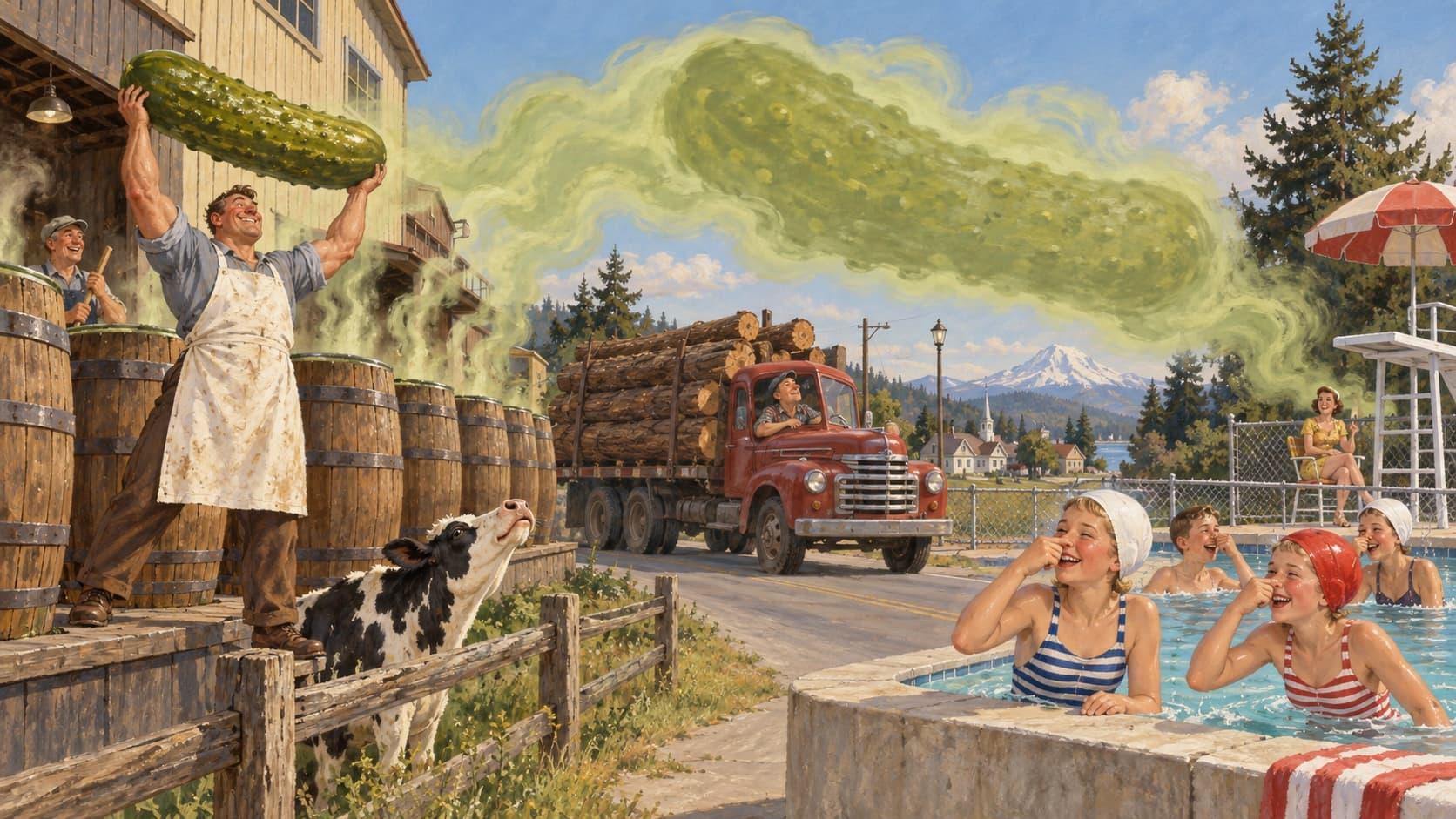
Two brothers started Farman's Pickles in an Enumclaw basement in 1944. King Pickle reached 13 states before the plant closed in 1988. The road kept the name.
Ask anyone who lived in Enumclaw before 1988 what the corner of Highway 410 and Farman Street smelled like, and they will tell you before you finish the question. Dill. Forty-four years of it.
The street sign says Farman Street. The town has never once called it that. It is Pickle Factory Road, and it will be Pickle Factory Road long after the last person who remembers the smell is gone, which is how a town keeps a company it lost.
The guard
Richard G. Farman, Dick to everyone, was born in 1916 in Belmond, a small town that one account places in Iowa and another in Nebraska, and grew up in Kent. He went to Washington State, played on the line for the Cougars in the late 1930s, and in his senior season of 1938 was on the field for 589 of a possible 600 minutes, a statistic that only gets recorded about people who never come off.
The Washington Redskins drafted him in 1939. He played six professional seasons and won a championship in 1942. Then, in 1944, he hung up the helmet and went to Enumclaw to grow cucumbers.
The basement
Dick and his brother Fred started with a ten-acre cucumber patch in Enumclaw and a pickling operation in Fred's basement. The early fermenting was done in 200 wooden barrels of brine. In 1948 they hired a mechanic, Don Grover, to build them processing equipment, including a sorting machine that picked cucumbers by size, and the operation stopped being a basement.
Early production was 65 tons of pickles a year. The brand was King Pickle, and it reached 13 Western states, a footprint HistoryLink records as still intact in 2001 under the later owners. The Farman Brothers Pickle Company sold 14 varieties of pickles, relish and sauerkraut from a plant at the intersection of 410 and Farman Street, kitty-corner from Pete's Pool and the log field house.
That is the detail worth holding for a second. Louise Poppleton, remembering the pool in her town history, listed three sensations: the glacial water, the roar of the logging trucks, and the smell of fresh pickles. A generation of Enumclaw children learned to swim inside the cloud from Fred Farman's barrels.
The other pickle factory
Enumclaw, by the historical society's count, has been home to three pickle companies, and for a stretch of the twentieth century two of them ran at once.
The Jokumsen family started Naches, later Osceola, Pickles in 1929 and ran it for 48 years, by the Enumclaw Plateau Historical Society's reckoning. A plateau of dairy farms with a lumber mill at its center somehow supported two brining operations for decades, which tells you something about how many cucumbers a place with this much rain and this much flat ground can grow, and something about how much the Pacific Northwest of the mid century wanted them in a jar.
The sale
In July 1987 Curtis-Burns Foods of Rochester, New York, which owned Nalley's Fine Foods of Tacoma, acquired Farman Brothers. Nobody in Enumclaw needed to be told what happens next when a company from Rochester buys a company from Enumclaw through a company from Tacoma.
In March 1988 the Enumclaw plant shut down. The Seattle Times counted the cost: 44 regular and 200 seasonal workers out of work, and a headline that read like an obituary, Enumclaw Pickle Plant to Close after 44 Years. Production moved to Tacoma. The dill went with it.
The rest of the life
Fred Farman had died in 1981, at 67, after serving eight years as mayor of Enumclaw, by the account Voice of the Valley gives. Dick lived another fourteen years after the plant closed. He was inducted into Washington State University's athletic hall of fame in 1990. He served in the West Seattle Kiwanis, volunteered at the YMCA, belonged to Seaview United Methodist Church, and was married to Harriet for 61 years. He died in Seattle on May 5, 2002, of heart failure, at 85.
HistoryLink posted an essay on him three days after he died. The Seattle Times ran his obituary the day after that and called him the Pickle King. Enumclaw kept calling the street what it wanted to. That is a better memorial than a plaque, because nobody voted on it.
What is at the corner now
The intersection of 410 and Farman Street is still a busy one, still across from the field house and the stadium that carries Pete Chorak's name. This summer it acquired a new fixture: the police department's license plate readers, four of them on 410 at Semanski and at Farman under the department's plan, part of the eight-camera system the council approved last year and was counting results from by September.
So the corner where the town once smelled of dill is now the corner where the town is photographed coming and going. Progress has a way of swapping one kind of record for another.
What survives
The photograph of Pat Berens and Laurie Hobert taking a break from packing pickles, which ran with the 1988 closing story, survives in the collection of an Issaquah historian, JoAnne Matsumura, who supplied it to Voice of the Valley. The Washington Rural Heritage digital collection has the Farman's Pickles sign. The name itself survives too: the historical society's page says Farman's now belongs to Treehouse Foods and the pickles come from India, among other places. And if you want the name to survive another generation, give the directions the old way. Past the dump, past the pickle factory, past Pete's pool.
Story label: Original Story or Guide
Originally published: