

Feature
Federation Forest is the second old-growth forest Washington's clubwomen saved. The highway took the first one.
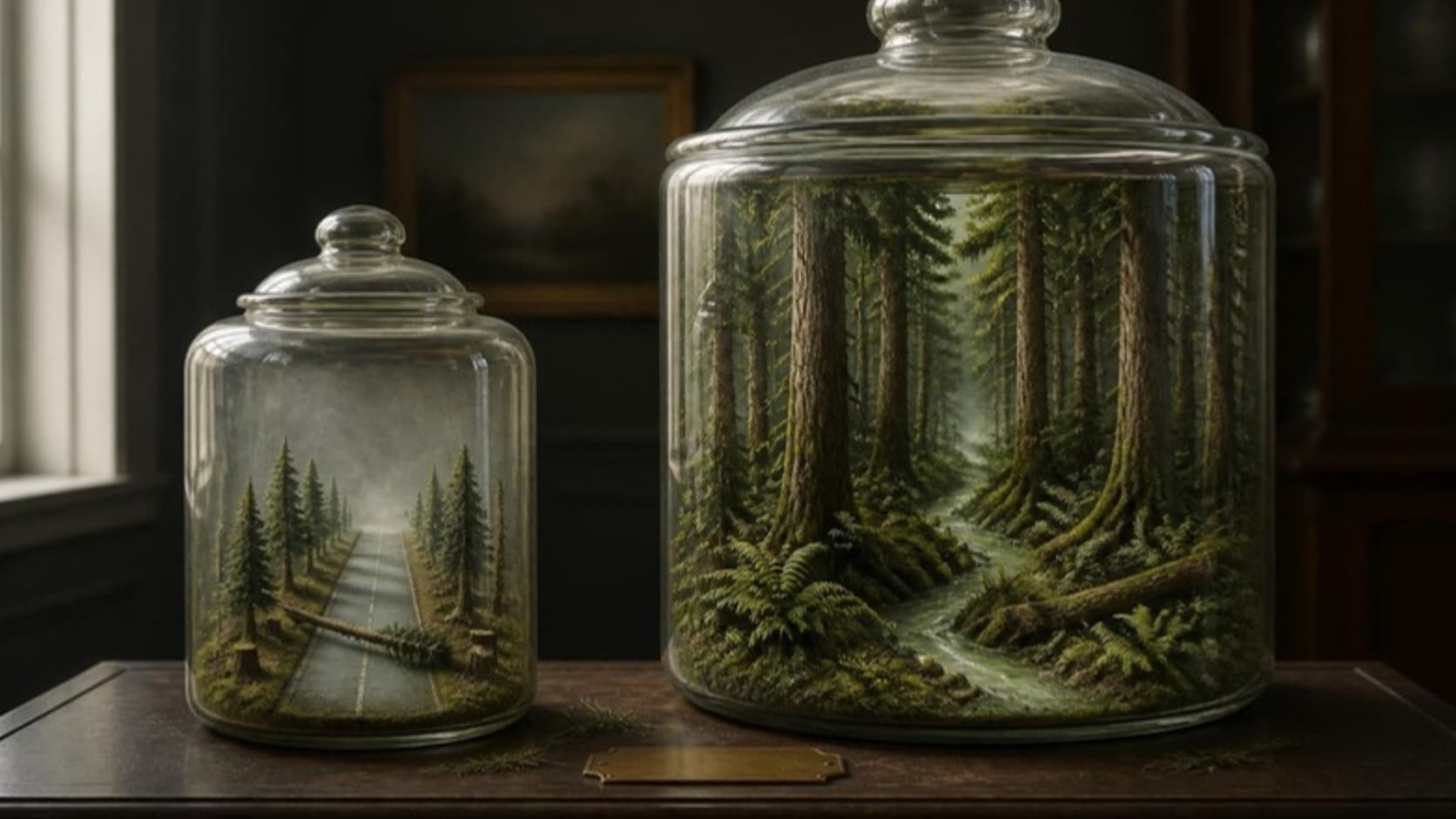
Federation Forest on SR 410 is the second old-growth forest Washington's women's clubs saved. The first, by Snoqualmie Pass, lost to the highway.
About seventeen miles east of Enumclaw on SR 410, at milepost 41, the road runs for a stretch between trees that are too big to take in from a car. Douglas firs 200 to 300 feet tall, 300 to 400 years old or more, by Washington State Parks' count, with western hemlock, western red cedar and Sitka spruce among them. The sign says Federation Forest State Park. To drivers headed for Crystal Mountain or Chinook Pass, the name explains nothing.
The Federation is the Washington State Federation of Women's Clubs, and the forest carries their name because their money started it and their lobbying finished it. What the sign does not say is that this is their second forest. The first one is gone, and the highway it was bought to line had a great deal to do with that.
The Tree Lady
The idea belonged to Jeanne Caithness Greenlees, a teacher at Everett High School. She gave up the job when she married in 1925, which State Parks notes was "customary (and often mandatory) at the time," and put her energy into the clubs instead. She took the idea to Esther Maltby, the federation's president: buy a stand of old growth beside a highway, so that people who would never hike into one could still see what the state had looked like before the saws.
The minutes of an 1898 meeting record one of the federation's founders pleading "for the preservation of forests because they purify the air and water, modify climate, prevent freshets and keep up supplies for springs." In 1926 Greenlees, now chair of the Forestry Committee and known as the Tree Lady, launched the Save a Tree campaign with Maltby.
The price list was simple. A dollar bought a Save a Tree button. A hundred dollars bought a tree, marked with an engraved metal plaque. The first check, for $500, came from Stephen T. Mather, director of the National Park Service. More than 70 clubs gave $100 or more, from small-town book clubs to the Federation of Washington Colored Women's Organizations, founded in Spokane in 1917. Bon Marche and Frederick & Nelson gave. So did Mrs. John P. Weyerhaeuser, whose family's company, as it happened, owned the trees.
The first forest
Within two years the women had $25,000, enough to exercise an option on about 62 acres of old growth owned by the Snoqualmie Lumber Company, a Weyerhaeuser subsidiary. The grove stood on the route of the Sunset Highway, then being built over Snoqualmie Pass to tie the two halves of the state together. Knute Berger, writing for Cascade PBS, quotes the Seattle Times headline: "Forest Giants Will be Saved for Posterity."
When the check was handed over, the Weyerhaeuser manager George Long told the women, in a remark State Parks allows may have been a joke, that "the option would never have been granted had the firm believed that the women could carry out the terms." Long had in fact given generously to the campaign himself. Charles L. Pack, another donor, was more gracious: "Hats off to the clubwomen of Washington. They finish what they begin."
The land went to the State Parks Committee in 1928. Once the highway was finished, the park, called Big Tree State Park or Women's Federated State Park depending on who was talking, was dedicated on June 12, 1934.
Posterity lasted four years.
How the highway won
The trouble started at the edges. Logging on the park's west boundary threw a slash burn that ran into the park and burned its trees. A logging contractor strayed over the line and cut 22 trees, many of them, State Parks says, more than 1,000 years old. And the Washington Highway Department, worried that the giants beside the new road might fall onto it, decided they were a hazard to motorists and ordered many of them removed or topped.
The women had bought a forest beside a highway so that motorists could see it. The highway department was now ordering it cut back so that motorists would not be hit by it.
The end came on December 2, 1938, when a windstorm toppled 19 park trees, some of them onto the road. The Highway Department ordered every tree cleared for 200 feet on either side of the pavement. The State Parks Committee and the federation agreed to close the park and use a reversionary clause in the original deed to get the purchase price back. Senate Bill 371, signed by Governor Clarence D. Martin on March 29, 1939, authorized selling or trading away the park "for the purpose of preventing the timber in Big Tree State Park from being further damaged and a continued menace to public safety." That October, the $25,000 went into an account set aside for one purpose: buying a replacement.
As for the first forest, State Parks is blunt. "Today, the site of the original park is largely occupied by the Exit 45 interchange on Interstate 90. None of the old growth trees remain."
Why the White River
The replacement came from a route conservationists had been watching for twenty years. As early as 1921, the Natural Parks Association of Washington had been lobbying the state to save the old forest along the Naches Trail, the ancient route over the Cascades, whose western approach up the White River was being turned into another cross-state highway, the one that now runs past the park.
In January 1941 the State Parks Committee bought 222 acres straddling the old trail from the White River Lumber Company, which was, like the Snoqualmie Lumber Company, a Weyerhaeuser subsidiary. The same timber empire had now sold old growth to the women's cause twice. The committee exercised its option on the timber in 1942.
This time everyone had learned something. According to State Parks, the federation and the Parks Committee understood that the park "needed to be large enough to be resilient to logging activity on adjoining lands or natural disasters such as fire or windstorms." So they went back to Olympia. In March 1943 Governor Arthur B. Langlie signed House Bill 309, which put $125,000 of unused state park gas-tax money toward an adjoining 294 acres of old growth. The purchase closed in May 1944. The Women's Federated Forest State Park was dedicated on July 16, 1949, and the name was shortened to Federation Forest State Park in 1974.
The storm that proved it
The proof arrived on Christmas Day 1983, in the middle of a subzero cold snap, when a storm with winds State Parks puts at up to 110 miles an hour hit the White River country. An ancient Douglas fir fell on the park manager's residence and crushed it. More than 400 old-growth trees went down inside the park.
And the forest held. Foresters surveying the damage found that the closed canopy was intact throughout the park. Thirty-acre Mahler State Park, nearby, had no such margin: it lost 920 trees in the same storm, was left unusable, and was dropped from the state park system in 1994. It was the Snoqualmie Pass lesson again, except that this time the answer had already been bought.
The schoolteacher and the interpretive center
The building at the heart of the park is named for another clubwoman. Catherine T. Montgomery joined the founding faculty of the New Whatcom Normal School, now Western Washington University, in 1899, and in 1926 suggested to the mountaineer Joseph Hazard a trail from Canada to Mexico along the crest of the western mountains. That idea became the Pacific Crest Trail, which today passes Naches Pass about 14 miles east of the park.
In 1951 Montgomery gave two acres next to the park to be the Ella Higginson Grove, after her friend the poet. She died in 1957 at 90 and left $89,000 to the federation for natural history education at Federation Forest. The Catherine Montgomery Interpretive Center was dedicated on September 20, 1964, according to the State Parks history page and the Kirkland Woman's Club. In 2018 the Muckleshoot Tribe added two carved cedar house posts, made by apprentice carvers Keith Stevenson and Tyson Simmons from a tree that had fallen in the park.
The Naches Trail still runs through the woods here, about a mile of it, wet most of the year. The park brochure points out the "broadax-hewn logs and springboard notches from early logging operations" along the paths. The emigrant wagons of 1853 are a story this site has told on its own, in the piece on the Naches Pass wagon road.
If you go
Go soon, or wait until May. State Parks gives two closing dates: the park's own page lists it as closed for the winter from October 1 through April 30, while the agency's 2026 winter schedule says day use ends October 15 and resumes May 1, weather permitting. Call the park at (253) 735-8839 before you drive up. In season it is open 8 a.m. to dusk, day use only, at 49201 Highway 410 E, and a Discover Pass is required. An alert posted June 22 and still up on the park's page says the trail from the parking lot down to the riverside picnic area is completely closed because of storm damage, so check before you plan a picnic by the water.
Look for the plaque in the upper picnic area with the donors' names on it. The trees those names paid for stood near Snoqualmie Pass, where the freeway is now. The forest around the plaque is what their refund, and their lobbying, bought instead.
Story label: Original Story or Guide
Originally published: