

Feature
Ravensdale's model train show runs in the burlesque theater from the 1962 World's Fair. Its grand opening came 26 years after Gracie Hansen dedicated it.
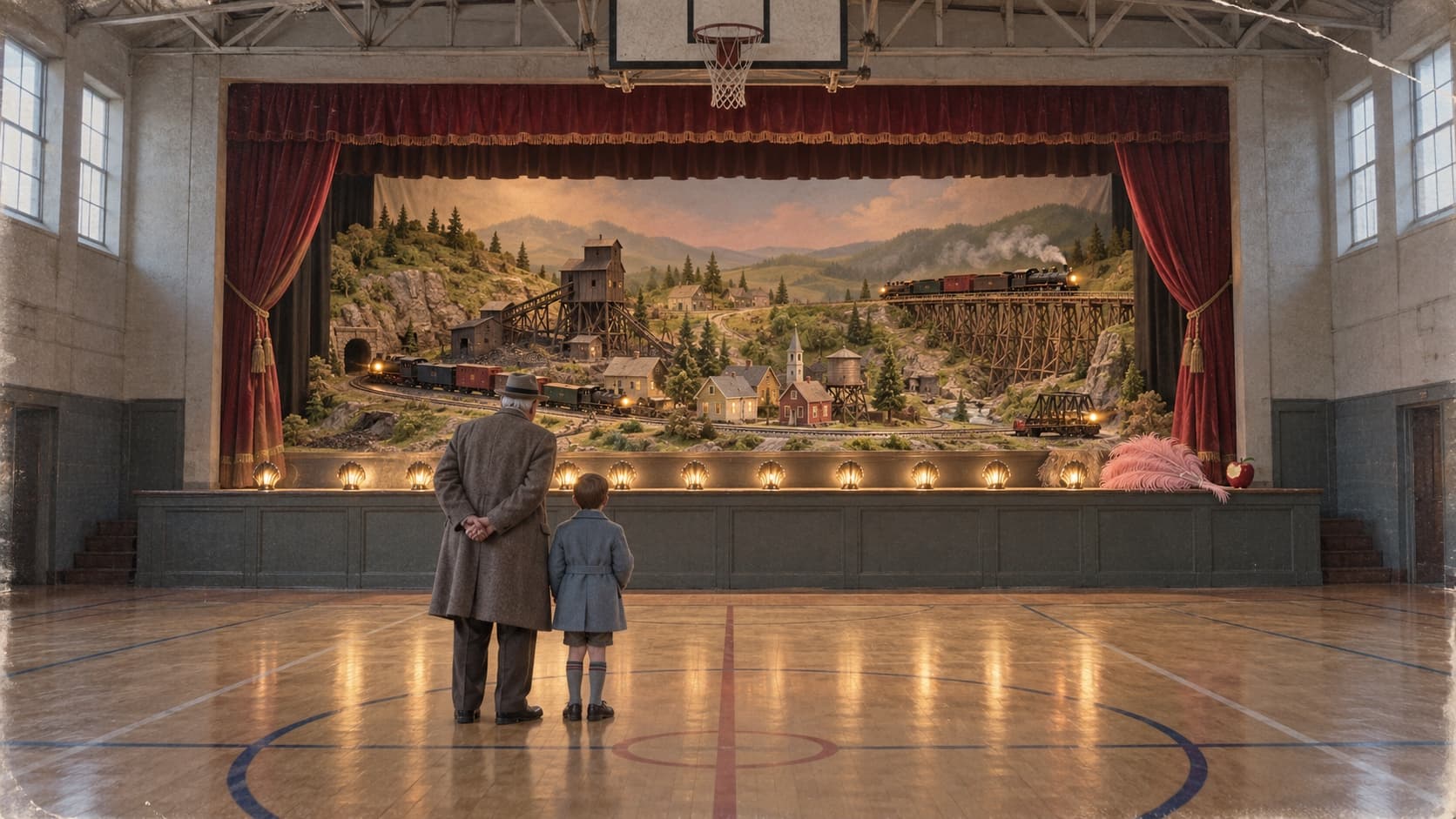
The Maple Valley Model Train Show, October 17 and 18, fills a Ravensdale gym that was Gracie Hansen's burlesque theater at the 1962 Seattle World's Fair.
The gymnasium at 27132 SE Ravensdale Way fills with model railroads every year on the third weekend of October. Clubs from around the Pacific Northwest set up working layouts in most of the common scales, somebody builds a city out of Lego, and the Black Diamond museum brings a display on the coal and timber that made this corner of King County. This year the Maple Valley Model Train Show runs October 17 and 18.
The gym is a two-story box of precast concrete, 100 feet long or 110 depending on which newspaper measured it. In 1962 it stood on the grounds of the Seattle World's Fair, seated 700 for dinner, and was called the Paradise International. Gracie Hansen ran four shows a night in it, with some of the showgirls, as she put it, "nude from the waist up."
King County had it taken apart and trucked to Ravensdale, where Hansen herself dedicated it on July 4, 1963. The Seattle Times reported the next day that the building "will be ready for use later in the summer." The grand opening was set for Saturday, September 16, 1989.
Saving the fair from science
Hansen was not a showgirl and, by her own account, not much of a singer. Peter Blecha's biography for HistoryLink has her born Gracie Diana in Louisiana in 1922 and raised in Longview and Centralia. She eloped with a logger and moved to Morton. There, in 1953, she started the Morton Follies, a two-hour variety show for the PTA. It was credited as "Written, Borrowed, Stolen, Directed, and Produced by Gracie Hansen."
The Follies grew racier, and the 1959 edition was the last. Seattle magazine, as Blecha quotes it, said church groups shut the show down after a logger dressed as Queen for a Day lifted his skirt to reveal his boots and nothing else. Hansen, by then divorced, sick and broke, drove her old Buick to Seattle and told the people planning the fair that she wanted to put on a show. "I decided that my mission must be to save the fair from Science," she told KVOS-TV in 1962. They were amused, and told her not to call.
She moved to the city, took a job at a savings and loan, and spent her lunch hours calling on people with money. Her theory, as she put it: "Science will never replace sex or cotton candy." Her boss, Robert Chinn, spent an hour and a half on the telephone and found 18 friends willing to put in $5,000 apiece. In November 1961 she handed the fair a check for $90,000.
Four shows a night
The Paradise International opened with the fair on April 21, 1962, on Show Street, the fair's adult entertainment corner. Its neon sign was an apple with a bite out of it. The burlesque showman Barry Ashton staged the revue, "A Night In Paradise." Hansen opened each show by greeting the house with "Hi-ya, Suckers!" and then sang, loudly.
Seattle's censor board let it stand. "It's not thrust upon you," Hansen explained. "In fact, sometimes you have to look for them in there." A Catholic parish in Lake City wrote to complain of "Pagan displays," and when the fair's performing arts director proposed father-and-son nights at the Paradise, Governor Albert Rosellini declared himself shocked. His office said it had received 1,200 letters.
The reviews were better than the mail. HistoryLink's account of Show Street calls the Paradise its "largest, most polished, least dodgy adult venue" and says the revue was well received. The money was thinner. Hansen had told reporters, "We may go broke, but we'll never be flat-busted." Blecha writes that the club paid off its debts, the investors never saw a profit, and Hansen left with an empty savings account.
On May 19 the fair counted its millionth visitor: Mrs. Evalyn Van Vliet, 28, of Ravensdale. The Seattle Daily Times listed her prizes, among them a week of Monorail rides, a portable television and a meal at the Paradise International. A little over a year later the restaurant followed her home.
Slab by slab to a coal town
Ravensdale sits about 12 miles north of Enumclaw, past Black Diamond, at the far edge of this site's range. It belongs with the towns in the pieces here on Black Diamond, Franklin and Selleck, places a company built and then left. A Northern Pacific subsidiary, the Northwestern Improvement Company, owned the mine and the town, which incorporated in 1913 with a thousand or more people.
On November 16, 1915, an explosion in the mine killed 31 men, and the mine never reopened. The company carted many of its buildings off to Roslyn, the population fell below 200 by the Seattle Times's later count, and sometime in the 1920s the town let its incorporation lapse.
That was the place King County sent Gracie Hansen's theater after the fair closed on October 21, 1962. A county parks planner told the Times in 1989 that the county had been given three fair buildings and that the other two were at its fairgrounds in Enumclaw, now the Expo Center. The Expo Center says three of its own main buildings came from the fair, which is one more than the planner's count leaves room for. Whether the county paid for the Paradise is not clear. The Times of 1963 said it was "bought by the county." Later accounts say donated, deeded or sold. Enumclaw's own paper had the terms that spring. The Courier-Herald of April 18, 1963 reported a 35-year lease, signed at the Tahoma school board's meeting on April 8, that called for the building to be installed within six months. The move and installation were to be paid for with about $30,000 that the King County Park Board had already allocated for a Ravensdale field house.
Ravensdale had a park with ballfields and no major building, and by the Covington Reporter's account the Ravensdale Community Club did "much prodding." The move was the easy part: the precast walls came apart in sections and went by truck. On July 4, 1963, after a parade, Hansen flew in from an engagement at Ocean Shores in a pink dress and a matching hat, was met by Miss Ravensdale, and dedicated the building at the ballpark as a county "activity center." "But you'll never be able to replace the sex and cotton candy," she complained.
Later in the summer
Whether it was ready that summer, the record read for this piece does not say. For a while the building served as a field house, and a Ravensdale man later told the Times the county used to pay him to unlock it for basketball and volleyball. After a six-month lease to an athletic association in 1976, it sat. A county capital budget from 1979 set aside $27,500 for "initial renovation of the Ravensdale Community Building, commonly called the Gracie Hansen Building," all of it for the roof.
In 1982 the county allocated block grant money for a renovation in three phases and held a ribbon cutting that December. Phase one was done by October 1983, and the youth board formed to run the place gave a dinner. Hansen came and promised to return for the grand opening and "put on one heck of a show." The opening was penciled in for the fall of 1984. She died in Los Angeles on January 9, 1985.
By the Times's account the first contractor went bankrupt and a dispute arose over who owned the land; the Voice of the Valley said the dispute took nearly two years to resolve. In 1985 the health department condemned Ravensdale's water system, and the county took about $65,000 of the building's grant money to fix it; more went to a sprinkler system for the community center in Maple Valley. The youth board quit in 1986. Vandals took the copper plumbing.
In March 1988 the Times found the building "as desolate as an abandoned farmhouse," unused for a decade, with more than $1 million spent once the move was counted. "It was a comedy of oddball things," said Linda McMonagle, the youth board's former president. HistoryLink's biography says the Paradise "was put to immediate use" in Ravensdale. The newspapers of the 1980s describe a building locked up for most of the twenty years before 1988, and the Times of 1989 wrote that plans to use it stalled.
The ribbon cutting for good was set for Saturday, September 16, 1989, with punch, cookies, bluegrass and a free-throw contest on the program. A county recreation manager called the gym, with its new maple floor, the largest in any county community center. "It's the stuff nightmares are made of," Robin Cole, a county parks project administrator, said of the retrofit. The site had been an elementary school, and workers had dug up yards of clinkers and ash, which Cole guessed came from the school's coal furnace.
What the building does now
The center is part of King County Parks' Ravensdale Park. Since November 2007 a nonprofit called Rock Creek Sports has run an indoor baseball and fastpitch training center inside it. Around the park runs the Ravensdale History Trail, 15 signs put up in 2015 for the centennial of the explosion, one of them bearing the faces and names of the miners.
For one weekend each October the trains get the floor. The sponsor is the Greater Maple Valley Unincorporated Area Council, a nonprofit established in 1977 that serves unincorporated King County residents of the Tahoma School District. It has put on the show for more than a quarter century, and it says the 2019 edition drew more than 780 people. Visitors may bring a train of their own, which the clubs will run if the track fits.
If you go
The Maple Valley Model Train Show is Saturday, October 17, 10 a.m. to 5 p.m., and Sunday, October 18, 10 a.m. to 4 p.m., at the Gracie Hansen Community Center, 27132 SE Ravensdale Way, Ravensdale. Parking is free. The suggested donation is $5 for adults and $2 for children 3 to 11, and the council takes no cards, so bring cash. Food trucks are planned for both days.
Confirm at gmvuac.org/train-show before driving up. One sentence of the council's 2026 information sheet still carries last year's dates, October 18 and 19, and the Black Diamond museum's calendar lists the show from 8 a.m.; the organizer's web page, updated September 17, gives the dates and hours above.
From Enumclaw, take SR 169 north through Black Diamond and turn right on the Black Diamond-Ravensdale Road. Leave time for the history trail.
Story label: Original Story or Guide
Originally published: