

Feature
Black Diamond's John Henry mine won federal approval to dig coal again in 2018. It never did, and the approved plan turns its main pit into a lake.
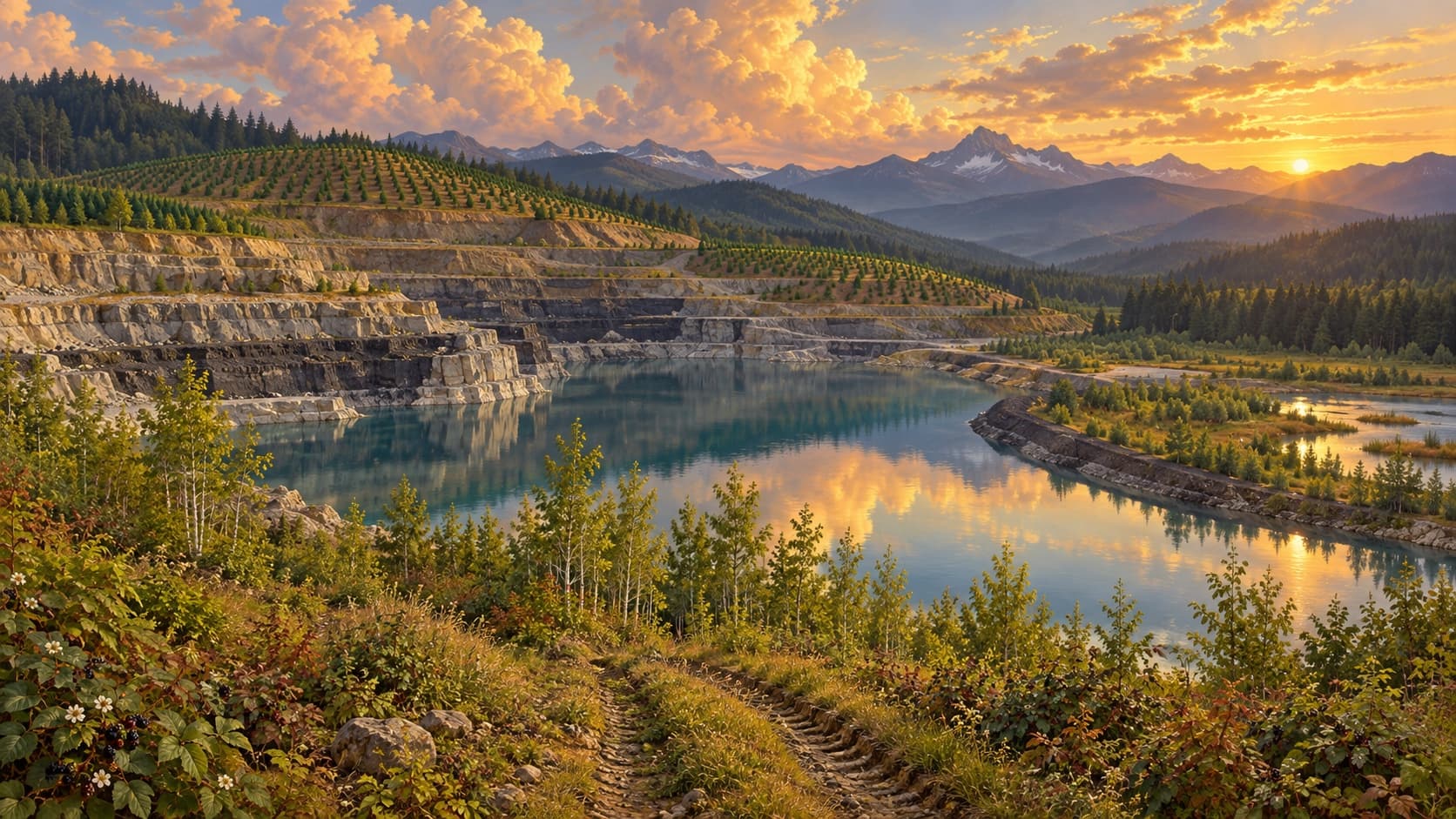
Black Diamond's John Henry coal mine won federal approval to reopen in 2018 and never mined again. The permit, the 2021 court decree and the lake in the plan.
A certified letter dated April 18, 2018, went from a federal office in Denver to Post Office Box 450, Black Diamond. It told the general manager of the Pacific Coast Coal Company that the Office of Surface Mining Reclamation and Enforcement had approved a significant revision of Federal Permit WA-0007E. The enclosed findings spelled out the meaning: the company could take an estimated 462,000 tons of processed coal, over six years, out of the John Henry No. 1 mine, an open pit on the outskirts of a town named for the stuff.
Coal mining had been approved in King County, 25 miles southeast of Seattle, in 2018.
None was mined. By every record found for this piece, the John Henry has not produced coal since 1999. The approval lapsed, the company agreed in a federal court decree not to mine there again, and the future that regulators approved for the main pit, back in 2001, is a lake.
The pit on the edge of town
This site's piece on how Black Diamond got its name told the start of the coal story. This is the end of it. The federal permit was issued on June 12, 1986, and mining began that month, according to the regulator's 2017 environmental assessment. The operator was a new Pacific Coast Coal Company, which had nothing in common with the historic company but the name, as Bill Kombol, then manager of the Palmer Coking Coal Company and since retired, wrote in the historical society's newsletter in 2020. It leased the ground from Palmer, a 1997 Daily Journal of Commerce story says, and in 1995 the Valley Daily News called it a joint venture with a U.S. subsidiary of Mitsubishi Materials. By 2020, a court filing shows, a corporation named Pacific Coast Coal Company, Inc. held 98 percent of it.
Kombol's Voice of the Valley column gives the name two sources: John Henry Morris, who founded Palmer Coking Coal in 1933, and John Henry, a Black Diamond miner killed in 1951 in a fall at the New Landsburg mine.
The mine worked six seams from two pits on 480 acres. The Valley Daily News put the hole at up to 300 feet deep in 1995, when the coal went by truck to lime and cement makers in Seattle and Tacoma and by rail from Ravensdale to British Columbia, bound for power plants in South Korea. The federal assessment says 75 people worked there in 1993, its peak, and counts 3,047,000 short tons mined in all. Kombol puts production at 1.87 million, a gap about the size of the rock and waste the mine's wash plant took out of the raw coal, to judge by yearly figures the Voice of the Valley printed in 2010. Those put the peak a year earlier than the federal assessment does, at 463,000 raw tons in 1992, and the low at 6,000 in 1999. In between, in January 1997, came a landslide that Kombol says buried coal and crippled the mine.
Last, with an asterisk
The John Henry was not the last mine to dig coal in Washington. The state had one other surface coal mine, TransAlta's at Centralia, and it kept digging until the company announced on November 27, 2006 that it would stop at once. The Seattle Times that week called Centralia "Washington's only coal mine." The John Henry had dug its last ton seven years before.
A narrower claim holds. A federal program page captured in January 2021 lists two permitted coal mines in Washington, this one and Centralia, neither producing. In 2018 only one of them was asking to dig: the state geologist, in an email that August, put the state's count of coal mines at one proposed or none. The John Henry's approval is the most recent federal go-ahead to mine coal in Washington that this site could find. It came from Denver because Washington never submitted a coal program of its own; the federal office regulates directly.
Ten years is not temporary
After 1999 the mine sat. The company told regulators in 2001 and again in 2006 that it was looking for buyers, the Voice of the Valley reported. In April 2009 the federal office ordered it to show a coal contract or start filling the pits.
The company appealed and lost. An Interior Department judge, Robert G. Holt, found that it "has not mined coal for ten years and has shown no present ability to resume mining or to sell coal," as High Country News quoted the ruling in 2019. David Morris, then the company's general manager, told the magazine the regulations were not clear on how long a mine may idle. An enforcement order, called a cessation order, followed on May 24, 2010, and crews pushed 572,000 cubic yards of spoil, the rock and dirt dug out to reach the coal, back into the pits that winter.
In April 2011 the company applied to mine again. Coal prices had recovered and it had a contract with a cement maker in British Columbia. The review took seven years.
Cleared to dig
A first environmental assessment in 2014 drew more than 2,300 public comments. The revised one, in 2017, came with a finding of no significant impact. The approval allowed up to 84,000 tons a year for about six years, mostly from Pit 2, with 30 jobs and some 60 percent of the coal bound for the Lehigh cement plant in Delta, British Columbia.
Dow Constantine, then the King County executive, opposed it. So did the Black Diamond City Council, by resolution in December 2017, and Puget Soundkeeper, whose analyst told an area council meeting in August 2018 that the mine had a long record of water violations. The county's worry was phosphorus, which feeds algae in Lake Sawyer downstream. Morris told the same meeting, by the council's account, that its phosphorus discharges were within limits. "It's a good asset," he had told the Seattle Weekly that spring.
The approval had a clock on it. The Department of Ecology says the company got about 18 months to restart, and the Seattle Weekly reported that it still needed an updated state water permit and a permit from the Army Corps of Engineers. It also needed a customer. On April 19, 2019, a company letter to the federal office, quoted in a later letter from Constantine, said it no longer had one: "Lehigh no longer requires our coal and we no longer have the required contract." Two days earlier, by Ecology's account, the company had told the regulator it was proceeding with reclamation, the filling, grading and replanting a mine owes its ground when the digging is over. Morris blamed federal regulators for not letting the mine reopen, High Country News reported; the magazine's reading was that the coal had no market.
That August the company asked to renew its permit. By the county's description its revised plan showed three years of reclamation only, but put off filling Pit 2 until late 2020, which the county said kept a future mining option open. Constantine wrote on November 12 that "full and complete reclamation is long overdue" and urged the agency to allow cleanup only. What the agency decided, this site did not find. Ecology's inspection reports of 2021 and 2023 say the mining authorization has expired.
The decree
On February 26, 2020, Puget Soundkeeper Alliance sued Pacific Coast Coal Company in U.S. District Court in Seattle, case 2:20-cv-00306, a citizen suit, the kind of action Section 505 of the Clean Water Act lets private groups bring to enforce it. It alleged the mine had been sending stormwater and pit water to Ginder Lake, Mud Lake Creek and a Lake 12 tributary without a valid permit since its 2008 state permit ran out in January 2013, or else in breach of that permit's limits on phosphorus and copper. Ecology, the complaint itself notes, held that the old permit remained in force.
There was no trial. The two sides filed a settlement on July 1, 2021, and Judge John C. Coughenour entered it as a consent decree on September 2. It admits nothing. It required $5,000 to the Mid Sound Fisheries Enhancement Group for water quality work in the Soos Creek basin and $60,000 toward Soundkeeper's legal costs. And it contains the sentence that matters: "PCCC agrees not to recommence coal mining at its Facility," a promise written to survive the decree, whose five-year term ran out last month at the latest.
The decree did not cancel a mining permit; by Ecology's account there was no live approval left to cancel. It made the ending enforceable. "Even closed mines must follow the law," Sean Dixon, Soundkeeper's executive director, said in the group's announcement. The decree records no admission by the company, and no statement from it turned up.
A lake by design
The lake owes nothing to the lawsuit. The federal assessment says it was approved in 2001: Pit 1 partly backfilled and left to fill with groundwater and rain, Pit 2 filled completely, the uplands replanted as forest and the water left to fish and wildlife. The 2018 mining plan ended in the same lake.
In April 2021 a federal inspector found Pit 1 overflowing into the Mud Lake wetland, according to a state report. After a neighbor complained in December 2022, state inspectors found a new dike about 20 feet high between the two. Their photograph, taken January 12, 2023, shows pale gray-green water under an overcast sky, a rim of dark fill, bare alder and a line of fir. The company's site map, attached to the report with no legible date, hatches the pit as water and marks the maximum level of the "Current Pit 1 Lake." The inspectors required no corrections.
As of October 1, 2026, Ecology's permit database shows the 2008 water permit still in force in extended status, the renewal applied for in 2018 still a draft, and one phosphorus reading in May a hair over the limit, 83 micrograms per liter against 82. Ecology has said it will require the permit until the mine is fully reclaimed. Whether any of the reclamation bond has been released, whether the lake has reached its final level, and what is planned for the ground afterward, the records found here do not say. What is being built on the coal lands nearby is the subject of this site's field guide to Ten Trails.
From the road
The site is private, and the federal assessment is plain about its future: "The approved post-mining land use does not include recreational uses." The company's map marks a gate on the entrance road and puts the lake just inside the permit line along SE Green River Gorge Road, a public road; how much shows through the trees, this site could not confirm from the desk, and nothing here is a reason to cross a fence.
The Black Diamond Historical Society's museum, at 32627 Railroad Avenue, is free and keeps the rest of the story, though not on a Friday: it opens Thursdays from 9 a.m. to 2 p.m. and weekends from 11 a.m. to 3 p.m. The last ton came out of the John Henry in 1999. The reports are still coming in.
Story label: Original Story or Guide
Originally published: