

Feature
Lulu Kombol went back to teaching after a 1925 mine blast blinded her husband, and by her own count 36 of her 44 years in the classroom came after it.
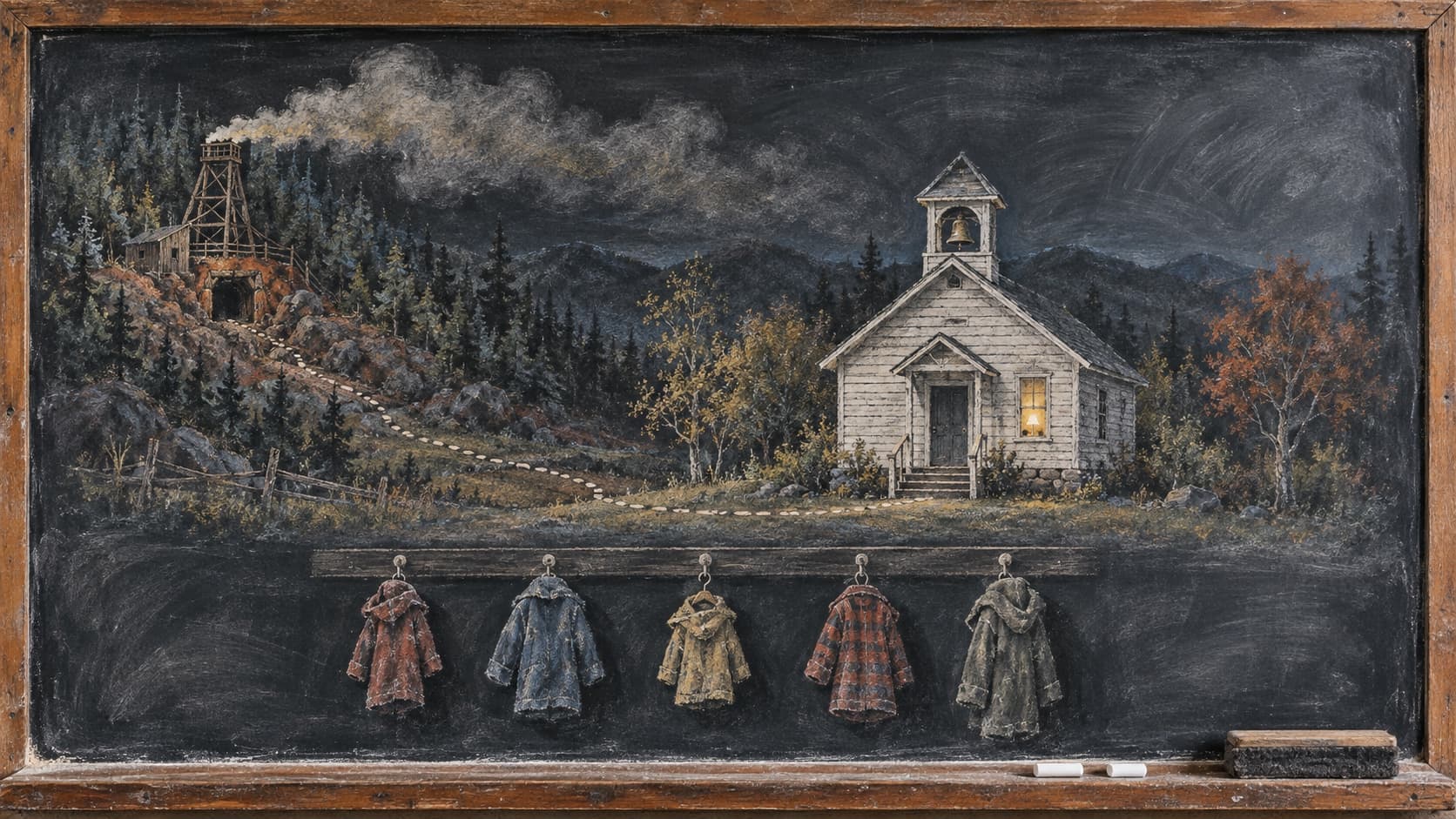
A 1925 mine blast blinded Tony Kombol. His wife, Lulu, went back to teaching at Cumberland, then Selleck, and was still in the classroom at 76.
The Seattle Daily Times of Saturday, May 19, 1962, announced a reception for the next afternoon at the Selleck School, about 15 miles northeast of Enumclaw, where three generations of former pupils were expected. The guest of honor was Mrs. Lulu S. Kombol, who taught the first and second grades and was, the paper said, "nearing the end of 44 years as a teacher." The Parent-Teachers' Club had voted to start a scholarship fund in her name. "She's the most dedicated teacher I've known," said the principal, Alex McDougall.
Well down the column the reporter, Rill Schear, spent one sentence on why any of it had happened: "Her husband, Antone, was disabled in a mining accident while the children were young."
Her working life turned on that accident. Lulu Kombol had been out of the classroom for years when a blast in a Kangley coal mine blinded her husband in 1925. She went back the next year, at 41, and by her count 36 of the 44 years came afterward.
Nearly everything known about her comes from her family. Her memoir is dated April 1975, when she was 89 (her grandson dates it to her 89th birthday, in August 1974), and HistoryLink published it in 2011 in a version expanded by her grandson Bill Kombol, with a note that it does not verify such memoirs. He has since written the family's history at BillBored.org. This piece leans on both, and says where a public record or a newspaper of the day supports them and where the numbers disagree.
The six-month school at Ethel
She was born Lulu Mildred Shircliff in Walla Walla on August 27, 1885, by her account. Her parents' marriage was brief. Her mother remarried, and Lulu grew up first with a strict grandmother in Walla Walla and then, from about the sixth grade, on her stepfather's 350-acre farm on the Cowlitz River near Toledo. She finished at Chehalis High School in 1904.
A year later a county superintendent who had once been her country-school teacher gave her the teacher's examination and sent her to a one-room school at Ethel, on Cowlitz Prairie, for a six-month term in 1905 and 1906. It is the only classroom of her own that her memoir describes closely: a pot-bellied stove, a tin pail and dipper that everyone drank from, and older pupils who drew the water, split the kindling and swept the floor. She was small and a year out of high school, and some of her pupils were large. When the superintendent visited, she asked what she was to do with them. "Just throw them out the window, Lulu," he answered, joking. They never gave her trouble. "And, no one sassed the teacher in those days!" she wrote.
On money her stepfather had left her, she spent a year at the normal school in Bellingham, a college for training teachers, and a year teaching fourth grade in Centralia, and decided the pay would not do.
Ravensdale, where the pay was tops
"I landed in the hinterlands in Ravensdale where the pay was tops," she wrote of 1908.
Tony Kombol arrived about the same time. Born in January 1885 in Fuzine, in what is now Croatia, he had come through Ellis Island at 17 to the coal mines at Roslyn, by his grandson's account. The two married on August 4, 1914; King County's marriage records carry the entry for Tony Kombol and Lulu Shircliffe. He built her a bungalow. "We thought we were established," she wrote, "but we were privileged to live in it for little more than one year."
On November 16, 1915, the Ravensdale mine exploded and killed 31 men, a disaster this site has so far touched on only in its piece on the Gracie Hansen Community Center. The mine never reopened. Lulu wrote that Tony had worked that shift until the day before. His grandson writes that he was one of a hundred men sent home that morning when a blown fuse stopped the hoist.
It would be tidy to say the explosion also ended her teaching, and the family has told it that way. In 2023 her grandson wrote that she quit after the disaster. In 2025 he wrote that she had quit when she married, as young schoolteachers of the day customarily did, twelve years before her next classroom. Her memoir does not give the date she stopped, and nothing this site found settles which account is right. What the explosion certainly took was the town, Tony's job and the house.
A company house at Hiawatha
Tony left that December for the copper mines at Ray, Arizona, and she shipped the furniture and followed. Their first child, Bernell, was born there in 1916. The second, Dana, was born in Billings, Montana, on March 12, 1918, as her 2012 obituary in the Enumclaw Courier-Herald also says. Then Tony went back underground for the Northern Pacific's coal company at its new Hiawatha mine, between Kangley and Kanaskat. Nola, Jack and Nadine followed. King County's school census lists Kombol children in District 74, Selleck, from 1921. The family's company house stayed theirs for half a century.
Hiawatha failed, and by his grandson's account Tony moved to the Parkin Kangley Coal Company's mine, less than a mile from home. Lulu was raising five children under ten.
The third shot
On August 7, 1925, Tony Kombol was blinded in that mine. The date, the company and a state claim number come from a Department of Labor and Industries letter his grandson found among Lulu's keepsakes. The accident report has not surfaced; the department refused his request for the file in 2024.
The account of what happened underground comes from one man. In 2008 Bill Kombol interviewed Leo Gregorich, a family friend then 96, who had the story from Tony. As Gregorich told it, Tony lit the fuses on three dynamite charges and withdrew. Miners in the next room were shooting at the same moment. He counted three reports, walked back to his working place, and was met by his last charge. Apparently, Gregorich said, one of the three reports he had heard came from the next room.
He spent 30 days in a hospital. Ten months later, by the family's papers, the state approved a pension of $40 a month for Tony and $35 for the children, with $3,955 for his eyes and part of his hearing. An operation some years on gave him back enough sight to read and do chores. He never worked for wages again.
Lulu held a credential she had not used in a decade. "I was able to do this," she wrote of going back, "as I had a life certificate granted by the state after nine years of experience." By her grandson's account she started at Cumberland on September 3, 1926, teaching third and fourth grades for $100 a month, which was more than the pension. Tony kept the house, the animals and the children.
Cumberland, then Selleck
Cumberland was School District No. 66, one of the small districts in this site's piece on the plateau's one-room schools, which also gives her a paragraph. She was there 17 years, she wrote, and then moved to Selleck, a mill town this site has also profiled, where the Times's counts in 1959 and 1962 both put her first year at 1943.
Her memoir is silent on those classrooms; the newspapers are not. In April 1953, after a DC-3 crashed on Cedar Mountain, the Times photographed her among the Selleck women who had turned the school into an emergency hospital. In 1957 the Seattle Post-Intelligencer pictured her with a former pupil, his daughter, also a former pupil, and the daughter's three children, then in her classes. She told its reporter that there was no juvenile delinquency, only the parental kind, in an age of "broken-homes, can-openers, liquor, and blood and thunder movies." In 1959 the Times found her the senior of four teachers, with 100 pupils and two grades to a room. In 1962, of a child who had not been well brought up, she told the Times: "If you're firm and just and let them know you have a fondness for them, they'll come along."
The arithmetic
"Anytime one of the Kombols told a story," her grandson wrote in 2025, "there was sure to be a dispute about the facts or the event." Her years in the classroom are a fair example.
Her memoir gives nine years at Ravensdale, 17 at Cumberland and 19 at Selleck, for a total of 44. Nine, 17 and 19 make 45, before Ethel and Centralia are counted. The Times of 1962 says 44 years, 19 of them at Selleck, and gives no figure for Cumberland. The Times of 1959 calls it her 40th year and her 16th at Selleck, with 13 at Cumberland. The Post-Intelligencer's headline says 52, which is 1957 less 1905.
September 1926 to the fall of 1943 is 17 school years, which fits her figure for Cumberland; the Times's 13 leaves four unexplained. Nine years at Ravensdale cannot fit her dates, since she arrived in 1908 and was in Arizona by 1916.
One reading makes her total come out: a year at Ethel, a year at Centralia and six at Ravensdale, ending at her wedding, then 17 and 19. That makes 44. It agrees with the later family account, in which she left teaching to marry. It is not the only sum that works. Eight years at Ravensdale alone, with 17 and 19 and nothing counted for Ethel or Centralia, is also 44, and eight school years from the fall of 1908 end in the spring of 1916, which would fit the earlier account. Both sums are this site's, not hers, and neither settles when she stopped.
The dictionary
The Times did not say she was retiring. Her family says she taught full time until 1965, the year she turned 80, and substituted afterward; no newspaper report of her retiring was found. If the family is right, her own counts of 19 years at Selleck and 44 in all, which match the Times of 1962, stop three school years short. Tony died in September 1967. In 1974 she moved to her daughter Nola's house in Seattle, where she wrote the memoir. She died on January 19, 1977, at 91, by the state's death records; HistoryLink's introduction to her memoir says the 17th. The cemetery records of Enumclaw's Evergreen Memorial Park place her and Tony in adjoining plots.
Her son Jack married Pauline Morris, whose father and uncles had started the Palmer Coking Coal Company in 1933, and worked for it from 1952 until his death in 1979. Their son Bill took over as its head in 1982 and has since retired, by his own account. Since May 2007 he has also written "When Coal Was King," a history column in the Voice of the Valley, and this site has drawn on his work more than once.
He finished college in June 1975, two months after the date on her memoir. Her gift was a Webster's Third. It weighs 13 pounds, he writes, and he still has it.
Story label: Original Story or Guide
Originally published: