

Feature
A former mayor swore in 1922 that Sheriff Matt Starwich was no citizen. Starwich brought the charge that got him a prison term, then asked for his pardon.
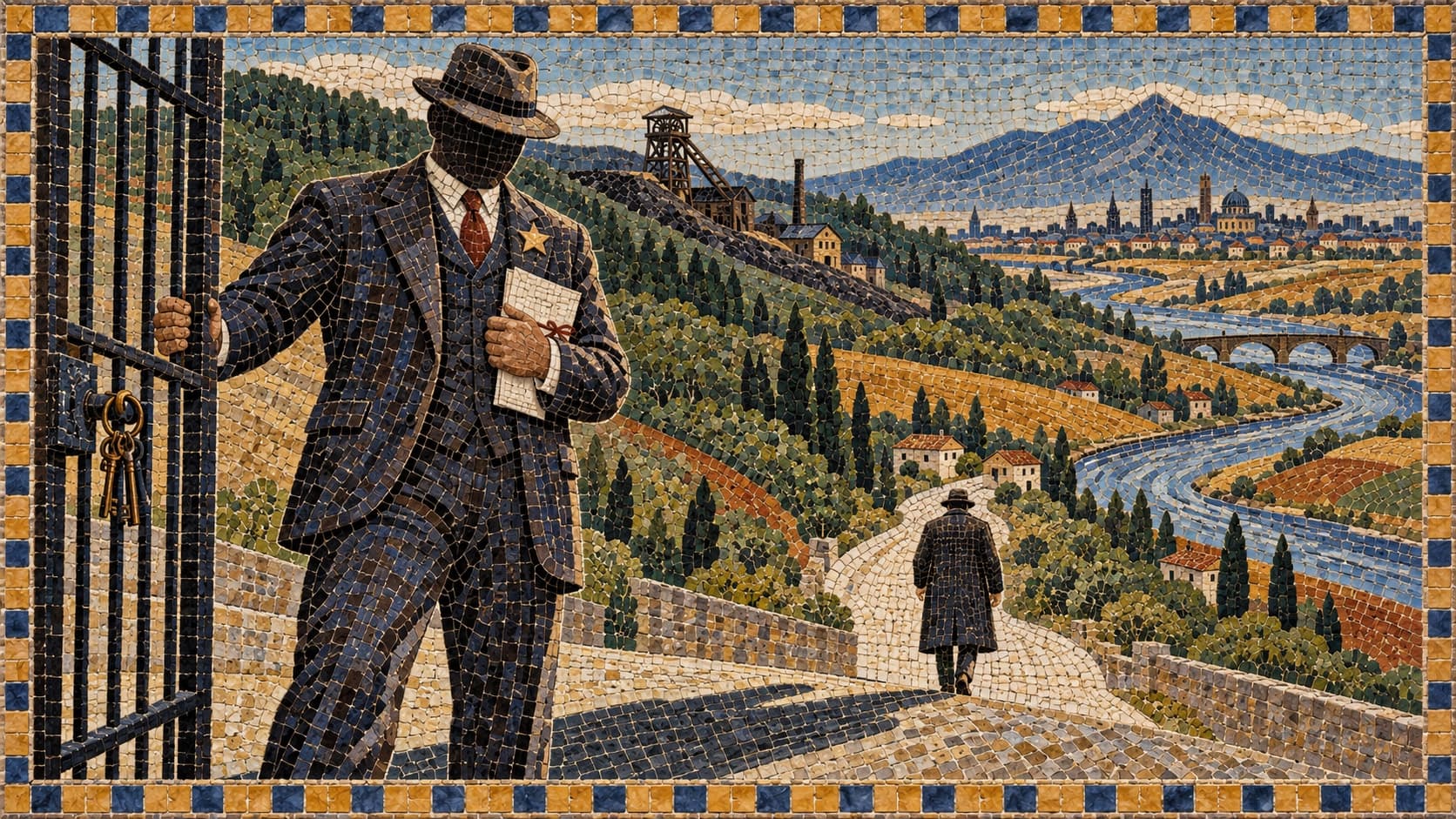
In 1922 a former mayor swore King County's sheriff was no citizen. Matt Starwich brought the charge that convicted him, then asked the governor to pardon him.
On the evening of Friday, October 27, 1922, the sheriff of King County was bowling at the Elks' club in Seattle when word reached him that a warrant was out for his arrest. It had been sworn that day before a justice of the peace, a local magistrate, in Kent and handed to the county coroner to serve. The complaint attacked the citizenship papers Matt Starwich had taken out in Illinois 28 years earlier. If it held, he was no citizen and no lawful voter, and by the Seattle Union Record's reading he would be out of office. The election was 11 days away.
Starwich did not wait to be served. By the Seattle Star's account, he called his lawyer and a deputy prosecutor and had a deputy drive him to Kent. The justice, A. M. Reynolds, later testified that they arrived about 10 p.m. The Star put the hearing in the little office where Reynolds ran an express agency; the Union Record called the place his barn. Starwich produced his papers, the deputy prosecutor said the state had already investigated them and found them legal, and the complaint was dismissed. The sheriff called it a "low-down political trick."
By the middle of February his accuser had been tried, convicted and sentenced to the state penitentiary on a charge the sheriff himself had brought, and Starwich had gone to Olympia to ask the governor to let the man go.
A beat that reached Enumclaw
When Starwich first won the office, in November 1920, the Star reported that his election was celebrated at Enumclaw by burning in effigy Robert Bridges, the Farmer-Labor candidate for governor, and it scolded those responsible for poor sportsmanship. By then he had spent most of two decades as a deputy sheriff, the first decade and more of it at Ravensdale.
The newspapers show a beat that reached the plateau's edge and the woods outside town.
In October 1918 he and Deputy Tom Smith, whom the papers elsewhere place at Enumclaw, seized a trunk of liquor at Kanaskat. By Starwich's own account, as the Union Record printed it, a man and an Enumclaw woman were lifting the trunk onto an automobile when he stepped up and asked, "Can't I help you lift it?" He loaded the trunk, then drove the car, the trunk and both of them to town. The following June the Star had Starwich, Smith and a third deputy raiding a still in the woods near Enumclaw. In February 1920 he was sent at once when the postmaster at Cumberland, six miles northeast of Enumclaw by the Union Record's reckoning, was shot dead in his store.
In March 1922, with Starwich now sheriff, two masked men robbed nine loggers in a bunkhouse at the White River Lumber Company's Camp 7; he and his deputies followed their tracks through the snow to within a mile of Enumclaw and lost them. On March 17, 1923, three men who had tried for a mine payroll at South Prairie fled through Buckley under fire, and their car gave out near Enumclaw, two miles north or northwest of town by the Star's account. Smith's posse ringed a patch of woods, and one of its men shot the last fugitive in the shoulder, the Star wrote, "while Sheriff Matt Starwich and his bloodhounds were nearing the place." As in this site's account of the 1925 Buckley bank robbery, the men on the spot acted first and the sheriff came after.
A badge and a dollar
He was born Mateo Starcevis, a shoemaker's son, near Fiume on the Adriatic, according to the Times obituary of 1941 as reprinted by the Black Diamond History blog. The Union Record spelled it Starcevic. The papers of his day called him an Austrian, because that coast belonged to Austria-Hungary; Fiume is Rijeka now, and HistoryLink's 2016 biography puts his birthplace in Croatia. The obituary and HistoryLink give his birth year as 1879. A Times profile of 1908 implies 1877.
He became a coal miner young, came west about 1898 by his later testimony, and went underground at Ravensdale. In 1902 he joined the posse hunting the escaped convict Harry Tracy, and the county commissioners made him deputy for the district. "They gave him a badge and $1," the obituary says, and he kept his shift in the mine.
The 1908 profile fixed his dimensions for good: five feet four inches, 160 pounds, and a beat of 700 square miles, from Lester near the Stampede tunnel almost to the Seattle and Tacoma city limits. Cumberland, Kanaskat, Palmer and Kangley were among the sixteen settlements it named. The figure is the newspaper's, not a surveyor's. In the same piece Starwich told of going into a house after a man who had just killed two brothers in a Ravensdale saloon; the man pushed a pistol up under Starwich's chin and squeezed the trigger on a dud cartridge.
The saloon and the mine
In September 1913 he turned in his star, and the Enumclaw Herald reported that week that he had opened a saloon, in a tent, in newly incorporated Ravensdale. A surveyor had put the town in the wrong place on paper, the Herald added, and the saloon would have to close.
He was still in town when the Ravensdale mine exploded on November 16, 1915, a disaster this site has so far only mentioned, in its piece on the Gracie Hansen Community Center. The Times reported that the superintendent let him go down the slope because he was an expert timberman, one of the men who set the props that hold up a mine roof. HistoryLink says he went back to the sheriff's office as a deputy in 1916.
In 1919 a grand jury looking into seized whiskey that had gone missing indicted him and another deputy for unlawful possession, and a jury acquitted both in less than 20 minutes, by the Union Record's count. In November 1920, running as a Republican, he took 55,624 votes to his two opponents' combined 46,250, in the official tally the Union Record printed.
The warrant from Auburn
The man who swore out the 1922 warrant was Clarence E. West, an insurance agent, a Democrat and a former mayor of Auburn, which by then was Starwich's home town too. The papers in question had been issued on October 30, 1894, in LaSalle County, Illinois, to Mateo Starcevic. The newspapers gave the complaint two ways. By the Star's first account it said he had sworn falsely to his name when he took the papers out; later reports, and the judge at the trial, called it a charge of false registration as a voter, resting on the claim that he held no valid citizenship papers. Starwich testified that he had married, bought property and held office under the English form of the name, and the Union Record, three days after the warrant, had reported a second ground he claimed: that he came to this country under age and that his father was naturalized, which made him a citizen.
West tried again a week later before a justice in Issaquah, and that complaint was dismissed too. Starwich filed a $10,000 damage suit. He won the election, HistoryLink says, by better than two to one. "I guess the voters prefer to shake hands with a sheriff who has waded through mud to get his office," he said in the Union Record.
The criminal case had started before the election. The Star reported on October 30 that Starwich himself brought the malicious prosecution action against West, on a warrant issued the day after the Kent hearing, and the Union Record had West posting $1,000 bail that Monday. After the election the county prosecutor moved the case to superior court. The statute, part of the state's 1909 criminal code and still on the books, punishes anyone who has a person arrested or proceeded against out of malice, with no probable cause, for a crime he did not commit. The trial opened on December 18 before Judge Calvin S. Hall. On the third day the Union Record noted that the defendant had been picked to play Santa Claus at Auburn's community Christmas tree. The jury convicted him late that day. On January 13, 1923, Hall gave him the minimum, six months and one day at Walla Walla, and said the charge had been an attempt to beat Starwich at the polls. "If I had been a republican," West said afterward, in the Star's report, "I never would have been arrested."
What his daughter said
On January 29 a committee from Auburn and its neighbors, led by a Kent merchant, called on the sheriff to ask for mercy. "Every day my little girl tells me that I should get West out of his dilemma," Starwich told the Star. "She goes to school with West's girl at Auburn." HistoryLink gives him one daughter, Loretta, born in 1910. A penitentiary term would mark West as a felon for life and his family would carry it, Starwich said. "I think justice should be tempered with mercy and I will ask Governor Hart to pardon him." West came to the sheriff's office that day, apologized publicly and said he had been misinformed and had acted on his attorney's advice, which was also his defense at the trial.
It was not pure charity. West had promised to tell who was behind the affair, and nine days later Starwich was complaining that he had not. "He has double-crossed me," he told the Star. "But for his family's sake I'll ask his pardon." The judge and the deputy prosecutor declined to join the request, so the sheriff wrote to the governor alone. On February 16, 1923, with West waiting for the guard who would take him to Walla Walla, Governor Louis F. Hart issued an unconditional pardon, granted, the Union Record reported, "at the specific request of Sheriff Starwich and other officers familiar with the case."
After the star
In 1924 the Star editorialized against his jail after a man officially serving time there was convicted of selling liquor at a filling station near Enumclaw.
The state constitution barred a third straight term, the Times obituary says, and he left office in January 1927. He lost two later races for sheriff and in 1935 became superintendent of the county jail. On March 7, 1941, watching Seattle's test blackout from the roof of the County-City Building, he fell about five feet and never fully recovered. He died at Swedish Hospital at 11:22 on the night of December 6, 1941. His obituaries ran the next morning, HistoryLink points out, hours before the news from Pearl Harbor. The Star's notice of a requiem Mass at St. James Cathedral, with burial to follow in Calvary Cemetery, appeared on December 8 on a page given over to the city's first day at war.
This piece found no marker to him on his old beat. What survives is paper: a collection of his photographs at the University of Washington, and the Seattle newspapers of the winter of 1922 and 1923.
Story label: Original Story or Guide
Originally published: