

Feature
The first wagons over the Cascades came down the White River in 1853, and the road crew had already gone home
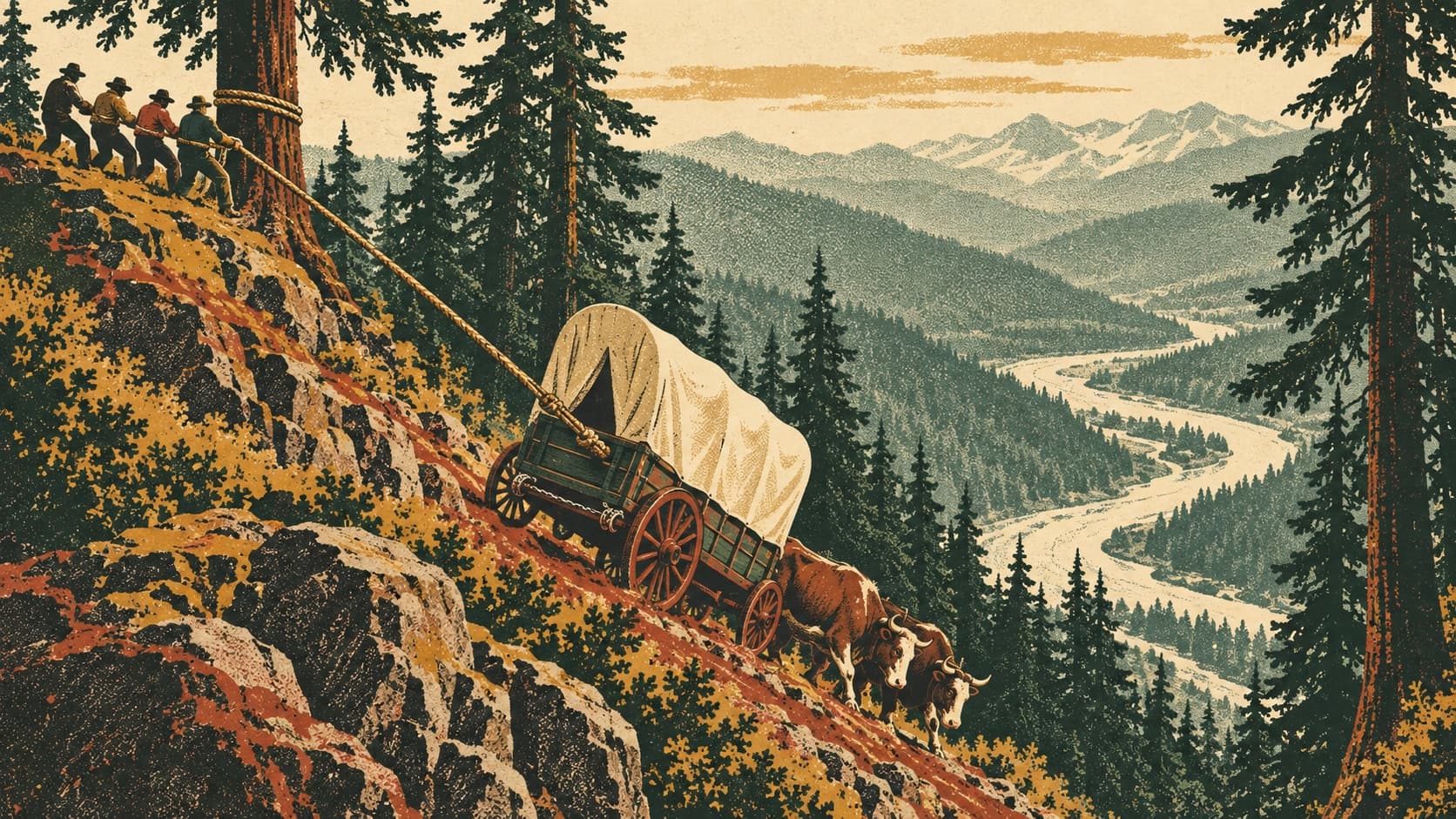
In 1853 the first wagons over the Cascades were roped down a cliff and came down the White River past Enumclaw. Four eyewitnesses, one hill, no agreement.
Just south of the Greenwater River bridge on SR 410, on the east side of the road, there is a stone pyramid that most people pass at 55 miles an hour. It was put up in 1941 by the Washington State Historical Society, paid for in part by students at Yale, and its left tablet says it was erected in memory of the pioneers who came over the Naches branch of the Oregon Trail. The right tablet lists forty families. Miles up the Greenwater behind it is the hill where, in the first days of October 1853, those families tied ropes to the back axles of their wagons and let them down a cliff, because there was no other way to get to the country on the other side.
The country was this one. The trail came down the Greenwater and the White past where Enumclaw would be platted 32 years later, and ended at Puget Sound. It was the first wagon crossing of the Cascades by any pass north of the Columbia. It was also, by most accounts, a road that did not exist.
Twenty thousand dollars and no road
Congress had appropriated $20,000 on December 29, 1852 for a military road from Fort Walla Walla on the Columbia to Steilacoom on the Sound, and President Fillmore signed it on January 7. The Olympia Columbian's editors, HistoryLink records, ran the words WE MUST HAVE THE ROAD in capitals. By spring it was plain to everyone on the Sound that the federal money would not be spent in time for the emigrants known to be on their way that summer, so the settlers did it themselves. Sixty-nine of them, by Ezra Meeker's count, subscribed money, and in July a crew under Edward J. Allen started cutting from the west end, with Quiemuth, Leschi's half-brother, as guide. On the east side a crew under Whitfield Kirtley blazed the line. Captain George McClellan, sent by the government to survey the passes, reached Naches on August 25, decided it was no good for a railroad, and moved on.
Allen's men cut the road through to the Greenwater. Then someone from the east side told them no emigrants were coming, and they went home. George Himes, who was nine years old on the crossing and later curator of the Oregon Historical Society, wrote fifty years afterward that they were greatly astonished two weeks later when the wagons appeared.
Nelson Sargent's sales pitch
The wagons appeared because of one man. Nelson Sargent had gone to California in 1849 and drifted north to Puget Sound, and in August 1853 he rode east to the Grande Ronde Valley in Oregon to find his family's wagon train and talk it out of the Willamette. All the good land there was taken, he said, in Himes's recollection; on the Sound you could have the pick of the best, and the settlers had cut a road through the Naches Pass. Longmire says he was the only man in the party who could speak Chinook, though not well enough to bargain, and it was Sargent who, scouting ahead near Wells Springs, first struck the settlers' blazes.
Two trains had already combined on the Platte: the Indiana group, which James Longmire led and including the Sargents, Van Ogle and John Lane, and the Biles group, led by James Biles, a tanner, with the Himes family and others. Longmire counted 36 wagons leaving the emigrant road; Himes remembered 140 or more people. On September 8 they finished a homemade flatboat at Wallula and ferried the Columbia all night. On September 20 the Upper Yakama leader Owhi hosted them in the Wenas Valley and sold them produce from his gardens; Longmire bought thirteen bushels of potatoes on Wenas Creek, and his son David later bought the farm on that exact creek. Then the party followed the Naches River up into the mountains for four days, crossing it, by Longmire's count and Himes's, 68 times, and climbed three days more to the summit prairie, where they rested the oxen for two days on good grass.
Three miles on, by Longmire's count, was the hill.
Summit Hill
What happened at the hill is the most-told story in the history of the pass, and the four men who told it, three of whom were there, did not agree.
Himes, writing to Meeker in January 1905, described a sheer bluff of thirty feet or more, with heavy timber on every side, so that the only way forward was down. The longest rope in the company was run over the edge and found too short. Then, in his account, James Biles said: "Kill one of the poorest of my steers and make his hide into a rope and attach it to the one you have." Three animals were killed before the rope was long enough. It took the best part of two days to get the 36 wagons down to the Greenwater, and two of them, with a small quantity of provisions, were wrecked. Meeker, in his own telling, had the same three steers and 29 wagons.
Van Ogle was 28 that year and drove four yoke of oxen for Asher Sargent, and when Edmond Meany of the University of Washington sent a research assistant, Katharine Judson, to Orting to interview him in 1912, he was having none of it. Asher Sargent, he said, had carried 180 feet of rope coiled under his wagon box the whole way across the country, thinking he might need it. It was tied to the hind axle, passed around a stout tree, and two men let it out while the oxen braced their feet and slid straight down without lifting a hoof. Thirty-eight wagons came down that way. Lane's went first and upset. "There were no oxen killed for skins at all," he said. "I was twenty-eight years old and I saw everything that was going on."
James Longmire's narrative, taken down from him by Lou Palmer, printed in the Tacoma Ledger in 1892 and reprinted by the Oregon Pioneer Association in 1904, mentions ropes spliced together at Summit Hill, one end on the axle and the other around a tree held by the men, and the wagons lowered one by one and then drawn a quarter mile with locked wheels to the Greenwater. He says nothing about hides. He does say that every wagon came down safely except John Lane's, which was crushed to pieces when a rope broke, and that Lane's family rode the rest of the way on horseback.
So: one rope or three steers, 29 wagons or 36 or 38, one wreck or two. HistoryLink, choosing, goes with the rope, the tree and the cattle hides. This site declines to choose. What nobody disputes is the hill.
Andy Burge
Below it the party met the only man on the road, sent up from the settlements with supplies. Himes, in the same letter, passed on what Mrs. Longmire remembered the man saying when he came upon her walking ahead of the wagons with two of her children: "Good God almighty, woman, where did you come from? Is there any more?" There was not a blade of grass for fifty miles, he told her; they would have to turn back. Her answer, as Himes gave it: "We can't go back; we've got to go forward." She remembered hearing him called Andy and thought he was Andy Burge; HistoryLink names him without the doubt.
Down the White
Forward meant the Greenwater to its mouth, then the White. Longmire says they crossed the White seven times in all. Himes remembered the ascent of Mud Mountain in a drenching rain, with a dozen yoke of oxen hitched to one nearly empty wagon; that is the same ridge that names the dam this site has written about, and the same rain. Most families gave up on the wagons somewhere in there and drove their failing oxen ahead to grass. Van Ogle put it at seven days from the hill to what he called Boys Creek, across the river from where Buckley is now, and said they went back into the mountains for the wagons later.
The creek was Boise Creek, and the grass was Boise Creek Prairie, on the Enumclaw side of the river. Four miles on was Porter's Prairie, where Allen Porter had filed the plateau's first claim under the Donation Land Act that year, 320 acres on a prairie some 300 Smalkamish people used, and was away in Olympia when the wagons rolled across it. There the party crossed the White a seventh time to Connell's Prairie, where Michael Connell had taken his claim that year, and went on to the Puyallup at a ford that by the 1890s was Van Ogle's own hop farm. By James Longmire's dating, which Pierce County follows, they climbed South Hill on October 8. On the ninth, his narrative says, the day after they camped at Clover Creek, the men all walked to Fort Steilacoom to look at Puget Sound and left the women to keep camp.
Nothing in the narratives puts the wagons in what is now downtown Enumclaw. They stayed by the river, at the prairie and the creek, and then crossed. A piece of the track near Osceola became one of King County's first roads, and a local history site traces it in SE 456th Way.
What became of the road
Not much. A second train had followed three weeks behind them in 1853. In 1854 Lieutenant Richard Arnold took an army crew over the route, cut the Naches crossings, 68 by the emigrants' count, to 44, and eased the west-side grades, and the Ebey and Meeker parties used the improved road that fall. But there was no forage on the west side, and HistoryLink's judgment is that the road never served as a primary route over the mountains. The Puget Sound War finished it. Michael Connell was killed at his prairie in the last days of October 1855, and two parties of territorial volunteers were ambushed nearby, which is what the historical society's second pyramid, at Connell's Prairie Road and Barkubein Road East near Bonney Lake, commemorates. Settlement drifted north, and Snoqualmie Pass got the wagons and, eventually, the interstate.
The state has never quite given up. A Naches Pass highway was added to the state system in 1943 and survives in the law books as State Route 168, unbuilt; a 1946 study found a tunnel there harder than the alternatives, and a study in the early 1960s priced the toll at $1.50. What exists instead is a jeep trail, revived by four-wheel-drive clubs in the 1950s. On the west side it is Naches Trail 1175 in the Mount Baker-Snoqualmie National Forest, 5.7 miles from a trailhead 9.6 miles up Forest Road 70 off SR 410 to Government Meadows and the Urich cabin, with the stretch between Forest Roads 7065 and 7033 closed to everything but boots. On the east side it is Trail 684, a twelve-mile route the jeep world ranks among its badges of honor, closed to motors from mid-November to mid-July and, since a Forest Service alert of August 5, 2025, broken at a collapsed bridge over the North Fork of the Little Naches. The Pacific Crest Trail crosses the old road at Government Meadows, which this site's piece on the trail to Mexico mentions.
The Longmires
James Longmire took a claim on Yelm Prairie that winter, guided Hazard Stevens and P. B. Van Trump to the mountain for the first recorded ascent in 1870, found the mineral springs on the mountain's south side in 1883, filed a mineral claim in 1887 and opened a hotel in 1890 that advertised relief for rheumatism, heart disease and piles. His son Elcaine, a boy on the crossing, ran it after him. The park arrived in 1899 and the Park Service in 1916; it bought the family out in 1939, and the place is still called Longmire. James died in Tacoma on September 15, 1897. Van Ogle died at the Orting soldiers' home in 1919, still certain about the rope.
The markers
The Greenwater pyramid is the one you can reach: SR 410, east side, just south of the river, with a bronze plaque of a wagon and oxen heading into a sunset by the sculptors James Earle and Laura Gardin Fraser. The Connell's Prairie pyramid is off the Sumner-Buckley road near Bonney Lake, and in 2015 Bonney Lake added a marker for Connell's cabin at 7109 Barkubein Road East. Nothing in Enumclaw or Buckley marks the trail, so far as this site could find, though Buckley's museum says the town was founded on it. There is a large interpretive sign at the Greenwater Lakes trailhead. The rest is in the Washington Historical Quarterly, where the University of Washington's Edmond Meany printed David Longmire in 1917, Van Ogle in 1922 and James Longmire in 1932, three accounts of one hill, and let them argue.
Story label: Original Story or Guide
Originally published: