

Feature
For thirteen years the Northern Pacific's main line ran through Enumclaw. Then it built a cutoff and left.
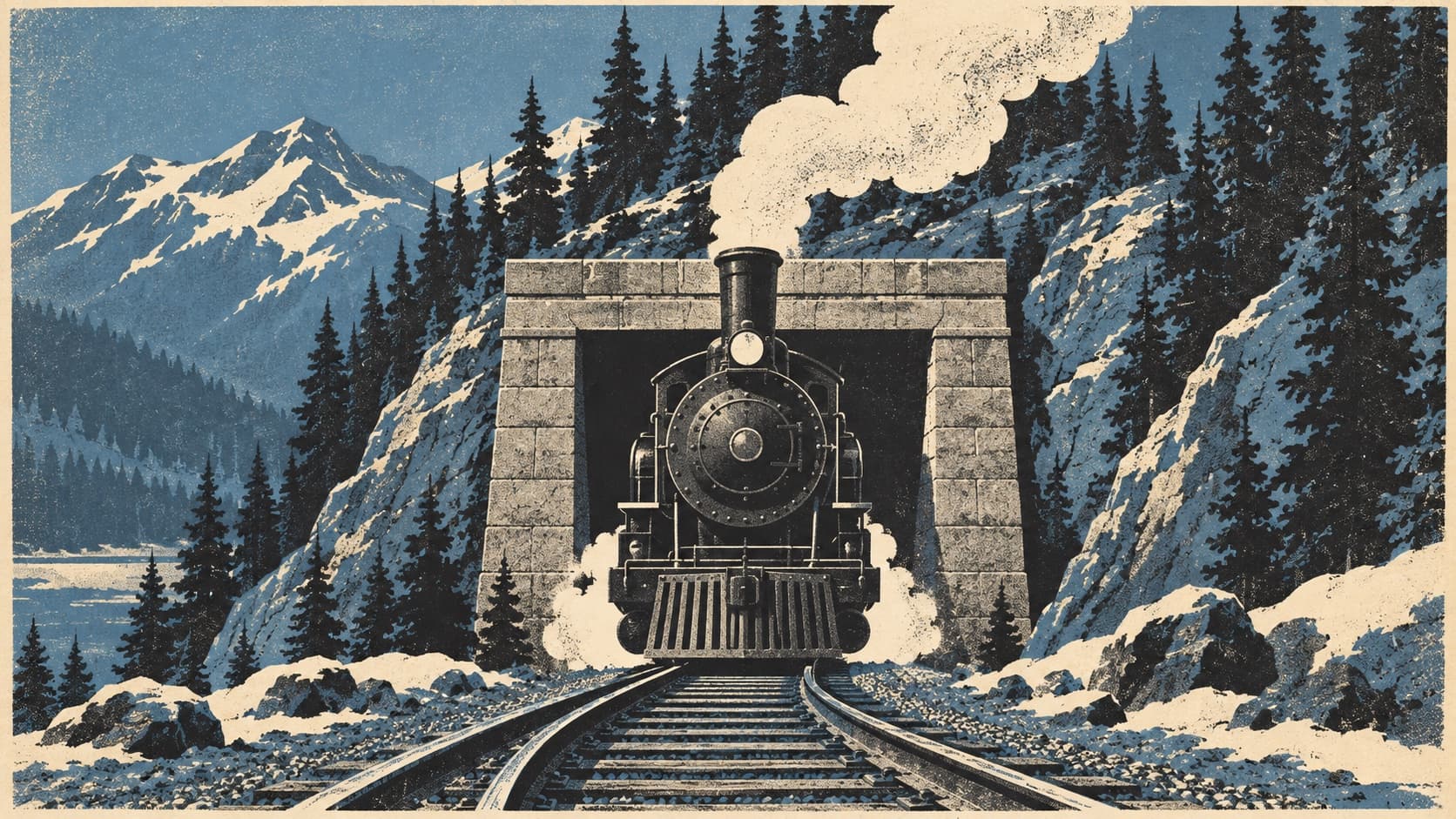
The Northern Pacific reached Enumclaw in 1885, opened the Stampede Tunnel in 1888 and rerouted through Auburn in 1900. The branch is now the Foothills Trail.
The Enumclaw library at 1700 1st Street stands on railroad land. The Enumclaw Plateau Historical Society's history pages say the Northern Pacific depot stood on that spot until 1963, and HistoryLink's account of the library says only that the 1991 building went up on ground that had belonged to Burlington Northern. Either way, the reason there is a town here at all is under the reading room. Plenty of towns this size have a depot that became a museum. Enumclaw's became a library, its tracks became the trail you walk to Buckley, and the tunnel the tracks were built to reach is, after a thirteen-year sleep, one of BNSF's two main lines across the Washington Cascades.
Cleared, level land
Frank Stevenson, a Cornishman who had mined coal in Pennsylvania, and Mary Fell Stevenson, from Ontario, homesteaded here in 1879 on what Mary described as "wild and woody land, full of mud, water and mosquitoes." By 1883 the Northern Pacific had chosen the upper White River valley for the last leg of its transcontinental line to Tacoma, and the Stevensons made the railroad an offer HistoryLink records as cleared, level land for a siding. The railroad took it. In 1884 the company built a spur out from its 1877 coal line at Cascade Junction, between South Prairie and Buckley, to a place it called White River Siding, and a year later kept going. The Northern Pacific's own engineering office later recorded the date: "The tracks reached there (what was later to become Enumclaw) on July 22, 1885, and the place was selected as a location for a siding and a section house."
The Stevensons filed their plat with the county that fall (HistoryLink gives October 1, 1885 in one essay and October 31 in another), built a hotel that charged $21.50 a month for room and board, and gave away lots for a general store and, to Mary's father, for a saloon. The name came from a railroad official's request for something that did not end in ville. Two years later White River Siding was renamed Buckley, for the railroad's district superintendent.
The switchback
The line's first way over the mountains was not a tunnel. It was a switchback, eight miles of track at a 5.6 percent grade that zigzagged up to the 3,672-foot summit of Stampede Pass and down the other side, with a double horseshoe at the top and a forty-foot snow cut, and it took an hour and a quarter to cross. The railroad celebrated the completed Cascade Division on June 1, 1887, ran a test train over the switchback on June 6, and began scheduled passenger service over it on July 3. HistoryLink gives the same date, July 3, 1887, for the first train through Enumclaw and says the depot was built that year; the historical society's own pages say the depot came in 1888 and the first transcontinental train with it. Louise Poppleton's town history says July 4. Pick one; they are all within a year.
Between Enumclaw and Buckley the line crossed the White River on a timber trestle that a Buckley newspaper, reporting a freight collision at its east end in 1891, described as "nearly half a mile long and nearly a hundred feet high." It was rebuilt more than once, including after the flood of 1906 destroyed it, and it stood, in one form or another, for a hundred years.
Stampede
The pass got its name from a work crew. A trail-cutting party camped at Stampede Lake quit when a new foreman arrived with orders to take charge, and when he told the cook that company food was not for men who had quit, the rest stampeded; the men who stayed blazed a fir and wrote Stampede Camp on it. The tunnel under the pass was let to a contractor named Nelson Bennett in January 1886. His brother Sidney ran the east heading, which started on February 13, 1886, and the west heading began April 1. The crews drilled by hand at first, about three and a half feet a day by one Tacoma account, then with machines that pushed the rate to nearly six, and a period trade paper reported the rock being blasted every six hours and hauled out at a hundred cubic yards a day. Fifteen hundred Chinese laborers worked the grade east of the summit in the summer of 1886; a Tacoma history blog puts the total at nearly two thousand and notes that, as was the custom, no count was kept of their deaths; by contract their bodies were shipped home to China. Twenty-nine men are recorded killed, by one count.
The Bennetts offered $1,000 to the first man through the bore when the two headings met, and a steak dinner with whiskey for his side. Shortly after noon on May 3, 1888 a blast opened the hole, and the man on the west side collided head-first with the man coming from the east and, in HistoryLink's words, won "battered and bleeding." The bores fully met on May 11. A locomotive named for Bennett's daughter ran through on the 14th, and on May 27, 1888 the tunnel opened to traffic: 9,850 feet, second longest in the country at the time, at a cost recorded in a 1904 encyclopedia as $1,013,006.63.
From July 1887 over the switchback, and from that day through the tunnel, Enumclaw was on the Northern Pacific's transcontinental main line, and every train from St. Paul to Tacoma came down the Green River to Palmer, over the plateau, through the Stevensons' clearing and across the trestle to Buckley.
$25,000 a month
It lasted thirteen years, and they were the years that made the town. The White River Lumber Company started its mill in 1889, the year Washington became a state. A physician named J. J. Smith, writing up Enumclaw for The Coast, a Seattle monthly, in June 1909, gave the numbers as a booster would: 56 miles from Seattle by rail, 32 miles east of Tacoma, and freight handled by the Northern Pacific at the Enumclaw station averaging, he wrote, over $25,000 a month.
By then the main line was gone. In 1899 and 1900 the railroad's contractors, Horace C. Henry and the same Nelson Bennett, built the Palmer Cutoff, a new line from Palmer Junction across the Green River to Kanaskat and west through Ravensdale and Covington to Auburn, where the Northern Pacific opened its big yard in 1913. HistoryLink puts it in one sentence: "the Northern Pacific bypassed the town with a cutoff routed through Palmer." The old line from Puyallup through Buckley and Enumclaw to Palmer Junction became what the railroad called the Buckley Line, a branch.
A second railroad arrived to keep it company. The Chicago, Milwaukee and St. Paul built into Enumclaw in 1910 on a spur that left its own line near Cedar Falls, opened a depot on April 2, 1911, and connected at Enumclaw Junction to the lumber company's logging track. That is why the mill, in 1949, was shipping on both the Northern Pacific and the Milwaukee. In 1933 the Milwaukee gave up its own track north of Enumclaw and ran instead over the Northern Pacific's rails to Selleck. Its Enumclaw station had been closed for years by the time the railroad ran its last train through Maple Valley in March 1980.
The last train
A White River Valley Museum photograph from 1956 shows Northern Pacific engine 1381 crossing the trestle near Buckley. The local history site says rail service came to an end in Enumclaw that year, though freight kept crossing the trestle for two decades more; what the sentence means by service is not clear, and no timetable this site could find settles when the last passenger boarded here. The depot came down in 1963. The Milwaukee's depot lasted until about 1976, when a hardware store replaced it.
On February 5, 1982 Burlington Northern, the Northern Pacific's successor, applied to abandon the line from Veazie, a few miles north of Enumclaw, to Cascade Junction, and the Interstate Commerce Commission let it, on March 16. The railroad pulled the tracks through Buckley, and the City of Buckley sued over who owned the ground, a case the Washington Supreme Court decided in the city's favor in 1986. The trestle was torn down in 1987, a century after it went up. Its abutments, sunk 23 feet into the subsoil, are still there.
The next year Burlington Northern quit Stampede Pass too. It stopped running trains through the tunnel in 1983, or August 1984 by some accounts, to cut costs, and kept the right of way.
The trail
The line that made the town is now the Foothills Trail, which follows the Northern Pacific grade from 252nd Avenue SE at the south edge of Enumclaw to Buckley, with one exception. At the river the trail leaves the railroad, because the railroad's bridge is gone. It uses instead the old highway alignment that SR 410 abandoned in 1949, crosses Boise Creek on the old highway's refurbished concrete arch, and crosses the White on a bridge that is newer than almost anything else in this story: a 572-foot weathered-steel span that King County opened on September 28, 2024, at a cost of $16 million, $12.8 million of it from the county parks levy, joining the King County trail to Pierce County's and making 22 continuous miles. When a truck damaged the SR 410 bridge in August 2025, the trail bridge became a way across, which this site has covered without mentioning that the trail is a railroad. The county's 2024 plan lists the next two pieces, 4.2 miles from Enumclaw to Nolte State Park and 4.3 miles from Nolte to Kanaskat, both on what the plan calls the abandoned, or historic, railroad corridor, neither programmed.
Stampede, again
Then the tunnel came back. On April 26, 1996 the Burlington Northern Santa Fe announced it would restore the 78 miles between Auburn and Cle Elum, at about $125 million, because of the trade coming through the Puget Sound ports. It raised the tunnel's clearance, built new snow sheds, and ran the first regular train through on December 5, 1996, the same tunnel, 108 years and a few months after the head-butt. A 2017 university study, citing state transportation data, counted six trains a day on it in 2010. It carries freight only; the last Amtrak went over the pass in 1981. Palmer Junction, where Enumclaw's line used to leave the main, was relocated about 1958 to make way for Howard Hanson Dam, whose reservoir later covered the old grade, so the trains do not pass the spot anymore. They pass the gap, which this site's piece on the east wind describes, in Seattle's planners' phrase, as the lowest pass in the region, and which the same 2017 study says the railroad chose in 1884 for its gentler grades. Wind and railroads want the same thing.
Enumclaw got thirteen years on the main line, a sawmill, a name without ville on the end, and a library on the depot site. The trains still cross the mountains some thirty miles east of here, through the hole Nelson Bennett's crews cut. Nobody on them knows the town was ever on the way.
Story label: Original Story or Guide
Originally published: