

Feature
The Enumclaw stubbornness rankings: thirteen things still doing exactly what they were built to do
A fair nobody can agree on, an insurance company older than the city, a hall that arrived by horse for twenty dollars, and a diner that, at fifty, is the baby of the list.
Enumclaw did not become a city until 1913. By then it already had an insurance company, a newspaper, a creamery, two churches, a fraternal hall, a water supply and a fair, all older than the government that eventually turned up to regulate them. Most are still here, still doing their original job, which in a country that flattens a downtown every time a highway moves is a small statistical miracle.
The rule is simple. An institution qualifies only if it is still doing what it was built to do, ranked by the year it started. Buildings that changed careers and companies that got bought and moved wait at the end, among the ghosts. Where the sources fight, you will hear about it.
1. The King County Fair, 1863, with an asterisk
The fair's own history page opens with Abraham Lincoln, which is what you do when your founding date is a genuine 1863. That makes it, in its own words, "the oldest fair this side of the Mississippi." Walla Walla, whose fair began in 1866, calls itself "the oldest fair in the state of Washington." Both claims are printed with total confidence and at least one is wrong.
The asterisk is that the fair is not from here. The Expo Center says it began in Georgetown, moved to Renton around 1900, and came to Enumclaw "after World War II in 1965." One local history site says Renton. Bill Kombol, citing Louise Poppleton, has Enumclaw's fair starting in 1946 as a Spring Dairy Show for FFA and 4-H kids in rough barns on the Bruhn farm, then becoming the King County Fair in 1965 with three buildings trucked down from the Seattle World's Fair. The Historical Society's timeline lists the "1st King County Fair" under 1900. The oldest thing in town, then, and a recent arrival, and nobody agrees which. First place, on a technicality it never asked for.
2. Sacred Heart Catholic Church, 1888
Founded as a mission of the parish at Krain in 1888, a parish in its own right by 1898, and still saying Mass, which is the entire test. The first church, at Griffin and Porter, went up between 1887 and 1889 and burned in 1911. The parish moved to Farrelly Street in 1973. The building is on its third address. The congregation has never needed a second one.
3. Calvary Presbyterian, 1892
The church puts its founding at 1892 and earns a bonus point for a side job. In 1915, before the city had a library, the town's Presbyterian church opened a reading room with 350 books and magazines after its pastor, Joseph Cleland, failed to land a Carnegie grant. Still open on Porter Street on Sundays; the library it hatched is number nine.
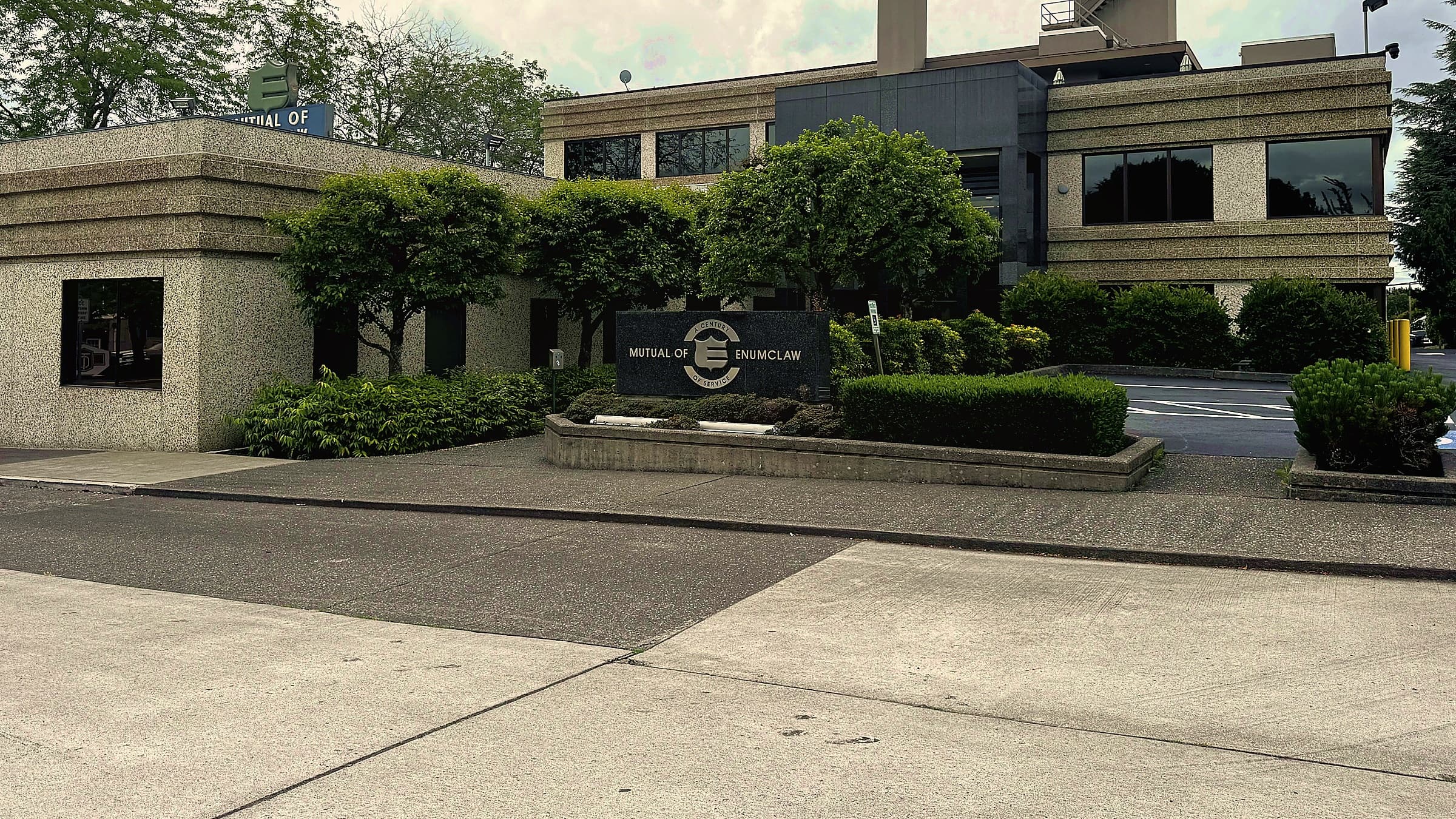
4. Mutual of Enumclaw, 1898
On February 17, 1898, plateau farmers led by Danish immigrants filed papers for the Farmers Mutual Insurance Company. The idea was fire: when a member's barn burned, the others were each assessed a share to cover half the loss. HistoryLink calls it the oldest mutual insurer in Washington. By January 1, 1914, it carried $8,002,520 of insurance and had paid just $6,000 in losses the year before, a ratio to make a modern actuary weep. It became Mutual of Enumclaw in 1966. The city it is named for was incorporated fifteen years after the company. Enumclaw is, strictly speaking, Mutual's younger sibling.
5. The Danish Hall, 1900
The Danish Brotherhood, chartered in 1898, bought the general store at Birch, three miles north of town, for $125, took it apart, and paid Anton Johansen $20 to haul the pieces in by horse and wagon. It was reassembled on Porter Street and dedicated on June 10, 1900. The Sisterhood, organized in 1904, has met there ever since, paying the brothers $15 a year in rent from 1915 to 1931. The Brotherhood dissolved in 1998 and sold the hall to the sisters for one dollar. When a wall came open for repairs in 2019, the original cedar was still there under 1970s faux brick. The aebleskiver breakfasts continue. The only entry ever moved by horse.
6. The Courier-Herald, 1900
D.C. Ashmun and his wife printed the first Enumclaw Courier in July 1900. A rival Herald arrived in 1908 and, in the most small-town move imaginable, hired Ashmun to run it. The two merged on October 6, 1933. Circulation was 2,000 in 1936, 6,800 in 1987 and 1,764 in 2023. In June 2026 the paper closed its Cole Street office, the editor now works from home, and the archive back to 1923 went to the Historical Society. It still comes out every week. A newspaper that has lost its building and kept its deadline is the purest stubbornness here.
7. The water, 1902 or 1913
The Historical Society dates water service to 1902. HistoryLink says the city bought a spring from the White River Lumber Company in 1913. Either way the town has drunk from the same hills for over a century, now from four sources serving 6,350 customers through 154 miles of main, and HistoryLink notes the city has capped its own growth to match the supply. In 2008 Nestle tried to buy half of it. The town declined.
8. The Historic Mint, 1906, with an asterisk
The Mint claims 1906, and the word "historic" was earned rather than assigned. By its own account it began as a stick-built building at Cole and Griffin, lost it to a fire, and moved across the street into the brick building at 1608 Cole. It has spent time as The Lemon Tree, closed for a while, and reopened on August 2, 2013, with a kitchen. The asterisk is for the closure and the alias. The tap count, 28, is not in dispute.
9. The library, 1923
In March 1923 the city set up its first public library in a room at City Hall, with Agnes Christensen as librarian at $16 a month. By 1924 the shelves held 1,439 books, 450 of them in Danish. When Mary Stevenson Yerxa, who had platted the town with her husband, died in 1928, she left it her house and $100. The current building opened in 1991, and in April 2012 voters handed it to the King County Library System by 34 votes. A city room, a widow's house, a bond issue, a county branch, and it has never once stopped lending.
10. The Sales Pavilion, 1938
Every Saturday since 1938, by the auction's own account; the present company dates from 1993. Poultry at 9, livestock at 1, sold in the order calves, cattle, horses, sheep, goats, pigs. The website's most honest sentence is "We never really know what will show up until Saturday morning," and the poultry list runs from baby chicks to peacocks. It is the one entry where you can get a bidder number and a hot dog and leave with a goose.
11. The golf course, 1947
Dave Salisbury laid out eighteen holes on 288th Avenue in 1947, and the city still lists it. Par 70, 5,561 yards, and from late September into early October the salmon come up Boise Creek to spawn beside the fairways. It is the one entry that gets more interesting this week.
12. The Chalet Theatre, 1949
A Legion hall on Wells Street became the Roxy at the end of 1949, opening with John Wayne in Sands of Iwo Jima, a 750-seat house arriving in the same season as television. Within a few years the town's other two cinemas were gone. Renamed the Chalet in 1977, it still sells an $8 ticket to 460 seats, the rows spaced out for legroom in 1993. One screen, as ever.
13. Charlie's Cafe, 1976
Breakfast on Roosevelt Avenue since 1976. At fifty it is the youngest thing here, and a diner that reaches fifty under the same name is rarer than a church that does.
The ghosts
The Cooperative Creamery, 1899, won a gold medal at the 1915 Panama Exposition, sold its milk route on December 6, 1951, and was torn down in the 1980s. The White River mill sawed its first shingles in 1889, became Weyerhaeuser's in 1949, and ran its final logs in April 2009. Farman's Pickles began in a backyard in 1944, sold to Tacoma-based Nalley's in 1987, and the jar is now filled by TreeHouse Foods with cucumbers that may have come from India. The 1909 Masonic Hall became an Episcopal church, then the museum: a fine third career, not the one it was built for.
What the survivors have in common
Nearly every survivor is a cooperative, a congregation or a club, owned by the people who use it. The ghosts are the ones that got bought. A creamery can be sold to Kent. A Sisterhood cannot. That is the whole ranking: the stubborn things in Enumclaw are the things that never had a price. Except the Danish Hall, which did. It was a dollar.
Story label: Original Story or Guide
Originally published: