

Feature
Peter Storbo of Enumclaw went to prison for mail fraud over his Mount Rainier copper mine. Later accounts say 1,200 neighbors signed to get him out.
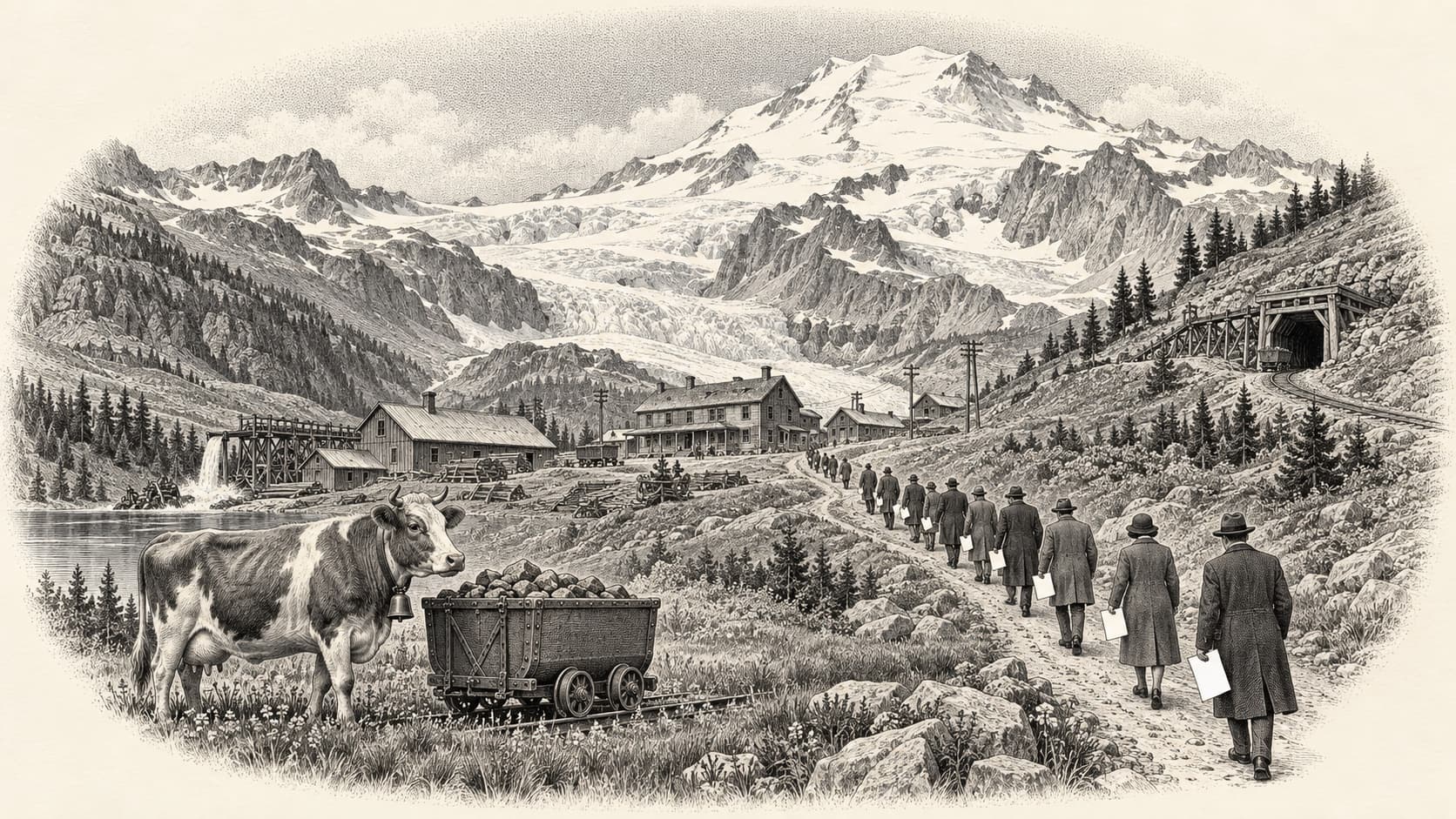
An Enumclaw farmer built a copper mine in Mount Rainier National Park and was convicted of mail fraud in 1930. Accounts say 1,200 neighbors petitioned for him.
In November 1930 a 56-year-old Norwegian immigrant from Enumclaw took the witness stand in federal court and was asked whether he believed there were two billion dollars' worth of ore inside Mount Rainier, as one of his company's letters to stockholders had said. Peter Storbo said he did.
On November 22 the jury found him guilty of mail fraud. Judge George M. Bourquin fined him $1,000 and gave him 18 months in the federal penitentiary on McNeil Island.
The part of the story Enumclaw kept is what came next. By HistoryLink's account and his family's, some 1,200 people signed a petition for his release. The 1930 census counted 2,084 people of all ages inside the town limits, though no source says how many of the signers lived in town and how many on the farms around it. And the rusting machinery that hikers still step around on the Glacier Basin trail, inside Mount Rainier National Park, belonged to an Enumclaw company.
A dairy farm, a hotel and 41 claims
He was born Peter Theodore Pedersen in Norway in 1874. His home town was Røros, a copper town since the 1600s. In Minnesota he took the name Storbo, after a Swedish town near home, to tell himself apart from the state's other Pedersens. That is the account in the Park Service's 2017 history of the mine, which credits a 1999 Tacoma News Tribune article. His grandson Arthur Storbo, who wrote the history's foreword, says he had a third-grade education.
He reached Enumclaw in 1902 with his bride, Gina Arneson, a year behind his uncle Bernt Korssjoen. "Soon after arriving, Storbo purchased a dairy farm and local hotel," the history says. Neither it nor HistoryLink names the hotel or places the farm. That same year, by the 2017 history's account, the two men purchased all 41 mining claims in Glacier Basin, a bowl at about 6,000 feet on the mountain's northeast side. The Park Service's 1996 administrative history says they staked the claims themselves. The 2017 book dates the incorporation of the Mount Rainier Mining Company to January 16, 1904, with 104 stockholders. The 1996 history, and one passage of the 2017 book, give 1905.
Gina saw the basin once, on July 4, 1922, the day the camp barn burned. Otherwise, Arthur Storbo writes, she stayed in Enumclaw "to tend the family's cows and kids." Rangers and mapmakers wrote the name as Starbo so often that the camp went into print as Camp Starbo. The history offers no cause beyond misspelling.
How a mine got inside a national park
Legally. Section 5 of the 1899 act that created the park extended the federal mining laws to it, and prospectors had been staking Glacier Basin since about 1896. The Pierce County auditor recorded 165 new claims in the park in the twelve months to mid-1907. Congress shut the door on May 27, 1908, with a law that barred new claims and left alone rights already acquired in good faith.
The acting superintendent, Grenville Allen, had made up his mind about the old ones. "There are no mines in the park from which any profit is derived except from the sale of stock," he wrote in his 1908 report. A General Land Office examiner went over Storbo's ground in 1910 and reported most of it poorly marked and short of ore. In 1912 the company gave up 32 of the 41 claims to keep nine. On January 12, 1924, over the Park Service's protest, it won patents to eight of them: a little over 160 acres of private property in a national park.
What they built at 6,000 feet
Between 1914 and 1916 the company built 23 miles of road up the White River, half of it inside the park, at a cost it put just under $70,000. A ranger priced its 400-foot log bridge over the river at about $6,000. It was the first automobile route into the park's northeast corner, an ancestor of the drive in this site's piece on the road to Sunrise.
Into the basin went a water-powered sawmill, a 2,400-volt power plant with 4,000 feet of line, an 800-foot aerial tram, and a two-story hotel, 36 feet by 70, with a dining room for 120 and beds for 40. The hotel cost about $11,000, was never quite finished, and served mostly as a boardinghouse for 30 to 50 men, Swedes and Norwegians paid partly in company stock. The park supervisor reported in 1915 that "no swearing or bad language is to be heard in the camp."
Less came out. A federal examiner's table lists seven shipments of hand-sorted ore between 1915 and 1928, about 127 tons in all. The company's own 1925 statement put spending at about $240,000 and ore sales at about $5,000, with no net profit.
The mountain of copper
That same statement said a $1,500 bill for back permit fees "would simply break the company." In February 1927 it hired two stock promoters, Charles Cresser and Orton E. Goodwin. A letter dated April 15 went to stockholders over Storbo's signature: buy at 50 cents a share by midnight on May 15, after which the price would be at least a dollar. It claimed about 12.1 million tons of proven ore and shipments of 100 tons a day once a tramway was finished that summer. "We have a whole mountain of copper to draw on," it said. "Only a banker could realize the figures."
The campaign raised about $100,000, by the history's account, from a list the letter itself put at 1,300 stockholders, most of them Scandinavian farmers in the Dakotas, Oregon and Washington. Some, the history says, had put in life savings, and some complained. In 1928 a postal inspector brought mail fraud charges against Storbo, Korssjoen, Cresser and Goodwin, and the park's superintendent, Owen Tomlinson, told his director that "the whole affair is nothing but a stock selling scheme."
What the court found, and what his defenders say
Korssjoen died in 1930 awaiting trial, nearly 76. Cresser was excused on a doctor's letter and died of cancer soon after. The case against the two who stood trial, as the Park Service history summarizes the stockholders' complaints, was that the company had used the mail to draw investment with exaggerated promises and warnings that the price was about to rise; the circulars were read to the jury. The history quotes the newspapers on what followed. Storbo testified, by the Seattle Times, that he had acted in good faith, that he had signed most of the letters but had not written them, and that he had taken no pay from the company in more than nineteen years. The jury convicted him and Goodwin. A Park Service director summarizing the file in 1942 wrote that the two were sentenced "for fraudulent use of the mails and circulating false literature concerning mining claims." Goodwin drew a second fraud sentence that month in a separate case involving a Seattle brokerage.
The family's account differs. "He had been framed with false signatures," Arthur Storbo writes, "but failed to mount a sufficient defense for lack of money, poor hearing (he used a lot of dynamite), lack of understanding of the law, and perhaps all three." The News Tribune reported in 1999, in a passage the Park Service history quotes, that Goodwin and Cresser later admitted forging his signature on stock certificates. No court record of that admission was found for this article.
The Park Service's historians land in between. They doubt Storbo wrote the letter, and doubt it could have gone out without his knowledge. But they conclude: "These are not the qualities of a willfully fraudulent organization."
The petition
HistoryLink puts it in a sentence: "Some 1,200 residents successfully petitioned for his release, and he left prison shortly after one year." The News Tribune, as the Park Service history quotes it, had him out after one year and three days, and said the signatures came from "just about everyone in Enumclaw." It added that in 1934 Senator Homer T. Bone won him executive clemency from President Franklin Roosevelt, with his citizenship restored and the fine returned along with $232.60 in costs. The grandson calls it a pardon.
No copy of the petition turned up for this article. Nothing consulted says who carried it around, whose desk it reached, or whether the release was a parole. The count, as far as it can be traced, comes down through the family. But no account consulted puts the town on the other side, and the choice was not a simple one. By Arthur Storbo's account, some of the Enumclaw friends who stayed convinced of his innocence were stockholders themselves.
A volunteer who helped build a Storbo display at the Enumclaw Plateau Historical Museum told the Courier-Herald in 2019 what people said when the name came up: "Oh, my parents knew Pete Storbo. He used to come into their store. He was their favorite." The 1930 census listed him as a road laborer. He died on October 4, 1956.
What the trail still passes, and if you go this fall
The company outlived him. It lost the claims at a sheriff's sale in 1932, recovered them, reorganized in 1946 and worked the tunnels off and on into the 1950s. The Park Service, which first asked to buy three days after the verdict, got the eight patented claims in 1984 for $55,800. They were the last private land inside the park.
The Glacier Basin trail runs largely on Storbo's road, rebuilt after the 2006 floods by Washington Trails Association volunteers and the park, a job finished in 2011. Parts of an ore concentrator that was never assembled lie beside it, and the backcountry camp occupies the site of his lower camp. An avalanche in the winter of 1906 to 1907 killed two men and a 13-year-old boy, and the men are still buried there. The park's trail page gives the whole enterprise one sentence, which says "nothing of commercial value was ever extracted." The glacier next door is in this site's piece on the White River and the Emmons.
To see it, take SR 410 from Enumclaw to the White River Entrance ($30 a vehicle, cards only) and drive five miles to White River Campground. The trail leaves from Loop D: 7 miles round trip, 1,280 feet of gain and about four hours by the park's trail page. Another park page and the Washington Trails Association put it at 6.5 miles with 1,600 to 1,700 feet of climbing. No pets, no fires, and a wilderness permit to camp. As of October 1 the park lists the trail open, the campground closing for the season on October 12, and the White River Road scheduled to close October 26, a date it says may change. The park's pages do not say whether the Loop D trailhead can still be reached and parked at between those two dates; the White River Wilderness Information Center, (360) 569-6670, can say, and it too closes October 12. Work on the Fryingpan Creek bridge replacement began September 28, by the park's news release: expect one-lane traffic, delays of up to 30 minutes, and no parking at the Summerland trailhead. The Sunrise Road above the campground is still closed to cars because of this summer's fires. Check the park's road status page the morning you go.
Story label: Original Story or Guide
Originally published: