

Feature
Pumpkin patches and corn mazes near Enumclaw: what is open this fall (2026)
Thomasson and Maris open September 26. Here is which weekend to go, which lot fills, and why a volcano is the reason any of this exists.
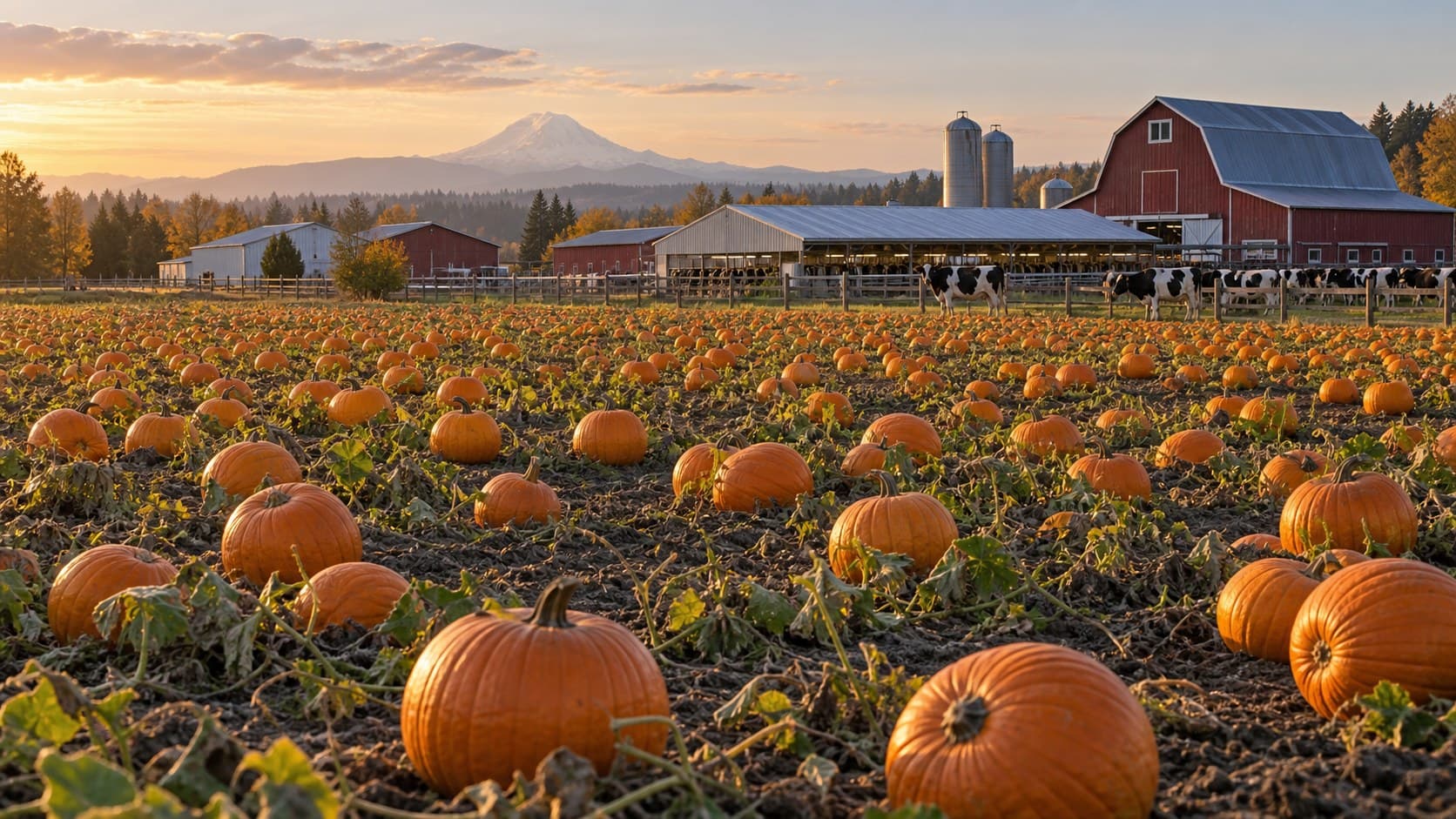
The pumpkin patch on 236th Avenue is a dairy farm. It says so in the small print on its own website, in a disclaimer warning that the structures are rough, the terrain is weathered, and this is a working milking operation with a corn maze attached. That sentence is the whole story of the Enumclaw plateau in the twenty-first century. The cows are still here. The cows are also, increasingly, the backdrop.
Two farms near town open their fall seasons on Saturday, September 26, and between them they account for most of what people mean by "pumpkin patch Enumclaw." The useful information is narrower: which days are packed, which are dead, what the farms have actually posted for 2026, and what you should not believe about a certain train.
What is open, as the farms state it
Thomasson Family Farm, 38223 236th Ave SE, Enumclaw. The farm's 2026 pumpkin page lists September 26 through October 30, 9:30 a.m. to 5:30 p.m. daily, closed October 31. The patch is ten acres, the corn maze five. Online tickets bought at least 24 hours ahead are $18.50 on weekdays and $23 on weekends, plus tax and fees; at the booth it is $22 and $26. Two and under are free. The weekday discount exists for a reason: several attractions and most of the food stands run only on weekends. Leashed dogs are allowed if registered at the booth. Pumpkins are priced by a size chart rather than weighed, which is either admirably low-tech or an invitation to argue, depending on your family.
One wrinkle: the site footer still reads "Open October 1st to 30th," under a 2020 copyright. The 2026 pumpkin page says September 26. Trust the page with this year's prices on it, and confirm before you go.
Maris Farms, 25001 Sumner Buckley Hwy, Buckley. Fall Fest runs September 26 through October 31, 2026, with Farm Fun Admission listed at $24 on the pricing page. Parking is free and the farm is open rain or shine. Hours vary by day, so read the calendar before you drive: October 14, 21, and 28 are school groups only, no public admission, and on October 15 and 22 the public gets in at 1 p.m. The Haunted Woods is a separate $45 ticket on 14 nights, and the farm says plainly it is not recommended for anyone under 12.
Maris also runs a quieter operation most out-of-towners miss: a u-pick patch at Rainier School, 2198 Collins Road, Buckley, October 10 through 30. No gate admission, no wristband. Pumpkins are by the pound, the Bigfoot-shaped corn maze is $10 a person, leashed dogs are welcome, and parking at the field is free. Hours are Monday to Friday 2 to 6, Saturdays 10 to 6, Sundays 11 to 5.
Carpinito Brothers, 27508 W Valley Hwy N, Kent. Farther, and down off the plateau, but the farm's page confirms its patch and mazes open Friday, September 25 through Saturday, October 31, 9 a.m. to dusk.
Which weekend to go
Maris Farms is unusually honest about its own crowds. Its fall page names October 10, 11, 17, 18, 24, and 25 as "the liveliest days of the whole year," which is farm-speak for the lot on Sumner Buckley Highway filling early. Group discounts are switched off on the 17th, 18th, 24th, and 25th, which says the same thing in accounting language. Weekday afternoons, by the farm's own account, are the quietest of the season.
Thomasson publishes no crowd calendar, but its pricing does the work. If you have small children who will not notice the closed ice cream parlor, a weekday in the first week of October buys you ten acres with elbow room. If you have teenagers, the weekend price is the cost of the laser tag.
The other variable is rain, which on this plateau in October is less a variable than a scheduled feature. Both farms operate in it. Maris says the farm is "quieter and prettier in the rain," which is true, and also a sales pitch. Bring boots.
Cider, and a train that is not here
Rockridge Country Market, 40709 264th Ave SE, is the plateau's cider address. Its site lists noon to 7 p.m. Monday through Thursday, 11 to 8 Friday and Saturday, 11 to 6 Sunday, and states outright: no u-picks or tours of the orchard at this time. A taproom and market stop, then, not an orchard walk. It is also policy history. On March 3, 2008, King County passed Ordinance 16028 allowing farmers in its Agricultural Production Districts to process crops on site, and HistoryLink records Rockridge's Wade Bennett, with his 41-acre orchard, as one of the growers pushing for it. Every cider pressed on the plateau since owes something to that vote.
About the "Cider Train" on regional event lists: it is real, and it is not in Enumclaw. It is the Mt. Rainier Scenic Railroad's 21-and-over evening run out of Elbe, listed at $65 with local ciders and a cheese plate. As of mid-September the railroad's page posts no 2026 dates; it sends you to the ticket link. Plan on Elbe, not Cole Street.
The town's own fall calendar
The Enumclaw Chamber of Commerce's 2026 events page lists Trick or Treat on Cole for Saturday, October 31, 4 to 6 p.m., and the Enumclaw Wine Walk for Saturday, November 14, 4 to 6 p.m., downtown, tickets through the Chamber. After that the calendar rolls into the city tree lighting on November 27 and the Santa Parade on December 5. Dates are as the Chamber posts them and should be confirmed before you plan around them.
Why there is a farm belt at all
The plateau is flat because a mountain fell on it. About 5,600 years ago the summit of Mount Rainier collapsed, and roughly seven-tenths of a cubic mile of mountain came down the White River as the Osceola Mudflow. It took the top 2,000 feet off Rainier and ran to what is now Kent. Near Enumclaw, evidence of human camps has been found under 75 feet of that mud. The pumpkin you carve in October grew in what a volcano left behind.
What the lahar left was clay, thick and nearly impermeable, and once settlers drained it in the 1850s it made good pasture. They tried hops first. An infestation of hop lice in 1890 ended that, and the plateau turned to what the soil actually suited: cows. Enumclaw's Cooperative Creamery was founded in 1899 and helped seed what became Darigold. Dairying was the primary industry by the early 1900s; chicken ranching boomed after the First World War.
The decline is more recent than people think. After 1960, dairies everywhere had to get bigger to survive, and on the plateau many simply sold. King County voters answered with the Farmland Preservation Program in 1979, and in 1985 the county drew five Agricultural Production Districts, of which the Enumclaw Plateau is the largest at more than 20,000 acres. Yet a 2009 county analysis found only 26 percent of that land owned by farmers and 24 percent formally preserved. In March 2020, Leann Krainick of Krainick Dairy told the Courier-Herald that six Enumclaw dairies had closed since the previous fall, leaving ten around the city and twelve in all of King County.
That is the arithmetic behind the corn maze. A farm on clay that once sold milk now sells a Saturday in October, and the county wrote the zoning to let it. When you pay $23 to walk into a patch on 236th Avenue you are, in a small and admittedly cheerful way, keeping a dairy on the plateau. The cows are still there. Go and look at them. They are the reason anyone bothered to farm what the mountain left.
Story label: Original Story or Guide
Originally published: