

Feature
Safeway was named for staying out of debt
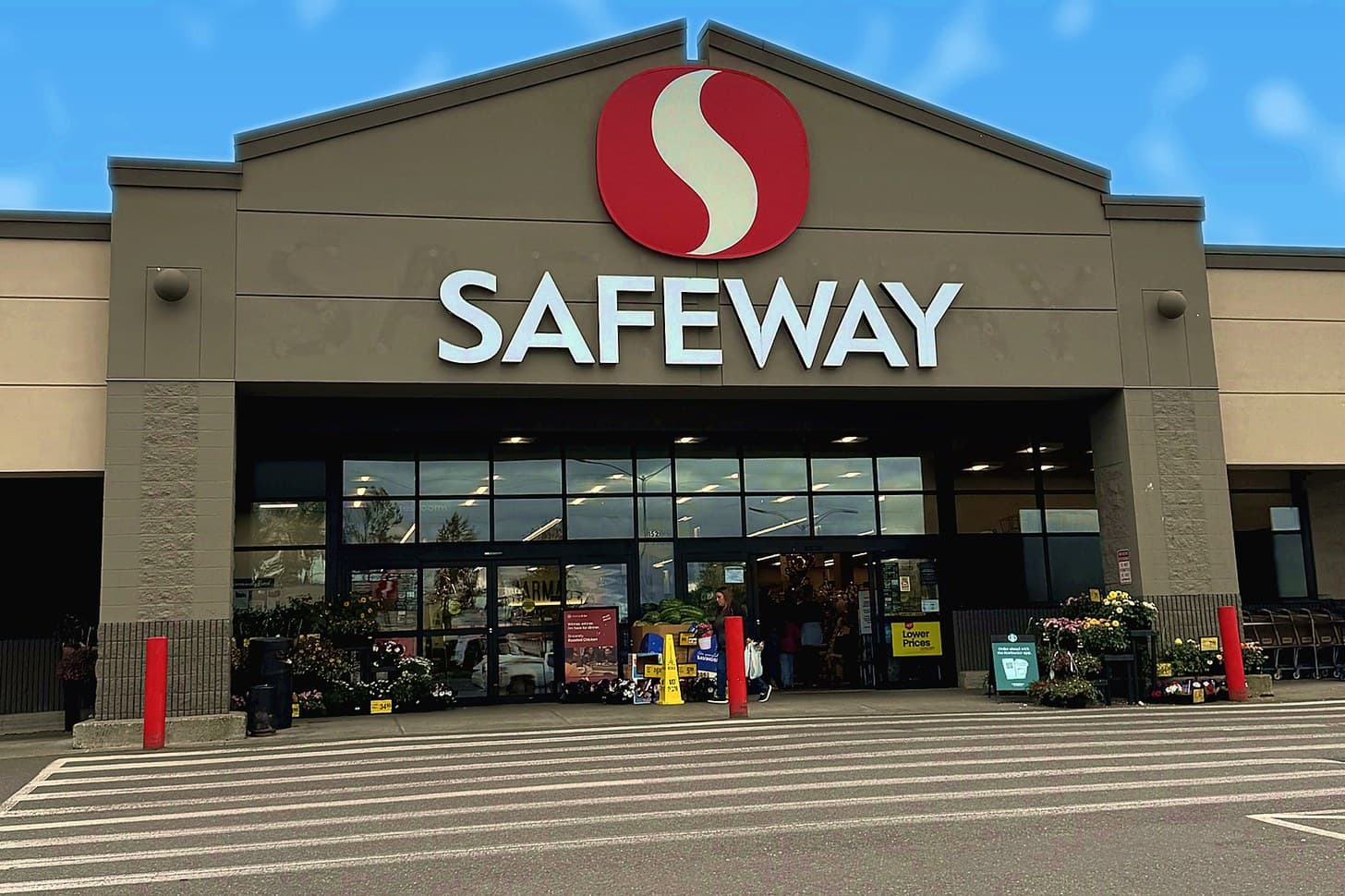
In 1925 the word on Roosevelt Avenue was a promise about money. In 1986 somebody bought the company with $4.2 billion, mostly borrowed.
$1,088.
That is what the first store cost. One small grocery in American Falls, Idaho, bought in August 1915 by a man named Marion Barton Skaggs from his own father, a Baptist minister.
Keep that number in your pocket. We will need it at the register.
The store at 152 Roosevelt Avenue East opens at five in the morning and closes at one, which means it is dark for four hours a day. The rest of the time somebody is in there. A nurse coming off shift. A contractor buying a sandwich and a quart of oil. A person in pajama pants who needs cough syrup and would rather not discuss it.
Above all of them is the sign. Red circle, white S, the word in capital letters.
Most people assume the word is about safety. It isn't. It is about money, and it is a promise, and the company broke it.
Aisle 1: the preacher's son
M.B. Skaggs had one rule that mattered more than the others. No credit.
In 1915 most grocers ran a tab. You took your flour and coffee home and paid at the end of the month, or tried to. Skaggs thought the tab was the problem. A grocer who had to wait to get paid charged more to cover the wait, and a family that ran a tab ended up owing. He later warned about what he called "the growing evil of installment purchasing."
So his stores were cash and carry. You paid in full, you carried it home yourself, and you owed nobody anything when you walked out the door.
He also put the goods on shelves where shoppers could reach them, instead of behind a counter with a clerk fetching each can. That sounds like nothing now. At the time it meant he could charge less.
Aisle 2: the contest
Meanwhile in California, a grocer named Sam Seelig ran a chain under his own name. In 1925 the company held a contest to find a new one.
The winning entry was Safeway.
It was never about the parking lot. The safe way was a way of paying. A family that bought its groceries with cash could not go into debt on its grocery bill. That was the whole pitch, and the company printed it as a slogan in two short orders: "Drive the Safeway. Buy the Safeway."
In 1926 Charles Merrill, the Merrill of Merrill Lynch, merged Seelig's stores with Skaggs's. He gave Skaggs a choice. He could take $7 million in cash, or $1.5 million plus 30,000 shares in the new company.
The man who did not believe in credit took the shares. He was betting on the name. By 1928 every one of his stores carried it.
Remember the promise. No debt.
Now skip ahead sixty years.
Aisle 3: the most expensive groceries in America
By 1986 Safeway was the largest grocery chain in the country, and it was being circled. The Haft family's Dart Group had been buying Safeway stock and wanted control. To keep the raiders out, Safeway's management turned to a private equity firm, Kohlberg Kravis Roberts.
KKR bought Safeway for $4.2 billion. It paid the way those deals were paid for in 1986, mostly with borrowed money, and the debt landed on Safeway's own books.
Read that with the sign in mind. The company named for never owing anybody was bought with an enormous loan, and the loan was its to pay back.
But the strange part is what came next.
To make the payments, Safeway sold stores. Nearly half of its roughly 2,200 stores went. Whole divisions went. In 1990 a Wall Street Journal reporter named Susan Faludi went looking for the people on the other end of those sales. Her story ran on May 16, 1990, under the headline "The Reckoning: Safeway LBO Yields Vast Profits but Exacts a Heavy Human Toll." She counted 63,000 managers and workers cut loose from Safeway through store sales or layoffs.
The next spring the story won the Pulitzer Prize for explanatory journalism. The prize board cited its account of "the human costs of high finance."
There are not many grocery chains with a Pulitzer in their history. Safeway has one, and it is not a compliment.
Aisle 4: the store across town
Safeway got through it. It went public again, and in January 2015 it merged with Albertsons. That is who owns the store on Roosevelt Avenue today.
In October 2022, Kroger announced it would buy Albertsons for $24.6 billion.
Kroger owns QFC. Enumclaw has a QFC, on Monroe Avenue.
If you live here, you have already done the math. The two big supermarkets in town were about to belong to the same company.
The companies had a plan for that. They would sell 579 stores to C&S Wholesale Grocers, 124 of them in Washington, and they published the list. The Enumclaw Safeway was not on it. The Enumclaw QFC, at 1009 Monroe Avenue, was.
On December 10, 2024, two judges ruled against the deal on the same day. One was Adrienne Nelson, a federal judge in Oregon. The other was Marshall Ferguson of King County Superior Court, hearing the lawsuit Washington's attorney general had filed to stop the merger. The next day the companies called it off, and Albertsons sued Kroger for at least $6 billion.
So when you drive from one end of town to the other to see who has eggs on sale, you can thank a King County courtroom for the drive.
Checkout
Go to the front of the store some morning and watch the registers. Tap. Tap. Chip. Somebody holds up a phone. Count the people paying cash. It will not take long.
M.B. Skaggs paid $1,088 for one store and would not let anyone owe him for a loaf of bread. A hundred and eleven years later, the company he built has been bought on credit, sold off by the half, and very nearly folded into its biggest rival. His own name came off the stores almost a century ago.
The word he bet $7 million on is still up there over Roosevelt Avenue, red and white, above the crosswalk stripes and the painted arrows.
Pay cash for your groceries once this week. Notice how it feels to walk out owing nobody anything.
Consider it.
Sources
- Marion Barton Skaggs, founder of Safeway
- Safeway's history, the 1925 naming contest and the cash-and-carry rule
- UPI, July 31, 1986: Dart gives up Safeway bid, joins in KKR acquisition
- Susan Faludi and her 1990 Wall Street Journal story on the Safeway buyout
- The 1991 Pulitzer Prizes
- The attempted Kroger-Albertsons merger and the December 2024 rulings
- MyNorthwest: the 124 Washington stores in the Kroger-Albertsons divestiture plan
- Safeway, 152 Roosevelt Ave E, Enumclaw: store page and hours
Photo: Consider / Enumclaw.com.
Story label: Original Story or Guide
Originally published: