

Feature
King County's first substantive ruling on the Cumberland gravel mine took 33 months. It ordered a study, and the yes or no comes after.
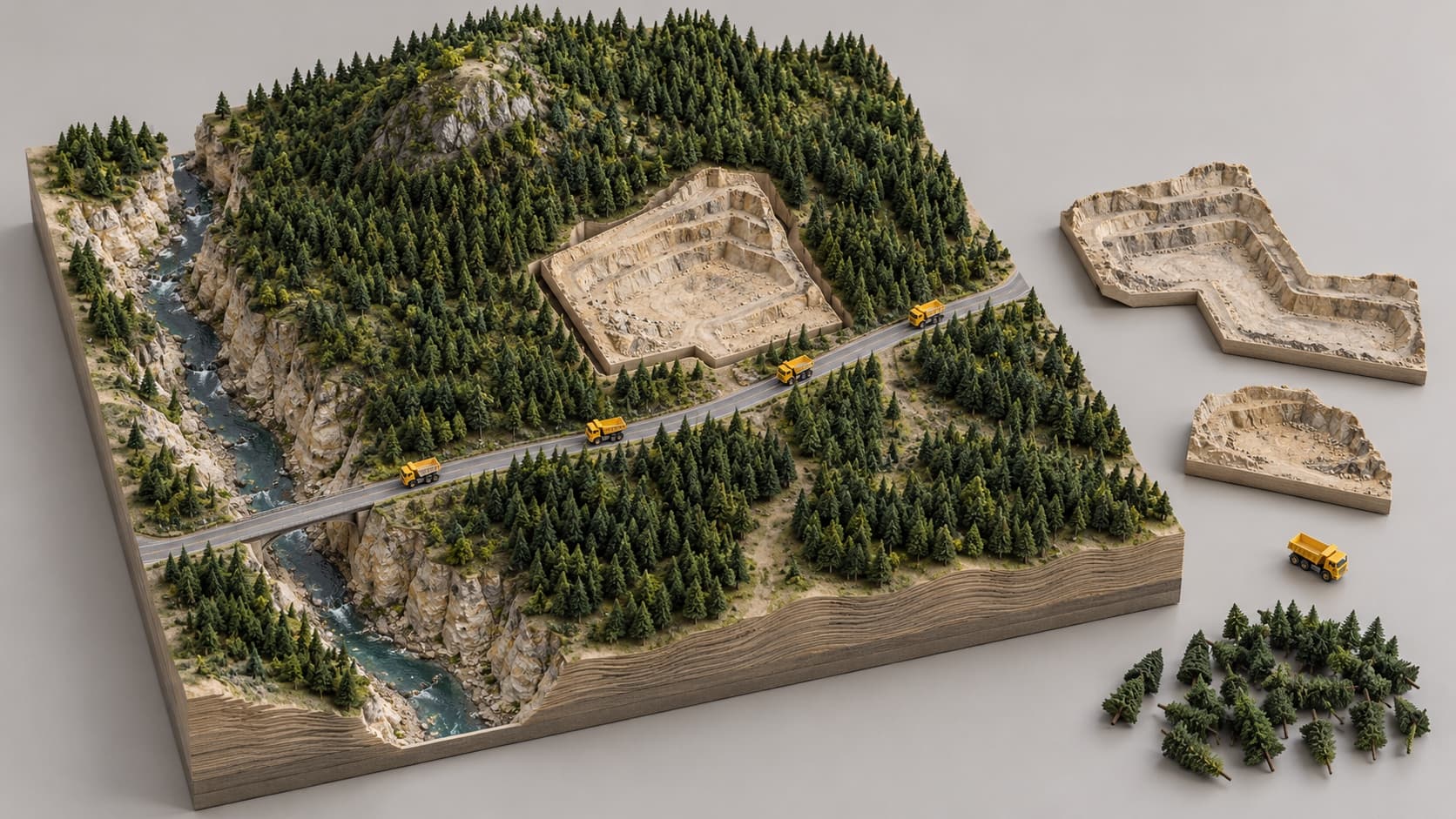
What Segale wants to build north of Cumberland, what King County ruled on July 8, 2026, who decides next, and the October 13 meeting in Enumclaw.
On the evening of February 27, 2024, the gym at Black Diamond Elementary filled past its chairs. Segale Properties had come to explain the gravel mine and asphalt plant it wants to build north of Cumberland. By the Courier-Herald's account the slides were blurry, the room was hot, and the shouted questions came fast enough that the presenters cut the presentation short and passed the microphone around. Many who spoke, the paper reported, seemed unaware that nobody was recording them. To count, the paper said, comments had to be emailed to King County by March 12.
The next room is at Green River College's Enumclaw campus on Tuesday, October 13, at 6 p.m. The opposition group Defend Cumberland announced the meeting, and Leon Richardson, director of King County's Department of Local Services, is to be the guest speaker.
After this long, the fight might seem near a verdict. The record says otherwise. Segale filed its application on October 2, 2023, by the county's notice, and the public heard of it the following February. The county's first ruling of substance came 33 months later, on July 8, 2026, and it approved nothing and rejected nothing. It found that the proposal "is likely to have a significant adverse impact on the environment" and ordered a full study. The yes or no comes after that, and the county has named four possible alternatives for the study: no mine at all, the mine as Segale filed it, and two variations on it.
What Segale filed
The permit file is GRDE23-0083, and its name settles one question: Cumberland Aggregate Mine and Asphalt Plant. The asphalt plant is in the application, listed beside an office, a truck scale, a maintenance shop and a wash-water recycling facility. Segale's environmental checklist says it would replace the plant at the company's Auburn pit, which Segale expects to run out of material within a few years.
The site is 990.53 acres of forest-zoned land in four blocks, by Segale's own slide: 436 acres to the south, 252 to the west, 158 to the north and 144 to the east. They sit on four sides of a 599-acre parcel that the county assessor lists under the state Department of Natural Resources. The Green River runs to the north and west, Kanaskat-Palmer State Park, a stop in this site's Green River Gorge piece, borders the northeast corner, and Cumberland's houses lie south across SE 352nd Street. Lizard Mountain straddles the south block and the state parcel; Segale says its steep slopes will not be mined.
Segale, which is based in Tukwila and describes itself as a family company, bought the land from Plum Creek Timber in 2003, and its checklist says it bought it for gravel. It estimates 50 to 55 million cubic yards of material, dug in stages of 50 to 100 acres and replanted as the work moves, over 25 to 35 years. The county's July paperwork says 30 years in one document and 35 in another.
The numbers, and whose they are
Start with trucks. The checklist, last updated in September 2023, puts peak construction season at about 668 vehicle trips a day and the off season at 298, counting every arrival and every departure, with 90 percent of them trucks, spread over 18 hours. In March 2024 the Courier-Herald quoted Segale's asset manager, Mike Pruett, at upward of 680. A Segale traffic summary posted in 2024 splits the 668 into 550 truck trips and 118 by lighter vehicles, or "1 truck trip every 2.5 minutes" averaged over 24 hours. By July 2026 the paper's shorthand was 600-plus trucks.
These are one estimate in four outfits. Segale's papers differ on how many of the 668 are trucks, about 600 or 550, and on whether the peak spreads over 18 hours or 24. The 668 is an estimate built from the trucks and staff Segale expects to run, which its checklist says is drawn from trip counts at the Auburn pit. The existing traffic it is measured against was counted at five intersections on a single Wednesday, October 27, 2021.
The application puts the entrance and exit on Cumberland-Kanaskat Road SE, with a second access on SE Green River Gorge Road for emergencies only. The Courier-Herald's July story named a different road, Cumberland-Veazie, as the one opponents fear the trucks would use. Segale's traffic study sends 60 percent of peak-hour trips north toward Kent-Kangley Road and SR 169, and 40 percent south through Cumberland, most of those toward SE 400th Street and SR 169 north of Enumclaw; one of its test intersections is on Veazie-Cumberland Road. Its engineers found no significant traffic impact. Opponents say the study leaves out noise, road wear and regional growth.
The county's July determination says the facility would operate 7 a.m. to 5:30 p.m. every day. The checklist's sound study modeled the asphalt plant and the trucks from 7 a.m. to 4 p.m. and again from 7 p.m. to 4 a.m. Neither document, as read for this piece, says how the two schedules fit together; it is a question the impact statement would be expected to answer.
Then water. The checklist asks for 175,000 to 250,000 gallons a day from "existing Group A or B purveyors using existing water rights," meaning public water systems in either of the state's two classes, and it names none. Segale's 2024 slides named the Cumberland Co-Op's system and said the company's use would bring investment and upgrades. Afterward a co-op member told the Courier-Herald the board would vote any hookup down, and Zach Pratt, a local geologist who opposes the mine, said, "They want about 10 times the volume that Cumberland currently uses." Segale's project website now says the water would come from Tacoma Water's pipeline beside the site, which in the company's words "provides the water source for the Cumberland Co-Op water system." This site's piece on Tacoma's Green River water covers that pipeline, though not the co-op. What the co-op's board has formally decided, if anything, is in no record this site could find.
What July 8 decided
Washington's State Environmental Policy Act makes an agency answer one question before it rules on a project: is significant environmental harm likely? If no, the environmental review ends there. If yes, the agency issues a Determination of Significance and an environmental impact statement must be written. The statement analyzes the likely harms, the alternatives and the possible fixes. It does not grant or refuse a permit, and under state rule it is the lead agency's statement, here the county's, whoever drafts it.
King County was to answer by April 25, 2025, the Courier-Herald reported. That became June 12, and then, in the department's words as the paper gave them, "a few weeks." The few weeks ran to nearly thirteen months. Ty Peterson, the county's SEPA official, signed the determination on June 30, 2026, effective July 8.
It lists twelve subjects for study, among them groundwater, the Green River, fish and wildlife, recreation, noise, air, traffic, fire safety and water supply. It also names four alternatives: no mine; the mine as filed; a version that "contemplates a land exchange with Washington Department of Natural Resources"; and a scaled-down mine. The exchange was Segale's request. Its checklist asks the county to consider a trade: the north and west blocks, and all or part of the east, for the state's 599 acres in the middle.
Comments on the study's scope closed August 7. Appeals of the determination closed August 3.
What each side says
Pruett told the Courier-Herald in July that Segale "has always anticipated that an environmental impact study would be required for this project and does not plan to appeal the SEPA determination." The company's website says, "No stormwater or runoff of any kind will leave the site." It says mining would stay a quarter mile from homes and ten feet above groundwater, use no explosives, and end with the land replanted as forest.
Defend Cumberland, the Enumclaw Plateau Community Association and a third group, Concerned Citizens of Cumberland, dispute those assurances and list their own concerns: the river, wells and springs, trucks at night, fire risk at the asphalt plant, and access to the state land. "If permitted, this proposed project would impact public health and safety, recreation, and environmental integrity for generations to come," Defend Cumberland's site says. Its spokesperson, Bernie McKinney, said of the county's delay, "we think it is because of the over 500 letters opposing this project." That is McKinney's reading; the county documents opened for this piece give no reason for the time it took. An online petition against the mine showed 5,472 signatures on October 1. Enumclaw's mayor at the time, Jan Molinaro, wrote to the county on March 8, 2024, to oppose the mine, mainly over traffic, the paper reported.
Who decides, and when
State law says a lead agency "shall aspire" to finish a final impact statement within twenty-four months of the threshold determination, the law's name for a ruling like the one of July 8, which here points to July 2028. The law attaches no penalty. Defend Cumberland told the paper it expects a couple of years.
A draft comes first, and by state rule anyone has 30 days to comment on it. If 50 or more people ask in writing within those 30 days, the county must hold a hearing.
After the final statement, the permit Segale applied for, a grading permit, is decided by the manager of the county's Permitting Division, inside Richardson's department. The July notice says: "A public hearing is not required for this application prior to the Permitting Division's decision." That decision can be appealed within 24 days to the King County Hearing Examiner, and from there to court. The county can approve, attach conditions or deny. To deny on environmental grounds, state law requires a finding that the final statement identifies significant harm that reasonable mitigation cannot cure. Segale would also need a state reclamation permit, a state sand and gravel permit and a regional air permit.
The checklist expected mining to start in "approximately the year 2026."
If you go, and how to read the file
The meeting is Tuesday, October 13, 2026, at 6 p.m. at Green River College's Enumclaw campus, 1414 Griffin Avenue. Defend Cumberland announced it and repeated the date, time and place on its Facebook page; the Courier-Herald reports that Richardson will be the guest speaker. The Courier-Herald's notice mentions no charge, registration or room, so confirm with the group, at defendcumberland.org or on its Facebook page. It is a community meeting and not a county hearing, and nothing in the notice says remarks will enter the permit file. In 2024 they did not. One more reason to confirm: the Enumclaw Plateau Community Association ordinarily meets on the second Tuesday of the month from 6 to 7:30 p.m. at the Muckleshoot library, which is the same evening, and nothing found for this piece says whether the two are connected.
The file is on King County's Projects of special interest page under GRDE23-0083: the determination, the checklist and a dozen technical appendices. To be on the record, write to Ty Peterson at ty.peterson@kingcounty.gov or call 206-477-0449, cite the file number, and ask to be notified of official notices. The next guaranteed comment period opens when the draft statement is issued. The county has published no date for it that this site could find.
Story label: Original Story or Guide
Originally published: