

Feature
Selleck is a lumber town that has outlived its company by 87 years, and it has been telling its own story slightly wrong
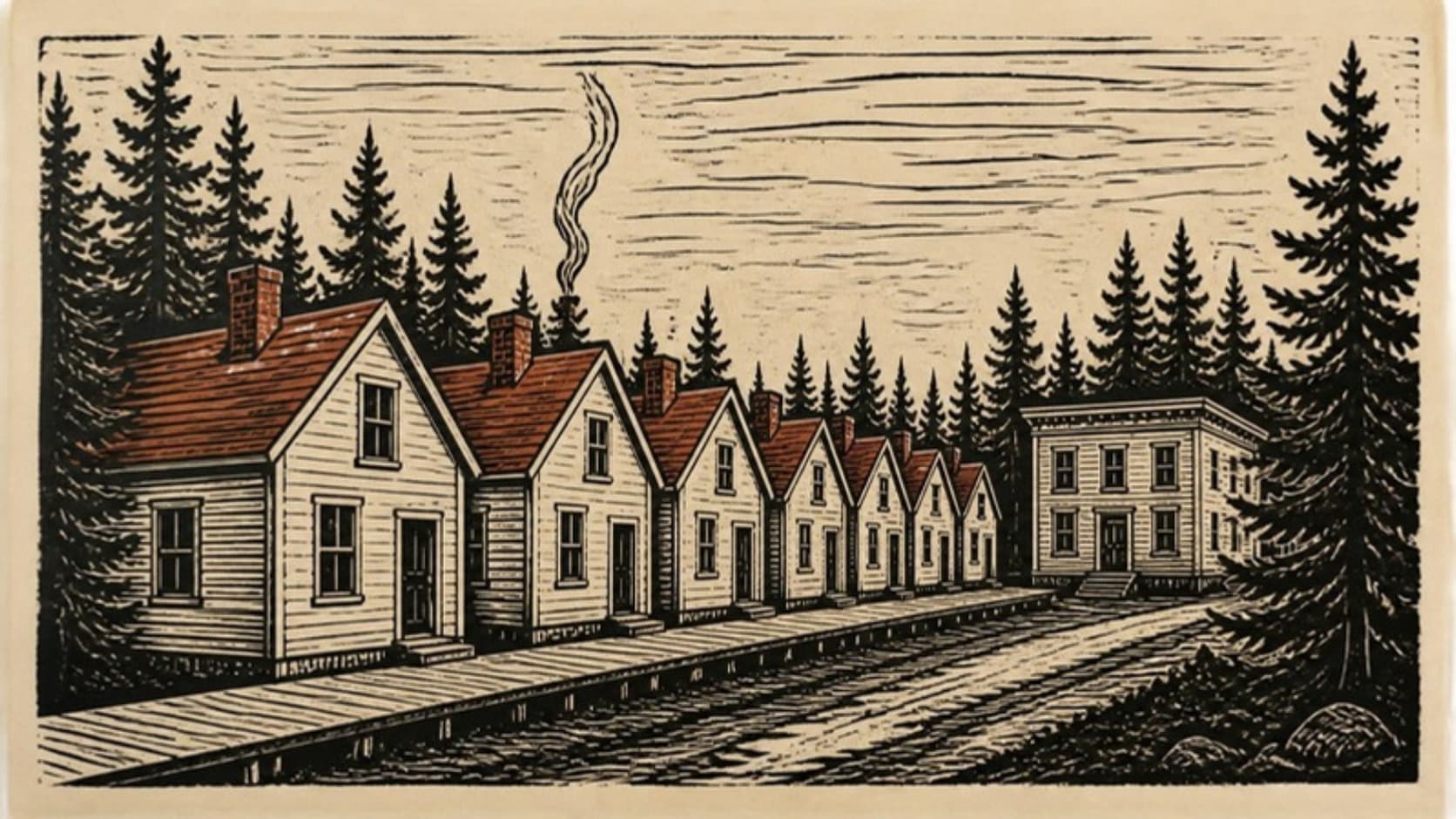
Pacific States Lumber built Selleck in 1909. The mill is gone, the houses stand, and the Japanese families it says came in 1923 were there a decade before.
Most company towns end the same way. The mill closes, the company leaves, the houses are hauled off or burned, and in fifty years a historical society puts up a sign in a clearing. This site has told that story once already, about Franklin in the Green River gorge, where a town of a couple thousand people is now a cemetery and some holes in the ground.
Selleck did not end that way. Drive north from Enumclaw through Cumberland and Kangley, cross toward the Cedar River, and at the end of the road there is a lumber town whose mill stopped for good in the late 1930s and whose houses are still in a row, rented as recently as 2007, and numbered, at last report, the way the company numbered them. It is on the National Register of Historic Places. What it has not kept quite straight is who arrived when.
Frank Selleck's first mistake
The company was formed in November 1908 by a group of timber men who were already cutting logs for the Tacoma market. They hired Frank L. Selleck, who was running a mill at Kapowsin, as vice president and general manager, and they picked a mill site on Taylor Creek. Selleck's own memoir, as quoted by Ken Jensen in the Black Diamond Historical Society's bulletin, records what happened a couple of weeks and about a thousand dollars into the job. A visitor appeared: R. H. Thompson, the city engineer of Seattle. "He said, 'Don't you know that you can't build a mill here? This land is all in the Seattle watershed and the city will never permit it.'"
They moved. The second site, northeast of Kangley near the Cedar River, started cutting in October 1909, before the plant was even finished. The company later sold its watershed holdings to Seattle for $50,000 and kept the right to log them. By 1911, according to the town's National Register nomination, the mill was cutting 175,000 feet in a ten-hour shift, the post office and the railroad station had moved from Kangley to Selleck, and 500 people lived there. Frank Selleck left that December and went to California. The town kept his name.
What a company town looked like
The nomination describes a place built in layers by rank. The superintendent lived in house number one. Supervisors and the company doctor had the 300 row; mill hands lived in the 200 and 500 rows, in plain houses with a living room and kitchen on one side, two bedrooms on the other, and two sleeping spaces upstairs. Loggers lived in the company hotel, 150 men in it during the 1920s, with 35 families in company houses and Tacoma dance bands in the hall on Saturday nights. The town was served by both the Northern Pacific and the Milwaukee Road, with a separate loading shed for each, and in 1925 the company built a logging trestle over the Cedar River 204 and a half feet high, which it billed as the highest in the world.
The mill burned in 1914 and was rebuilt. A fire in July 1929 destroyed eight to ten million feet of lumber and the dry sheds; the Enumclaw Herald wrote that it "threatened for a time to destroy the mill and entire town of Selleck." The school burned at the turn of 1930 and was rebuilt that year as the two-story building that still stands.
The Japanese Camp
West of the tracks, near John and Florence Lavender's store and tavern, in the little suburb called Lavender Town, was the Japanese section of the town, known as the Japanese Camp. The houses there were built by the families themselves among the stumps, on company land: they owned the house and not the ground, and when the company added bathrooms to its own houses in 1918, theirs did not get them. There was a Japanese language school in a small hall, a baseball team called the Yamatos with the town's name across the jerseys, and a foreman, Frank Ozawa, who ran the Japanese crew from 1925 to 1939, had nine children, and built a pond and garden whose remains an archaeologist found in 1988.
T. Z. Maekawa worked the green chain from 1923 to 1925. He told a Northwest Nikkei reporter in 1994 that he made "about $3.50 to $4 a day," on a six-day, sixty-hour week, with $18 a month taken out for food and $1.50 for housing. The skilled jobs went to white men. The school was shared. Rev. Joseph Sakakibara, who was born in Selleck in 1925, put it this way in the same interview: "We played together at school. But after school, we lived separate lives; we lived a Japanese lifestyle."
The story the town tells
Here is where Selleck's memory slips. The town's own National Register nomination, and a 2007 Seattle Times feature after it, say the Japanese workers came because of the great order of 1923, when Pacific States cut lumber to rebuild Tokyo after the Kanto earthquake. It is a tidy story: a catastrophe across the ocean, a contract, a crew brought over to fill it.
The record does not support it. A Selleck teacher of the 1920s, Mrs. Lloyd Qually, told a reporter in 1975 that Japanese families were there as early as 1912 or 1913. A Japanese American writer, Joe Abo, records that his father was born in Selleck in 1911. The Sakakibara family came around 1915, after a strawberry farm on Bainbridge Island failed. Local historians count 147 Japanese residents in the Selleck area in the 1920 census, three years before the earthquake, a figure this site has not checked against the census sheets. The Tokyo order came to a town where the Japanese were already neighbors of long standing. Somewhere between the 1970s and the 1980s the order, which was famous, became the reason for the people, who were not.
What happened to those families afterward is less certain. The mill had stopped running by the late 1930s, the company went bankrupt in 1939, and the Japanese began leaving, many for Oregon and California, as the wages stopped. The nomination guesses that any who remained were relocated during the war, and says so with the word "undoubtedly," which is the word people use when they have not checked. This site has not been able to check either, and will not guess.
Mrs. Qually had eight to ten Japanese pupils in her class. "I kept in touch with some of them," she said in 1975, "and learned in later years that all had gone to high school and most to college."
Why it is still there
In 1940 two former mill employees bought the whole town for $3,000. During the war about forty houses were rented to shipyard workers from Seattle and Tacoma. In the 1960s it passed to two Boeing engineers, then in 1969 to a couple who paid $150,000, and around 1971 to Robert Schaefer's company, Selleck Inc., which still runs it. King County made it a landmark on February 26, 1987, and it went on the National Register on March 16, 1989: eighteen acres, nineteen contributing buildings, including the 1930 school, the 1918 community hall and the superintendent's house. The Enumclaw School District ran Selleck Elementary into the 1970s; the building has been empty of pupils since 1981. In 2007 about ninety people lived in the town. "It's like keeping an old Model T running," Tim Schaefer told the Seattle Times then.
The nomination gives the reason in one sentence: "Single ownership has prevented the disintegration that has been the fate of other company towns." There is a second reason, and it is the one Frank Selleck ran into in the winter of 1908 and 1909. The Seattle watershed that threw the first mill off Taylor Creek, together with state and national forest, now bounds the town on three sides, and little can be built up against it. The city that would not let the mill start is the reason nothing has crowded in on the town it left behind.
It is private property, and the people who live there live there. Go look from the road, the way you would look at anyone's street.
Story label: Original Story or Guide
Originally published: