

Feature
Tacoma's water main runs through Enumclaw. Once, the water ran the other way.
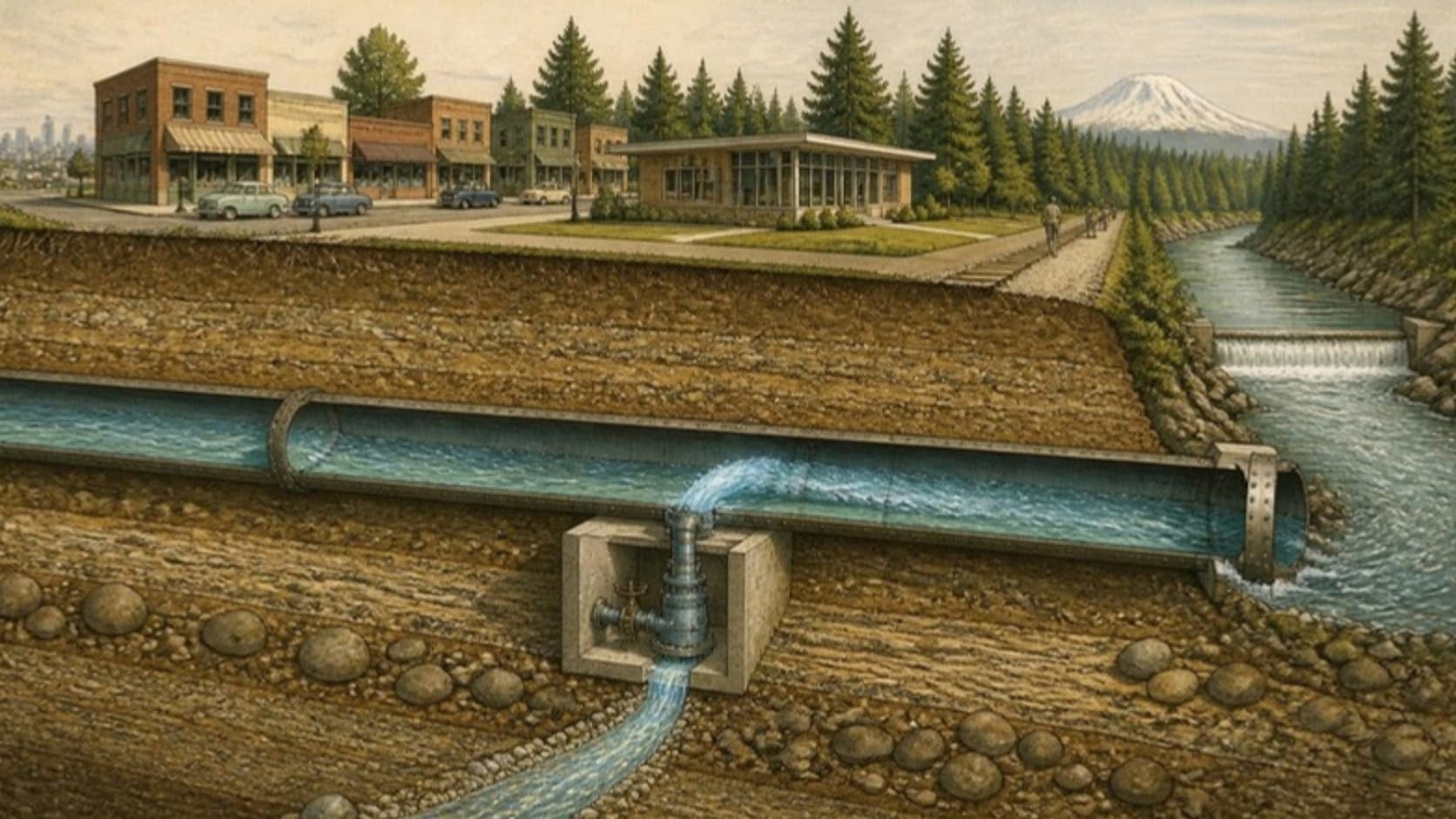
Since 1913 Tacoma has piped the Green River through Enumclaw. The town keeps an emergency valve on it, and in 1987 Enumclaw's water went into Tacoma's pipe.
About three miles above Kanaskat-Palmer State Park, a diversion dam turns part of the Green River into a pipe, and the pipe goes to Tacoma. Most people on the plateau know that much.
What people lose track of is the route. Tacoma Public Utilities, telling its own history, says that when the line was built "hundreds of workers laid 43 miles of pipe across difficult terrain from Enumclaw to Tacoma." A Tacoma contract from 2025 names the job here "Enumclaw Pipeline 1." The city of Enumclaw has a valve on it, and the valve has a story the town has mostly forgotten.
A city that hated its water
Tacoma went to the Green River because it was tired of what came out of its taps. HistoryLink's account of the project describes the city's early supply bluntly: "Creeks and flumes that supplied the city were exposed to contamination from humans and livestock and Tacomans complained of dirty, bad smelling, bad tasting water."
The fix was gravity. A river high enough in the Cascades could push water to Tacoma with no pumps at all, if the city would pay for the pipe. The argument over the river plan became so heated that Mayor George P. Wright had the police chief raid the offices of the engineer Harnett Fuller and seize his plans. Voters said no in 1907, even after Wright cut off water to South Tacoma just before the election to make his point. A few years later they said yes.
The city took a right-of-way along the Northern Pacific Railroad, whose line through Enumclaw came down from Palmer, which goes a long way toward explaining why the pipe passes through town. Landowners fought it in court. The work took two years and cost $2.25 million for the headworks, the pipeline and a receiving reservoir. On May 29, 1913, the commissioner of public utilities, Nicholas Lawson, opened the valve into Tacoma's J Street standpipe, and the pressure knocked the standpipe out of commission. Regular service began that July.
The original line was mostly wood stave pipe, with steel in places, and over the 1920s, 1930s and 1940s Tacoma replaced the wood with concrete or steel.
Under the river at Buckley
Where the line goes under the White River near Buckley, at river mile 23.3, the state's salmon recovery records say Tacoma's supply pipe was "installed at a shallow depth under the river in 1912." The White River does not respect shallow things. In the 1920s a concrete structure went in to keep the river from scouring the pipe out, and by the time it came out, the state's records were calling it a dam, with a fish ladder.
Between 2001 and 2004 Tacoma Water buried a new length of pipe deep enough to need no protection and took the dam and ladder out, a $2.1 million job, $940,000 of it a salmon recovery grant through the state Recreation and Conservation Office. After about eighty years, the river ran free over the pipe again.
The diversion at the head of the pipe is the older barrier. A King County assessment of the Green River notes that salmon have been kept out of the upper river since 1911, when Tacoma began building its diversion dam at river mile 61.
The gate and the guards
A gravity supply is only as clean as the ground it drains. Tacoma started buying land in the upper Green in 1951 and wanted a half-mile buffer around the river that nobody could enter. Property owners, anglers, King County and federal agencies fought it. HistoryLink records the low point: "At one point in 1962, a King County commissioner blew the locks off a gate to the watershed and dragged the gate away." Tacoma's answer is recorded in the next sentence. "Tacoma Water responded with another gate and guards."
The gates are still there. Tacoma describes a watershed of about 148,000 acres between Chinook and Snoqualmie passes, and says "gates and guards further limit public and commercial access." The surprising number on the same page is ownership. Tacoma Water owns approximately 12 percent of the watershed. The rest belongs to a variety of public and private owners, and Tacoma keeps people out through agreements with federal, state, tribal and private landowners as much as through title.
Seattle noticed the difference. As Tacoma's long-delayed second pipeline finally moved toward construction, Seattle signed on in 2000 for a one-third share of the water and then, in HistoryLink's words, "backed out in 2002 when it disapproved of using water from a watershed open for recreation." By Seattle's standard, Tacoma's gates were not enough.
A dam, a scare and a filter
The Army Corps of Engineers' Howard A. Hanson Dam, 3.5 miles above Tacoma's diversion, was dedicated on May 12, 1962, to stop floods in the Green River Valley. In January 2009 a storm pushed the reservoir to a record height, and afterward the Corps found depressions in the dam's abutment. The King County Council told residents that September that a major storm had "damaged an abutment adjacent to the Howard Hanson Dam, which has diminished the effectiveness of the dam and increased the flood risk to the Green River Valley." The Corps installed a grout curtain that fall. The scare was mainly about floods in the valley below, but it was the same river that fills Tacoma's pipe.
Tacoma's second line, Pipeline 5, took four decades from proposal to completion and cost $245 million. HistoryLink describes it crossing southern King County to a reservoir in Federal Way, and it serves a regional partnership with Kent, the Covington Water District and Lakehaven that can draw up to 65 million gallons a day.
Then there was the filter. Tacoma says that "until the Green River Filtration Facility was built in 2015, the Green River was one of the few major unfiltered surface water supplies left in the U.S." Federal rules on cryptosporidium ended that. The state Department of Health said it would be the largest filtration plant in Washington. Tacoma lists its original Green River supply at about 73 million gallons a day, with the second supply adding about 27 more on average.
The valve on SR 410
Enumclaw drinks from its own springs and wells east of town, which this site covered last week. It also sits on Tacoma's main, and in 1977 it built a way in. The city's 2024 Water System Plan describes a booster pump station in a concrete vault on the west side of SR 410, north of Warner Avenue, drawing from "Tacoma's 52-inch regional transmission main." The station has two 100-horsepower pumps, and one of them can move about 1,000 gallons a minute, roughly 1.4 million gallons a day, or about a fiftieth of Tacoma's original Green River supply.
Enumclaw does not want that water unless it has to have it. The plan is candid about why: "City policy is to avoid using the intertie due to the substantial difference in water quality and the fact that it costs less to produce water from City sources." Tacoma's water arrives filtered, fluoridated and typically carrying more than 1.5 milligrams of chlorine per liter, against about half a milligram in the city's own supply. Enumclaw adds no fluoride. The city says the intertie has not been used since 2003.
The pipe also turns up downtown. When Tacoma put out a 2025 contract for a corrosion-protection station on Enumclaw Pipeline 1, the power company's work order gave the address as 1700 1st Street. That is the Enumclaw Library, on old railroad ground.
1987
Here is the part the valve's reputation leaves out. The city describes the intertie as an emergency source, Tacoma water held in reserve for the smaller town. The same 2024 plan, in its section on interties, adds one sentence: "With minor piping additions, the intertie may also be utilized to supply water from Enumclaw to the City of Tacoma, as was done in 1987."
It has run the other way at least once. Enumclaw's water went into the pipe that exists to bring Tacoma a river.
The plan does not say why, how much, or for how long, and this site has not found a record that does. It is fair to say what else happened that year. 1987 was the worst drought the Northwest had seen in 92 years, and that October Tacoma warned 80 businesses they would face water shutoffs unless they cut their use. HistoryLink's history of the second pipeline says the droughts of 1987 and 1992 showed Tacoma it needed more water. Whether Enumclaw's contribution had anything to do with that drought is a question for someone with the 1987 council minutes, and this site intends to be that someone.
What it means now
A 52-inch pipe runs through a small town carrying water for a utility that serves about a million people, and the town mostly treats it as scenery. It has not ignored the valve, though. In January the city sought bids for a new masonry electrical building over the pump vault, and in March its public works committee was told the Tacoma intertie work had come in at $250,000 against a $340,000 budget. The agreement governing the valve dates from 1997; as of the 2024 plan, both cities had agreed to renegotiate it and neither had started.
Enumclaw has two positions on the water question. Most days it is the small town beside a big city's pipe. At least once, the water went from the small town to the city.
Story label: Original Story or Guide
Originally published: