

Feature
The rulebook says pitchfork
The seventy-ninth games come to the Expo Center this month
Somewhere there is a committee that had to formally specify that the pitchfork has to be a real pitchfork.
Not a small one. A tapered pole longer than a car, heavy enough that somebody has to help him stand it up. He works his hands underneath, cradles the narrow end against his shoulder, takes a few running steps, and heaves.
The first thing nearly everyone watching gets wrong is that he is not throwing it for distance.
Nobody out there cares how far the caber goes. It’s scored on a clock face. Twelve o’clock is perfect, the log turns over end for end and falls dead away from him in a straight line, like a felled tree. Off to one side is an eleven or a
So the event doesn’t reward power. It rewards control. It asks whether a person can put something very heavy exactly where he meant it to go.
That is a peculiar way to score a sport. It is a completely ordinary way to score a job.
The seventy-ninth Pacific Northwest Scottish Highland Games land on the plateau this month, Friday the 24th through Sunday the 26th, at the Expo Center, the way they have for more than seventy-five years. Sixth-oldest Scottish festival in the country, and it happens here. Friday evening is free.
So: a field guide to the heavy events, and what they actually are.
Start with the stone put. A man throws a rock. That’s the event, a stone, off the ground, heaved from the shoulder. The shot put’s older and rougher relative, except the shot put grew up and got a machined sphere, and this one kept the rock.
The hammer is a weight on a shaft: feet planted and never moved, wind it around your head, let go facing backward, never look. The weights are lumps of iron with a handle, thrown down the field or straight up over a bar, one-handed, which is as alarming as it sounds.
And then there’s the sheaf toss, which is where the whole thing gives itself away.
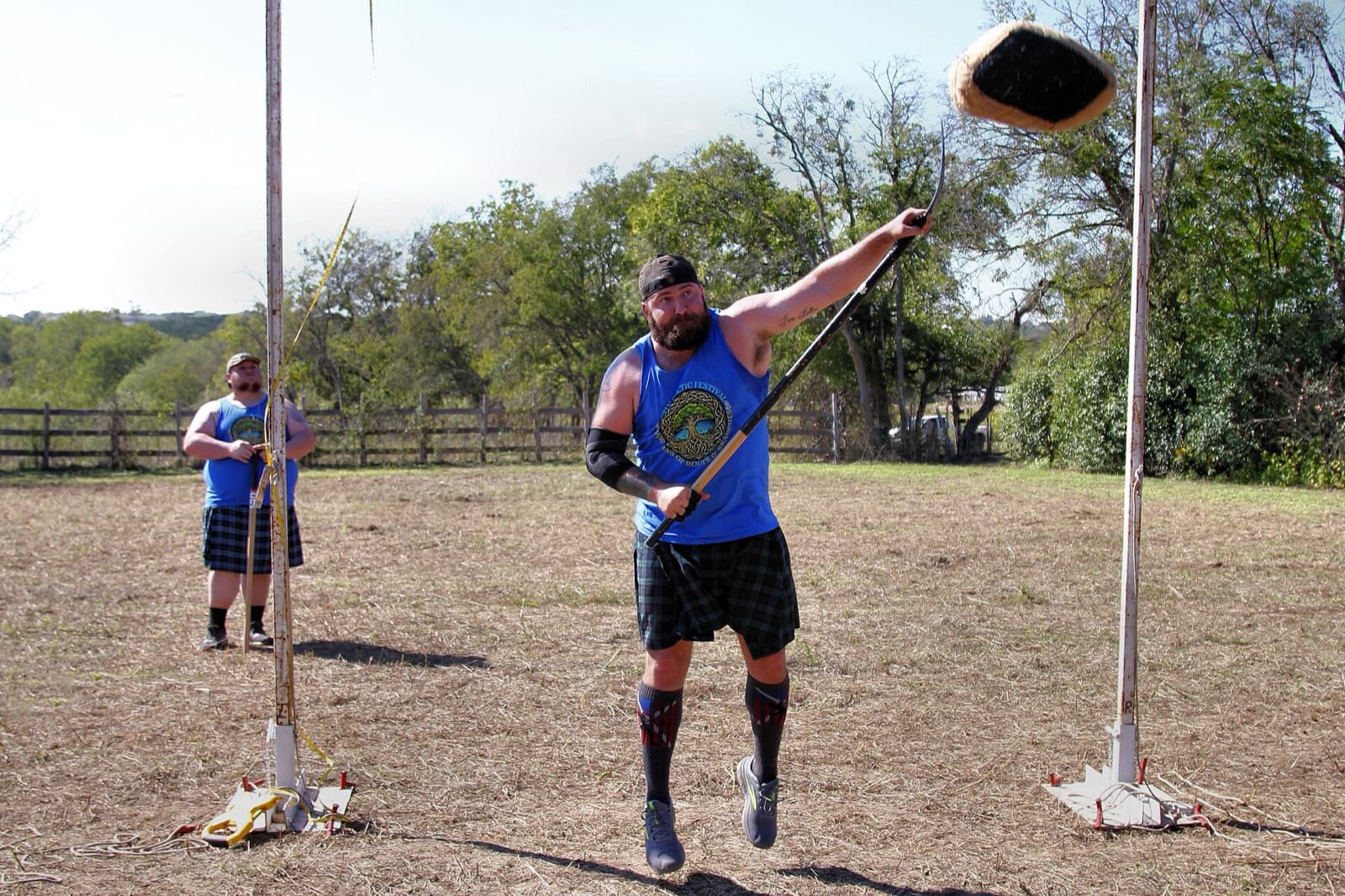
A burlap bag stuffed with straw, sixteen pounds, or twenty. A bar overhead. Three tries to put the bag over it. Everyone who clears moves on, the bar goes up two feet, and it repeats until one person is left.
The equipment rule is the part that should stop you. The competitor uses a pitchfork. Not an implement shaped like one, not a composite fork out of a lab. A pitchfork: five-foot handle, two or three tines, and, this is written down, in the rules, in earnest, no modified equipment.
Sit with that. Somewhere there is a committee that had to formally specify that the pitchfork has to be a real pitchfork. Because the moment you let somebody build a better one, you aren’t doing the thing anymore.
And the thing is haying.
That’s all the sheaf toss is. Pitching a bundle of hay up into a barn loft, which people did every year of their lives because the hay had to get in the loft. Somebody was doing it, somebody else said you’ll never get it over that beam, and here we are with a bar and a judge and a championship. The Gaelic is “Sguab”. It means sheaf. Nobody bothered to rename it.
Once you’ve seen it there you can’t stop seeing it. ‘Caber’ is Gaelic for wooden beam, he’s clearing timber. The stone put is picking a rock off a field, which every farmer who ever lived has done ten thousand times with no applause. The hammer is a blacksmith’s. The sheaf is hay.
There is not one implement on that field that somebody didn’t pick up first because they had to.
Which is why I’d say we have this event filed wrong.
We call it a Scottish festival, imported, four thousand miles from home, and there is genuinely a great deal of tartan. But look at what the athletes are doing. They are competing at farm chores. On a plateau that farms. At an Expo Center that is also the fairground, where the King County Fair, older than the state by twenty-six years, has been laying out what people grew and raised since 1863.
The sheaf toss, by the books, started at country fairs.
It came home.
We wrote about the fair a few weeks back, the quiet barn, the kid with the brush, the auction. Same fairground, same lesson in a borrowed hat. The Scots didn’t bring this town something exotic; they brought a scoreboard for work this valley was already doing. The kilt is the costume. The labor under it is native, and it’s native nearly everywhere, because every people who ever had to get hay into a loft invented a way to argue about who was best at it. Scotland kept score the longest and put it on a calendar.
Which brings it back to the log.
Twelve o’clock. Not how far he threw it. Whether it went where he meant.
No athlete would design that. A farmer would, a farmer doesn’t care how far the log went, he cares that it landed where he wanted and not on the barn. Somebody built a sport out of the difference between strength and control, hauled it across an ocean without quite meaning to, and set it down on the one plateau that already knew the difference.
Go Friday. It’s free after five-thirty. Stand at the rope, watch a man put a log at twelve o’clock, and know you’re watching his great-great-grandfather’s Tuesday.
Four thousand miles from home, and it landed somewhere that already knew the job.
Consider it.
This story first appeared in Beyond Enumclaw, the free Substack newsletter from Enumclaw.com. Subscribe to get new stories in your inbox.
Story label: Original Story or Guide
Originally published: