

Feature
The mill that built Enumclaw burned twice, changed hands twice, and closed in the spring of 2003
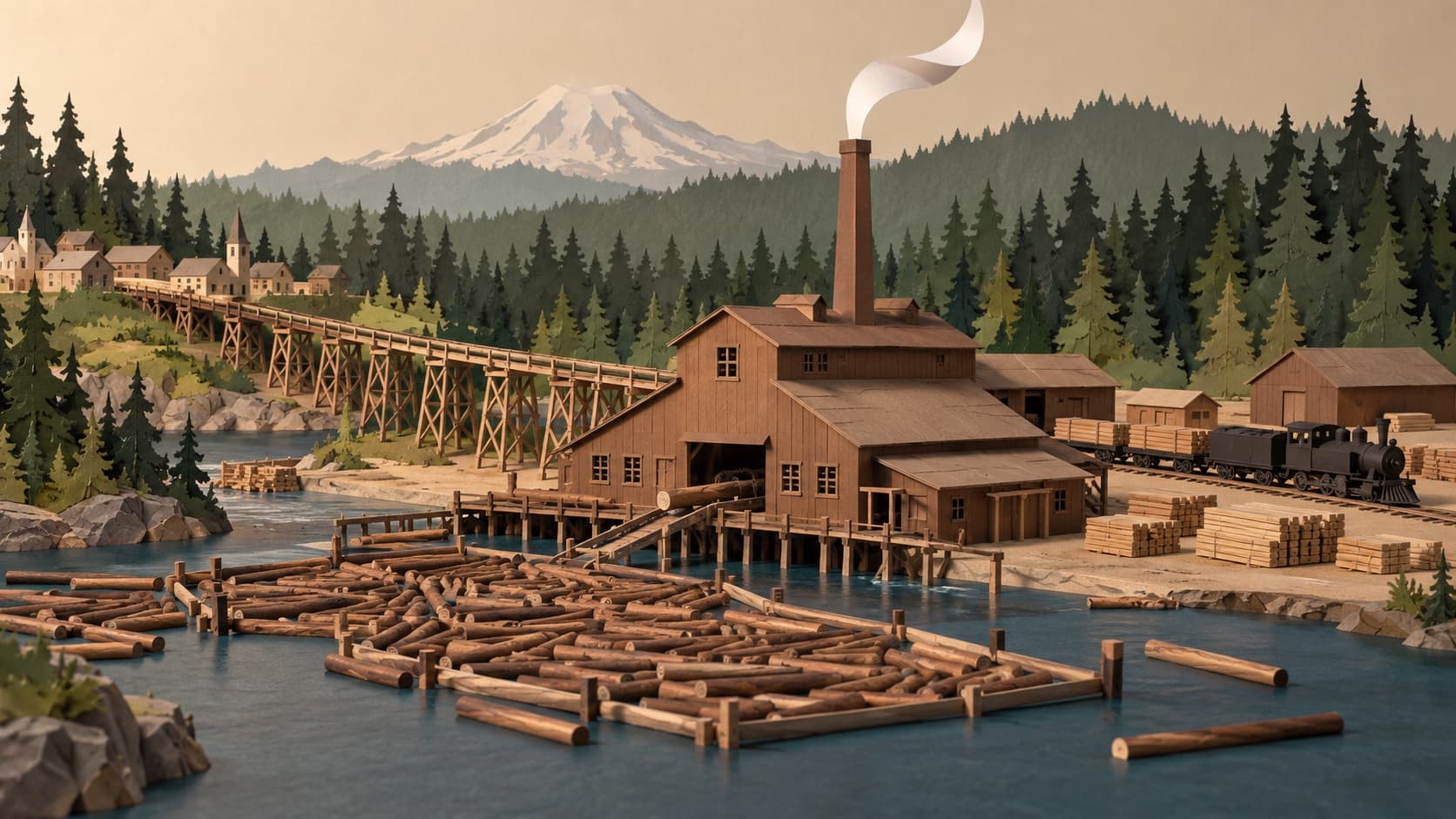
Elijah Goss started Enumclaw's mill in 1889. The Hansons rebuilt it after two fires, Weyerhaeuser bought it in 1949 and closed it in 2003. What is there now.
When Clarence Bagley wrote his history of King County in 1929, he needed two things to explain why Enumclaw existed. One was the town's habit of doing business by cooperative. The other was a sawmill three miles east of town run by a family named Hanson.
The cooperative habit survives as a mutual insurance company on Wells Street, whose beginnings this site's piece on barns and neighbors tells. The mill is a pond on the state's contaminated sites list.
Goss, and the flume
Elijah Goss founded the White River Lumber and Shingle Company in 1889, on the site the mill would occupy for the next 114 years. Within three years it was cutting 200,000 shingles a day, and it solved the problem of being three miles from the railroad the way a lumberman of the era would: rough lumber was floated down a three-mile flume fed by Boise Creek to a planing mill at the edge of town, where it was finished and loaded.
In 1896 the planing mill burned. Goss sold what was left.
The Hansons, and a Scot
The buyers, in 1897, were Carl M. Hanson and his three sons, Axel, Charles and Frank, with two partners: Louis Olson, who ran the Hansons' logging, and Alexander Turnbull, a Scottish mine mechanic from Black Diamond. Carl Hanson had owned a sawmill in Sweden, come to America in 1883, worked the coal mines at Black Diamond and Franklin, taken up a homestead at Lake Sawyer under a deed signed by Benjamin Harrison, and run small mills at Summit and Lake Wilderness with his boys before selling up to buy the burned-out plant at Enumclaw. They renamed it the White River Lumber Company. The town, for a while, called it the Swede company.
It burned again, in 1902 by the historical society's account and 1903 by Axel Hanson's obituary. This time the fire took the sawmill and everything around it, down to the top halves of the logs floating in the pond, and ran downhill toward the planing mill until townspeople and a change in the wind stopped it. The company rebuilt at once, and the rebuilt plant was described, when Axel died in 1943, as one of the model mills of the Pacific Northwest.
Within ten years of the purchase the company employed 500 people, and in time it shipped a hundred railcars of lumber a month: Douglas fir, hemlock and cedar, to every state, mostly the Midwest. HistoryLink records a detail about the owners worth keeping: they encouraged their workers to buy their own homes rather than depend on company stores.
A railroad that touched nothing
For its first dozen years the company's rail line connected to no track but its own. Its first locomotive arrived on the Northern Pacific, and then had to cross three miles of plateau to a mill with no rails leading to it. The crew laid temporary ties, ran the engine forward fifty feet, pulled up the ties behind and laid them in front, and did that for six days. The rail link to town was finished in 1909. Spar-pole logging came in 1912. In August 1920 a forest fire that had already burned a donkey engine and threatened twenty miles of the Page Lumber Company's railroad at Eagle Gorge reached the White River company's timber five miles northeast of Enumclaw, and a hundred of its men went out to fight it. Its timber holdings eventually ran to 50,000 acres.
What the mill gave the town
One of the first things the new City of Enumclaw did after voting itself into existence in 1913 was buy a spring from the lumber company and make it the town's water supply. This site's piece on the incorporation tells that story, and the water sources piece tells where the spring's successors are.
In November 1925 the Seattle Times ran a survey of Enumclaw as a place to watch grow, and the mill was one of its reasons. The sawmill on the White River could cut 250,000 feet in an eight-hour day. About 200,000 feet a day went down a three-mile flume to the planing mill in town. There was a shingle mill, a company power plant, a hotel for single men, houses with modern conveniences for married ones, a school bus for their children, roughly 500 employees across the mill, the camps and the railroad, and enough timber within forty miles, the paper said, to run for fifty years.
The company housing east of town was called Ellenson, for Axel's daughter Ellen. Swedish and Japanese workers lived there in separate quarters, and the Japanese families were taken from it to internment camps during the Second World War. Axel Hanson himself retired as vice president and manager and died at home in Enumclaw in January 1943, at 78.
Weyerhaeuser
In 1949 Weyerhaeuser completed a purchase the two companies had been edging toward since the late 1920s, and the White River Lumber Company became the White River Branch. A Post-Intelligencer reporter who came through that September found more than 600 people employed in the mill and the woods, a pond with room for seven million board feet, and up to ten carloads of finished lumber a day leaving on the Northern Pacific and the Milwaukee Road. In its prime, the Courier-Herald wrote when it closed, the mill turned out about 5.5 million board feet a week, enough for seven hundred houses. It was modernized in 1986 and later rebuilt to handle smaller logs, and by the end its rated capacity was 210 million board feet a year. Its lumber, the Seattle Times noted, had gone to troops in the Spanish-American War and into pontoons and tent poles in both world wars.
The last log
On October 22, 2002 Weyerhaeuser announced it would close the mill, which the Times called 113 years old, as soon as the orders on hand were filled. The company counted 145 employees; the woodworkers' union said about 235. The Enumclaw closure was part of a package of 350 jobs, with a Snoqualmie finishing plant and a timberland sale, and the reasons were the industry's that year: the $8 billion purchase of Willamette Industries, low lumber prices, and $31 million in Canadian tariff costs. A 25-year man named Bill Jameyson told the Times, "This is my life," and then, "What else am I supposed to do?"
The mill cut its last logs in the spring of 2003 and closed late that April. The next year a demolition contractor from Eugene, Staton Cos., began taking it down, sparing the office, the truck shop and the storeroom. The White River Tree Farm, the company's forest, was being sold to Boston's Hancock Timber Resource Group at the same time; the Muckleshoot Tribe bought the forest in 2013.
Cleanup site 1246
The Department of Ecology lists the property as the Weyerhaeuser Enumclaw Millpond, cleanup site 1246, with metals, PCBs, petroleum and other compounds confirmed in the soil and groundwater and metals in the surface water. A private summary of the file gives the address as 31002 SE Enumclaw-Chinook Pass Road, describes a 23-acre millpond, a machine shop from about 1919, a truck shop, a powerhouse and fuel storage, and says about 6,000 cubic yards of contaminated soil and sediment were dug out and a lined cap built over the rest. The state's status line reads Cleanup Started. What the land is used for today is not something this piece could verify.
Bagley's two outstanding factors have had different fates. The cooperative habit is still on Wells Street, in the mutual insurance company. The mill became a pond and a page on a state website. The thing that built the town belongs to someone else, and this is what is left.
Story label: Original Story or Guide
Originally published: