

Feature
Wilkeson's brick ovens fed a Tacoma smelter. The smelter's stack came down in 1993. The ovens are still here.
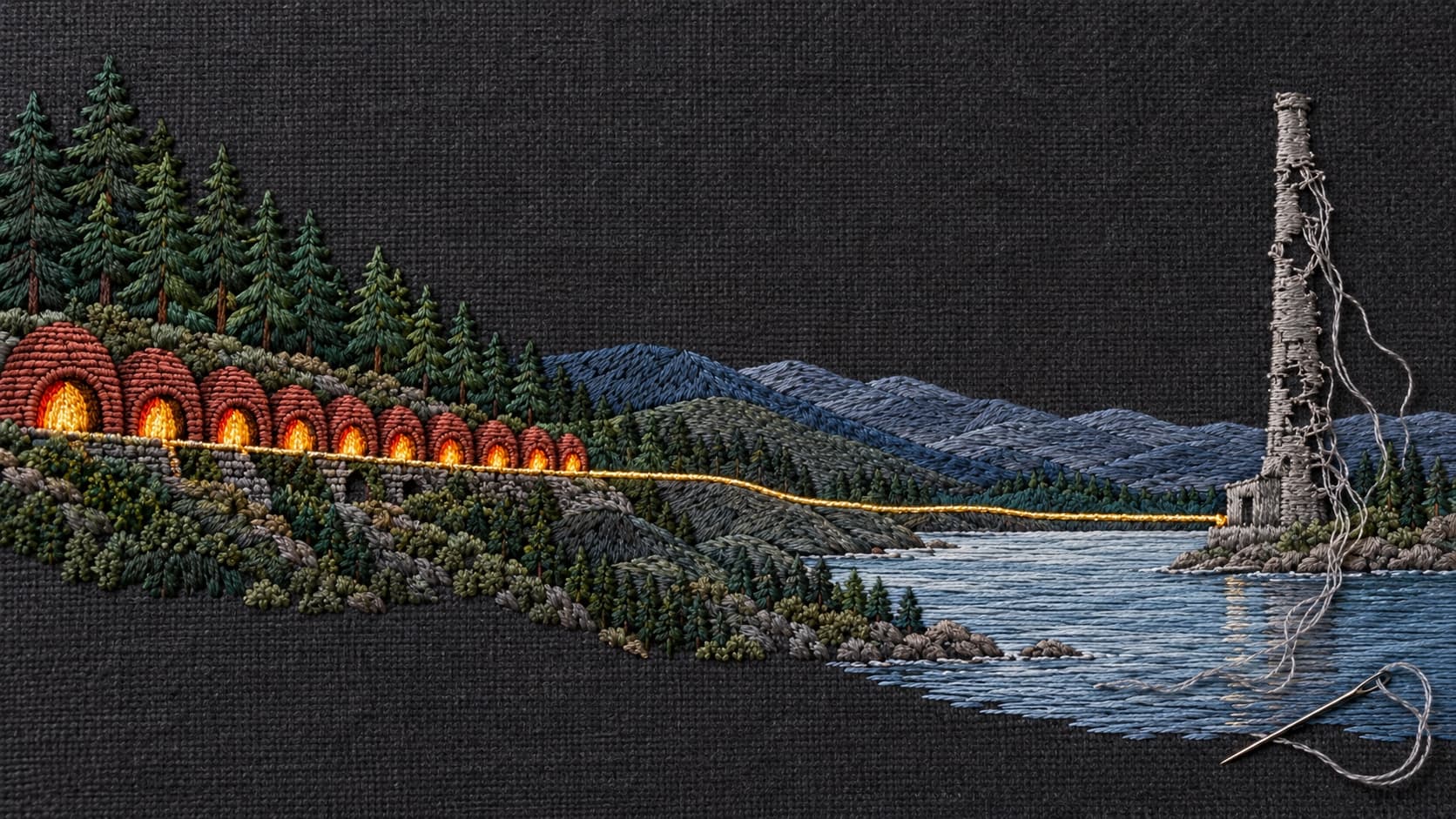
Wilkeson's beehive coke ovens baked fuel for the Tacoma smelter that became ASARCO. Its stack fell in 1993. Thirty of the ovens are still standing.
On Railroad Avenue in Wilkeson, near the sandstone school, a row of brick domes runs for about 400 feet. There are thirty of them, each about twelve feet across, each with a dark arched mouth at the front and a hole in the crown. Moss has the tops. In July, people sit on bleachers beside them and watch grown adults race railroad handcars down a strip of old track. The rest of the year they sit in the rain, looking like the kilns of some patient local craft.
They were nothing of the kind. This site's piece on Wilkeson sandstone and the State Capitol counted them in passing: 160 ovens at the peak, thirty left, on the National Register since 1974. What that count leaves out is where the fire went. The ovens were not the end of anything. For years they were the fuel end of a trade whose furnaces stood on the Tacoma waterfront, and the half that looked permanent is the one that is gone.
What an oven does
Coke is coal with the impurities baked out of it. What is left burns at high temperatures, which is why smelters and foundries, the plants that melt ore and metal, wanted it by the trainload.
Wilkeson had the rare coal that could make it. HistoryLink's David Norberg calls the Wilkeson, Carbonado and Fairfax field one of the few West Coast sources of coal that could be turned into coke. Edward Slade "Skookum" Smith, a former Northern Pacific manager, organized the Tacoma Coal Company in 1878 and began coking around 1880, at first in pits four feet deep. The first brick beehive ovens were built in 1885.
The method was simple. A crew dumped about five tons of coal through the hole in the crown and let it bake for 48 to 72 hours. Then the finished coke came out through the opening in the side. By 1887 thirty ovens were turning out 1,000 tons a month, and in late 1888 fifty more were going up.
The customer on the bay
The buyer mattered more than the builder. "The Ryan smelter in Tacoma purchased a significant amount of the output and used it to refine lead, gold, and silver," Norberg writes. Dennis Ryan had built that smelter in 1888 on the waterfront at what became Ruston. It changed hands and names, and in 1905 the American Smelting and Refining Company bought it. ASARCO converted it to copper in 1912, and in 1917 it put up a smokestack 571 feet tall, in HistoryLink's phrase "then the largest smokestack in the world."
The appetite never eased. When ASARCO bought the Tacoma plant it also took the Selby smelter in San Francisco and the one in Everett, and its general manager, William Rust, found that his plans kept running into the same shortage. "Rust's efforts to expand operations were limited by a lack of critically needed coke," Norberg writes in his history of Fairfax, and Rust solved it by buying the Fairfax mines and their sixty ovens up the Carbon River beyond Carbonado. Press accounts from the 1920s suggest Fairfax typically made about 2,500 tons of coke a month for his smelters.
So the glow over the foothills and the smoke over Commencement Bay were two ends of one trade. The coal came out of the Carbon River canyon, the fire in the brick domes turned it into fuel, and the fuel went down the railroad to the furnaces by the water. Summaries of the National Register listing call the Pierce County ovens, with Wilkeson's the most numerous, the sole supply of coke on the coast; other accounts send it to foundries in Seattle and Portland and to ports as far as San Francisco and Alaska.
Who fed the fire
The Wilkeson Coal and Coke Company, run by the Tacoma lumbermen Chauncey Griggs and Henry Hewitt Jr., came to dominate the town's coal in the 1890s on a 99-year lease from the Northern Pacific. Here the story gets less tidy than the usual summary. According to HistoryLink, the company "replaced the aging coke ovens with entirely new batteries," had at least 100 in use by 1902, and kept 160 at its peak. The date usually attached to the ovens, 1885, is the year the first ones were built. Whether any of the thirty on Railroad Avenue are that old, or all belong to the rebuilding, the sources consulted for this piece do not say.
The people who ran them came from everywhere. In 1910 the town had 899 residents and some 400 men in the mines, about half of them immigrants from England, Wales, Scotland, Finland, Italy, Sweden, Austria, Germany, France, Poland, Croatia, Hungary and Russia. The immigrant community had founded a Slavonian lodge in 1891 and built Roman Catholic, Greek Catholic, Presbyterian and Orthodox churches. Holy Trinity Orthodox, with its onion dome, went up in 1900, and the town's own walking tour says many in its congregation worked the coke ovens.
The town's labor history has an ugly side. In the anti-Chinese purges of 1885 and 1886 white workers drove Wilkeson's few Chinese residents out, and in 1891, siding with striking white miners at Franklin, where the Oregon Improvement Company had brought in Black miners to undercut the union, Wilkeson workers passed a resolution condemning the Black miners as unfit to associate with whites. Later that summer a mob of 300 to 400 ran the company's superintendent out of Wilkeson at gunpoint, and in the aftermath the Wilkeson Coal and Coke Company fired about 100 miners.
Robert Peloli was a boy in Wilkeson in the 1920s, when the Wilkeson Coal and Coke camp was known as Uptown. Decades later he told the Courier-Herald's Jessica Keller he remembered flames ten to fifteen feet high shooting from the ovens. "This place used to glow at night," he said.
When the fire went out
In 1912 a writer quoted by HistoryLink called the reserves "almost inexhaustible." The coal was not the main problem. The customer was. "Instead of using coke as a fuel, smelters increasingly employed electric furnaces," Norberg writes. Washington's coke output peaked at 98,644 tons in 1916, fell to 582 tons in 1931, and in 1937 the state made none at all. Nationally the old domes were losing to newer by-product ovens. A Pennsylvania state history site puts it plainly: "In 1910 beehive ovens made more than 80 percent of the nation's coke. Two decades later their share was less than 6 percent."
Exactly when Wilkeson's ovens went cold depends on whom you ask. A Town of Wilkeson history page says by the late 1920s or early 1930s; the Courier-Herald said 1935; the Washington Trust for Historic Preservation says production ended in 1937. When the Second World War revived the mines, the new Wilkeson Products Company built its coke plant in Tacoma, not here. Work at Fairfax had ceased by 1930, and its town is gone. Before 1970, 130 of Wilkeson's 160 ovens were pulled down and salvaged for their brick and sandstone.
The smelter outlasted the ovens by half a century, closing in 1985. At 12:40 p.m. on January 17, 1993, demolition crews dropped the great stack as part of a Superfund cleanup. The Department of Ecology still works a plume of arsenic and lead the smelter left across more than 1,000 square miles of the Puget Sound basin, and that is the copper plant's legacy, not the coke's. The fuel yard in the hills is still standing. The furnace it fed is not.
Thirty left
Survival has not been automatic. In 2010 the Washington Trust named Coke Oven Park one of the state's most endangered historic places, warning the ovens were "threatened with lack of protection from vandalism, neglect and vegetation overgrowth." The Wilkeson Booster Club, which started the handcar races in 1974, has sought grants to stabilize some ovens and rebuild the sandstone wall that once faced them, and in 2012 the town brought in landscape architects from the UW and WSU to sketch a park. The Trust now lists Coke Oven Park as saved.
The bigger change is next door. On October 21, 2025, the Pierce County Council voted unanimously to put $857,250 in Conservation Futures money toward the town's purchase of 139 forested acres from Weyerhaeuser, the land between Coke Oven Park and the Fairfax Bridge, which takes in the sealed entrance of the Skookum Slope mine. By May the town had the full price in hand. "We made it, it's time to close," Mayor Jayme Peloli told The News Tribune. She resigned on June 11, saying she wanted to separate her elected role from her advocacy, and the council appointed member Travis Waldher mayor until the 2027 general election. Whether the sale has closed has not been announced, and Peloli said in the spring that parts of the land could open around fall 2027.
If you go
Take SR 410 to Buckley and turn south on SR 165. In Wilkeson, the ovens stand at 669 Railroad Avenue, a short walk from the Wilkeson School at 640 Railroad. You can see the whole row from the road; stay out of the mouths, which the town has spent years trying to protect. The busiest day to go is Wilkeson Days, the last full weekend in July, when the handcars run beside them. On a quiet weekday you can stand at the end of the row and picture all 160 lit.
Story label: Original Story or Guide
Originally published: