

Feature
The State Capitol is built from a hill nine miles from Enumclaw, and the town says it was never paid
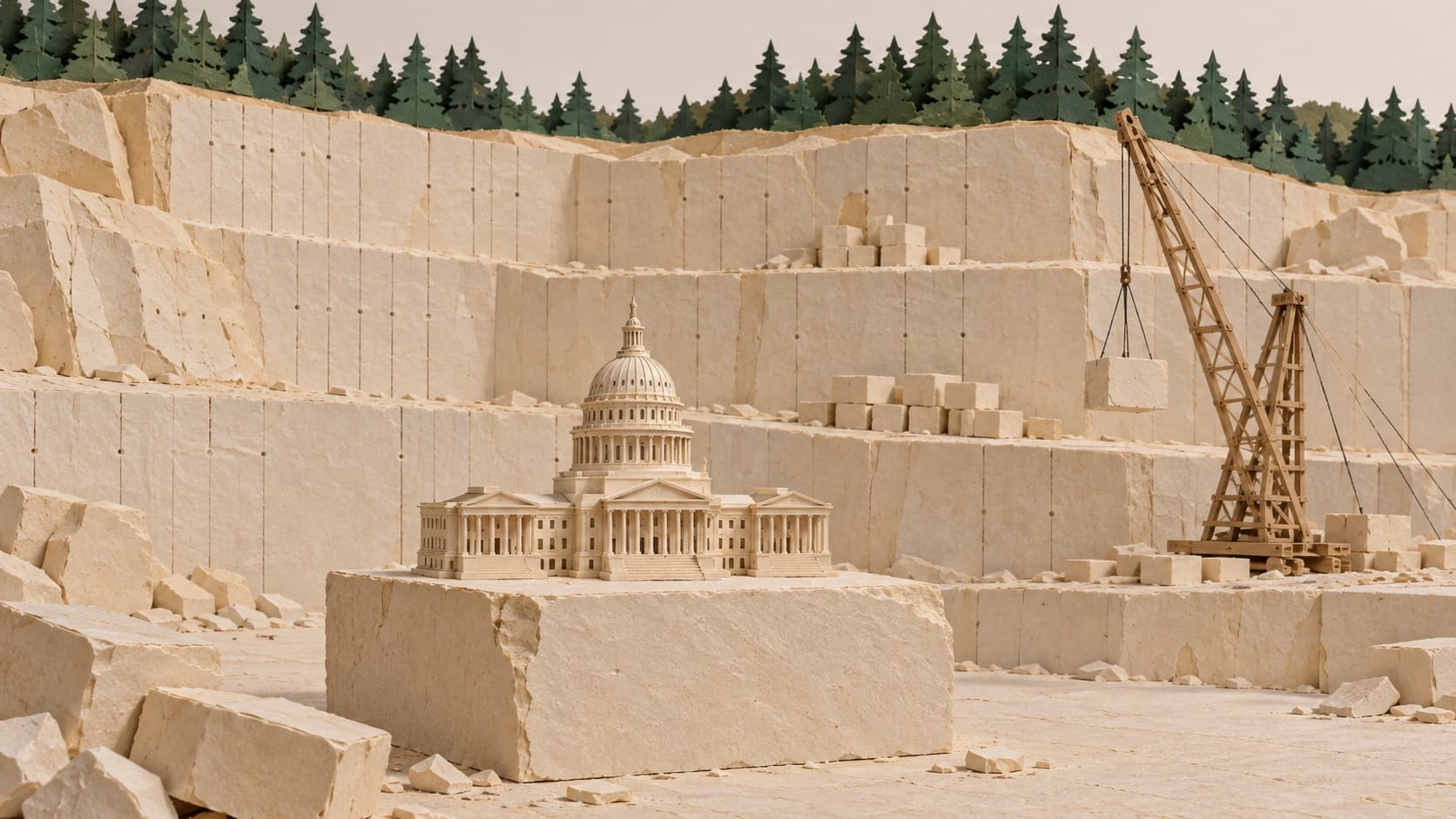
The Washington State Capitol is skinned in Wilkeson sandstone from a quarry nine miles from Enumclaw. The town says a 1925 bill was never paid. The whole story.
Drive west on 410 to Buckley, turn south on 165, and in about five miles you pass under a stone arch that a booster club put up in 1925 to tell you where you were. The lettering on the near side reads Wilkeson Coal Mines and Wilkeson Sandstone. The coal is gone. The sandstone is what the Legislature meets inside of.
Every state has a capitol. Washington's is skinned, dome included, in stone from one hill in a town of about five hundred people that sits nine miles from Enumclaw and still thinks it is owed money for the job.
The rock under the coal town
Samuel Wilkeson, a secretary of the Northern Pacific, surveyed the country in 1869 and noted a sandstone outcrop in hills where coal had been known since 1862. The coal came first. The railroad opened a 31-mile branch in November 1877, sent the first trainload of Wilkeson coal to Tacoma at the end of that month, and within a decade the town was making coke in brick beehive ovens, 160 of them at the peak. Some thirty survive in a park at the south end of town, on the National Register since 1974.
The railroad used the sandstone for ballast. That is what you do with a rock before you notice it is beautiful. Commercial sales began in 1883, when a past president of the Northern Pacific, Charles B. Wright, used it for St. Luke's Memorial Episcopal Church in Tacoma. Regular quarrying dates from 1886. The man who made the quarry an industry was Robert Walker, an English stonecutter who arrived in Tacoma in 1907, founded the Walker Cut Stone Company in 1908, and held the Wilkeson lease from 1911 until his family sold the business in 1959. The quarry failed in 1982, reopened in 1999 on a smaller scale, and is owned today by Chuck Nelson, who quarried the stone for an addition to the town's own elementary school funded by a 2016 bond.
Why Olympia wanted it
When the architects Walter Wilder and Harry White drew the Capitol campus, they chose Wilkeson stone for two reasons that a historian of the building sets out plainly: its light color, and a composition that resists water, which matters in Olympia. The Temple of Justice was first, ground broken in 1912 and finished in 1920 for $942,230. The Insurance Building followed in 1921. The Legislative Building began in March 1922, laid its cornerstone on September 1 of that year, finished its dome of more than 1,400 stones on October 13, 1926, and opened in 1928 at a height of 287 feet and a cost just under $7.4 million. Its skin, the state's own tour says, is Wilkeson sandstone; the granite steps are from Index.
The Walker company cut and polished all of the exterior stone. Tacoma's public library, which holds the company's records, puts the total for the Capitol campus, 1911 to 1928, at 15,400 tons.
The same stone went into the county courthouse in Tacoma, a Congregational church in Seattle, a federal building in Everett, two Tacoma high schools, Lincoln and Stadium, and the main library downtown in Tacoma. For twenty years around 1900 it paved Seattle: a 1993 survey found 93 sandstone cobblestone streets left, most of them Wilkeson rock.
How a block leaves a hill
The quarry's National Register nomination, written in 1976 and listed in 1978, describes the work as it stood then, with much of the machinery in place since 1915. The quarry face was about 250 feet high and 175 across, with three derrick cranes standing in a triangle on guy wires. Blasting holes were drilled by steam and reamed oblong, so that black powder would free a block along the line the cutters wanted rather than wherever the rock preferred. Blocks went by small rail car to gang saws, whose notched steel bands, fifteen feet long and a quarter inch thick, cut with a slurry of steel shot and water. Seventeen hours of sawing got through a block seven feet thick. Then the stone went out on the coal branch to Walker's plant in Tacoma and from there, cut to size, to Olympia.
The invoice
The story now turns on an invoice. In 1925, according to Senator Phil Fortunato's testimony as summarized in the Senate's report on this year's bill, the State of Washington did not pay a $56,000 bill it owed the Wilkeson quarry for work on the Legislative Building. The town paid it, the testimony says, and around 2018 asked for the money back, which with interest it put at about $5 million, offering to settle for a plaque on the Capitol saying where the stone came from.
Mayor Jeff Sellers told KOMO in 2019, when the story went around: "Ninety-two years and they haven't paid the bill." Ninety-two years before 2019 is 1927, two years off the Senate report's date, and KOMO gave the sum as $55,000. From the Secretary of State's office, Patrick McDonald answered that the state had kept everything, every bill that was paid and every contract that was signed. He did not say whether that file shows this one. The town says it found the bill and sent it to the State Treasurer. Neither the invoice nor any receipt has been published.
The second act
Three earthquakes have mattered to the Capitol. The 1949 earthquake damaged the cupola on the dome so badly it had to be replaced. The 1965 quake left the dome's brick buttresses in poor condition. The Nisqually earthquake of February 28, 2001 splintered a buttress and moved the freestanding columns around the base of the dome by three inches in one account and six in another.
The repair, which cost about $120 million and reopened the building on January 10, 2005, went back to Wilkeson. The engineers pinned the shifted columns by drilling 46 feet through the stone, and before they did it to the Capitol they tested the method on stacks of stone cored from the original quarry. In February 2003 a master carver from Tenino, Keith Phillips, carved replacement pieces for the dome's cracked lantern stones from Wilkeson rock. Tenino, about fifteen miles south of Olympia, has its own sandstone and its own quarry, and its crews did repair work too, and the two towns are now competing in the Legislature.
State sandstone
In 2024 two bills were filed: one to make Tenino sandstone the state stone, one for Wilkeson. Neither passed. In 2025 Senator Phil Fortunato filed SB 5489, to designate Wilkeson Sandstone the official state sandstone. It was reintroduced in January 2026, passed the Senate 48 to 0 on February 16, had its first reading in the House the next day, and was returned to the Senate Rules Committee on March 12, where it sits. It is not law, and unless it is refiled it dies with the biennium. The bill report quotes a 1927 county history calling the stone superior because it does not absorb water, and a 1988 history of the Capitol on its warm off-white tones. The bill itself, one sentence long, does not mention the invoice.
What the arch says
The arch, rebuilt in 2004 after the earthquake and moved several blocks south to SR 165 near Hill Street, has two sandstone pillars six feet square and twenty-five feet tall under a fir log. The school, built in 1912 and opened the next year, is two stories of local stone with a copper bell tower and is still a public elementary. The Community House of 1923, the town hall, is the same rock laid random. The coke ovens are beside the road, and south of Carbonado the highway has been closed to cars since April 2025 because of the Fairfax Bridge, so the road the arch calls the gateway to the glacier now ends at the next town. This site's Carbonado piece covers that end of it, and the memorial block the Wilkeson Eagles placed at the cemetery there.
The far side of the arch, the side you read leaving, says Remember Wilkeson. The Senate did, 48 to 0. The House has not got to it, and the invoice is a hundred and one years old.
Story label: Original Story or Guide
Originally published: