

Feature
The side of Rainier Enumclaw looks at is the one almost nobody climbs, and for years its great wall was off limits
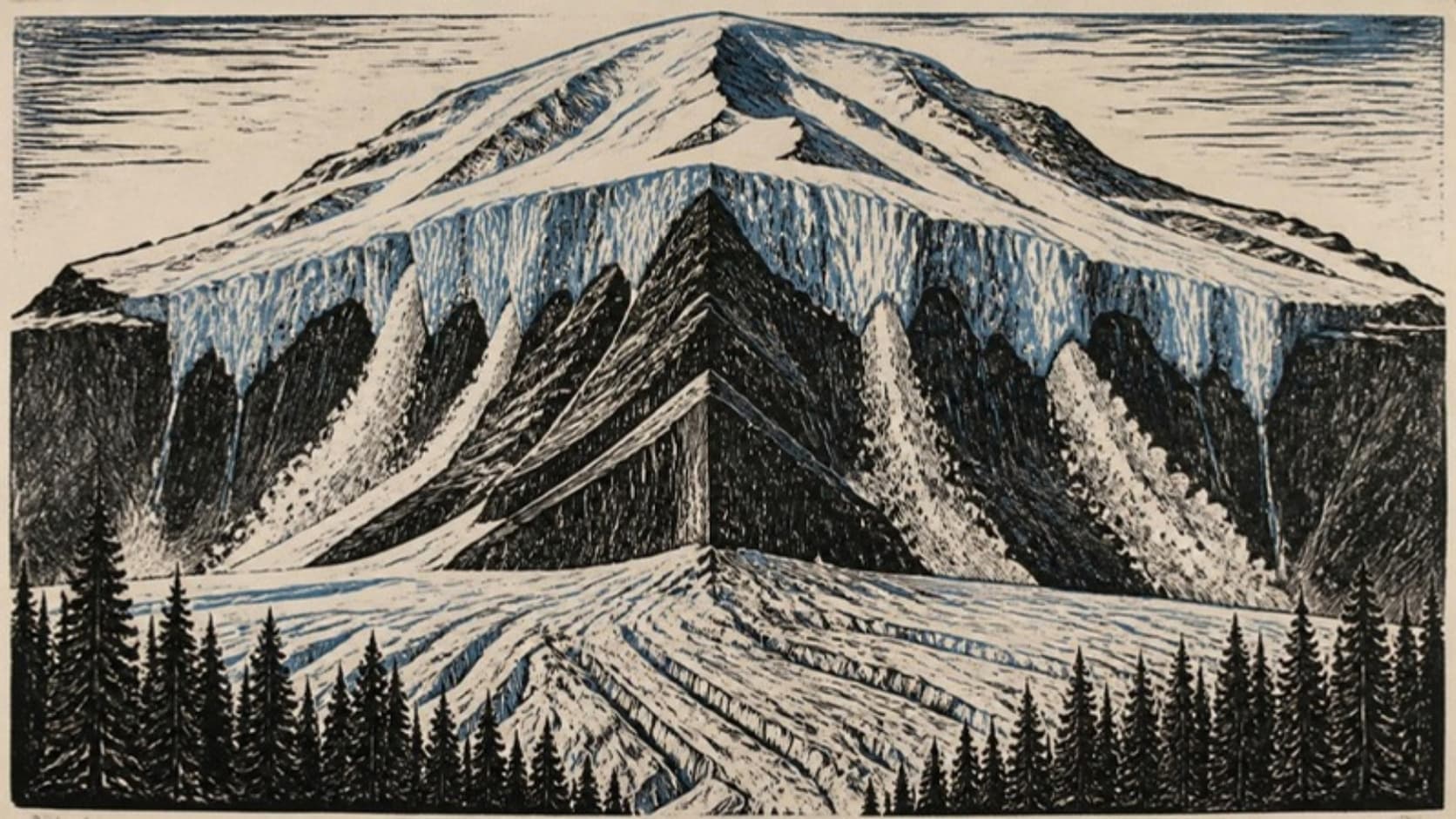
Enumclaw faces Rainier's north side: the Willis Wall, Liberty Ridge and the Carbon Glacier. About one climber in a hundred goes that way. History and risk.
The Rainier on the postcards is the south side, seen from Paradise, all white snowfields and the trail to Camp Muir. This site has written about it and about how different it looks from the southwest. Enumclaw sees a different mountain. The town lies northwest of the summit, about 27 miles away by this site's reckoning from map coordinates, and what it looks at is the north side, which is darker, steeper and far less climbed.
The wall
The center of that view is a cirque more than a mile wide at the head of the Carbon Glacier. Its back wall is the Willis Wall, an almost sheer face of old lava that the Park Service gives as 3,600 feet high in one publication and 4,000 in another. It is named for Bailey Willis, the geologist who explored the north side in the early 1880s and later helped get the national park created. Edmond Meany's 1916 history of the mountain describes it as "the great vertical cliff, 3,600 feet high, over which avalanches of snow crash throughout the summer months."
The avalanches are the point. On top of the wall sits a cliff of ice, about 250 feet high by one climber's estimate, that sheds blocks down the face. Ome Daiber, who climbed beside it in 1935, described a night on the ridge in one sentence: "All night long the avalanches tumbled, cracked and roared."
Liberty Ridge
Daiber did not climb the wall. He climbed the rib that rises up the middle of the cirque, Liberty Ridge, named by the USGS mapmakers in 1914. Daiber had asked the photographer Bradford Washburn to photograph the north face from the air in May 1934, and he chose his line from the enlargement. On September 28, 1935, he, Arnold Campbell and Will H. Borrow Jr. started up, and on September 30 at 5:30 in the evening they stood on Liberty Cap, the mountain's north summit. His account in the American Alpine Journal opened: "FOR years the north face of Mt. Rainier (Willis Wall and surrounding territory) has stood unconquered."
Liberty Ridge became one of the Fifty Classic Climbs of North America in the 1979 book of that name. It is also one of the most dangerous routes in the park. The Seattle Times reported in 2014, citing park statistics, that fewer than two percent of Rainier climbers go up Liberty Ridge but the route accounts for about a quarter of deaths on summit climbs. The park's route guide put attempts at about 98 climbers a year, with a little over half reaching the top. Its annual tables for 2011 to 2016 count 655 Liberty Ridge climbers, about one percent of everyone who tried the mountain.
The worst day came in late May 2014. Two guides and four clients from Alpine Ascents International were last heard from on the evening of May 28 near 12,800 feet on the ridge. They were found to have fallen about 3,300 feet to the Carbon Glacier below the Willis Wall. "There is no viable chance of survival from such a fall," the Park Service said on May 31. The park's later route guide carries a dedication to them with this sentence: "What stands out about this incident compared to others is that a capable team making good decisions still ended up in a dire situation."
Who climbed the wall first
The wall itself was for a long time off limits, and the question of who first climbed it was a quarrel. When Ed Cooper and Mike Swayne went up its eastern edge in June 1962, they told the Mountain Rescue Council but not the rangers. "We didn't notify the park rangers, since they had a policy of no climbing on the Willis Wall," Swayne wrote later, adding that the policy had been "taking a beating," since Charles Bell had been on the wall the year before. When four climbers went up the East Rib through the ice cliff in 1963, the American Alpine Journal printed an editor's note that none of the earlier claimed ascents had been authorized, "This was the first legal ascent." Bell's solo climb of 1961 is now generally credited as the first, though this site could not confirm that from a primary source. In February 1970 Alex Bertulis and Jim Wickwire made the first winter ascent, and Wickwire wrote of the ice cliff overhead that "for the remainder of the climb we were virtually at the mercy of whatever forces held the ice cliff together."
The Park Service's tables for 2011 to 2016 count six climbers on the Willis Wall, all in 2011, out of more than 63,000 on the mountain.
The glacier below
What comes off the wall lands on the Carbon Glacier, which does something no other glacier in the lower 48 does. The Park Service says it has "the lowest terminus of any glacier in the contiguous United States," at 3,617 feet, in a shaded valley where its lower end is buried in rock. It is third on the mountain by area and first by volume, thanks to its thickness. It drains to the Carbon River, named for the coal found along it in the 1870s, on the far side of the ridges from Enumclaw.
Above it all is Liberty Cap, the north summit, which a surveyor measured at 14,090.7 feet in 2024, a little lower than the old figures, as this site reported of the true summit.
Looking at it
On a clear evening from the plateau, what you can see depends on where you stand and on the foothills in between, and this site has not yet matched a photograph from town to every feature named here. But the mountain Enumclaw lives with is this one: the north side, where the wall sheds ice, where the ridge climbs through it, and where far fewer people have stood than on the sunny side most of the world knows.
Story label: Original Story or Guide
Originally published: