

Feature
Enumclaw to Yakima in winter means Snoqualmie or White Pass
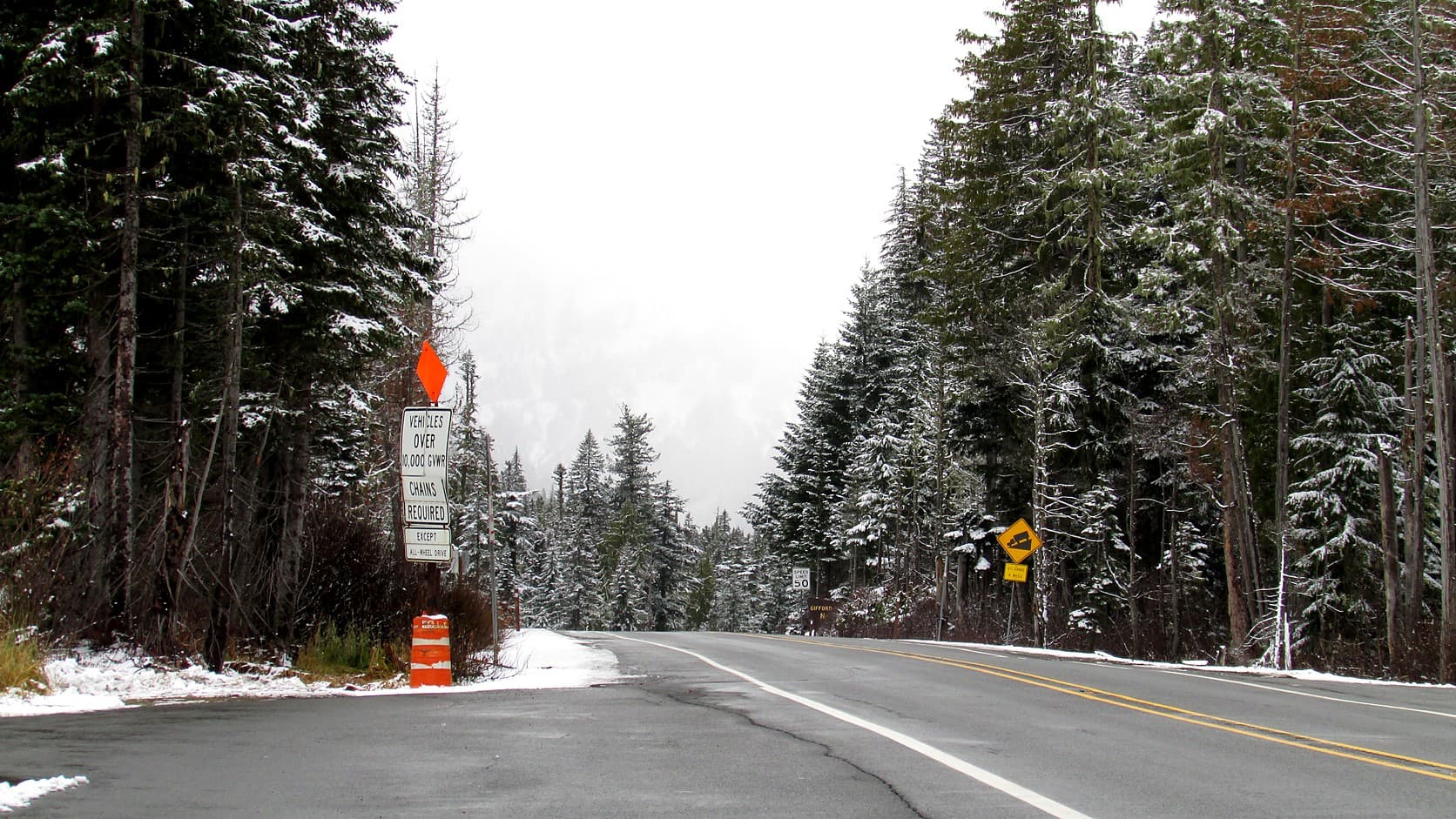
Enumclaw to Yakima in winter is about 146 miles over Snoqualmie Pass or 173 over White Pass. What each chain sign means, the $500 penalty, and where to check.
From Enumclaw, the winter drive to Yakima goes over Snoqualmie Pass or White Pass, because the short way, State Route 410 over Chinook Pass, closes every autumn and stays shut until late spring. The Snoqualmie way, north on SR 169 to SR 18 and Interstate 90, east to Ellensburg and south on Interstate 82, measures about 146 miles on a public routing engine; the White Pass way, south through Buckley, Orting, Eatonville and Morton, then east on U.S. 12 over the pass to Naches, is about 173; Chinook is about 110. Both open passes carry chain rules the Washington State Patrol enforces with a $500 penalty, and as of October 2026 the Washington State Department of Transportation reports conditions on each from November 1 to April 1.
The two roads close for different reasons, and the main one closes on purpose. Snoqualmie Pass, at 3,022 feet, carries about 28,000 vehicles a day by WSDOT's count, and when its avalanche crew judges the slopes above the west side ready to let go, the road is cleared and the snow brought down with explosives, by cable tram or from a 105 mm howitzer. White Pass, nearly 1,500 feet higher, was not formally opened as a through highway until August 12, 1951, when, by the Yakima Herald-Republic's account, 3,500 people watched a stone cairn carried off the summit to open it.
Is Highway 410 open from Enumclaw to Yakima in winter?
Not between the gates. WSDOT closes SR 410 for the season between Crystal Mountain Boulevard, about 33 miles east of Enumclaw, and Morse Creek on the Yakima side; its table of closing dates shows the 2025 closing on October 24, and the pass usually reopens in late May. As of October 13, 2026, its Chinook Pass report showed the road open with no closing date announced. The Chinook Pass closing-dates guide keeps the record, and the highway from Enumclaw to the gate stays open all winter for Crystal Mountain, which the Enumclaw to Crystal Mountain drive guide covers.
Which way is shorter, Snoqualmie Pass or White Pass?
Snoqualmie, by about 27 miles, and by more time than that, because more than a hundred of its miles are freeway. WSDOT's Snoqualmie Pass report carries a travel-time board for the 74.9 freeway miles from North Bend to Ellensburg, which read an average of 73 minutes on October 13, 2026. A routing engine puts the whole drive at roughly three hours this way and four and a half by White Pass. The Snoqualmie way also crosses Manastash Ridge on I-82, a 2,672-foot summit between Ellensburg and Yakima with its own WSDOT report.
The White Pass way is two-lane highway nearly the whole distance: SR 410 to Buckley, SR 162 to Orting, Orville Road and SR 161 to Eatonville, SR 7 to Morton, then U.S. 12 through Packwood, over the summit and down the Tieton River to Naches. WSDOT's White Pass report gives the 4,500-foot elevation and a summit camera at milepost 150.9.
What do the chain signs mean on Snoqualmie Pass and White Pass?
The same thing on both, because they come from one statute and one WSDOT page. Under RCW 47.36.250, WSDOT may post three levels when it finds a road unsafe for ordinary tires: a traction advisory that bars oversize loads; the same with chains required on vehicles over 10,000 pounds gross vehicle weight; and chains required on all vehicles except all-wheel drive. WSDOT's tires and chains page turns that into four signs, which it defines this way.
Traction tires advised: passenger cars, all-wheel drive included, may proceed without traction tires; large vehicles must have them on or chain up; oversize loads are barred. Traction tires required: every passenger vehicle under 10,000 pounds needs approved traction tires on, or chains or an approved alternative; anything over 10,000 pounds chains up. Tire chains required: front- and rear-wheel-drive cars fit chains; four- and all-wheel-drive cars under 10,000 pounds may continue on traction tires with all wheels engaged and chains in the vehicle; everything over 10,000 pounds chains up. Chains required on all vehicles: everyone fits chains. Of that last sign the page says, "This is often the last step before a pass is closed; having every vehicle chain up can help avoid a closure." A traction tire, under the Patrol's rule in WAC 204-24-040, has at least an eighth of an inch of tread and a sidewall marked M+S or with the mountain and snowflake symbol, and chains on any tire make it one.
Does an all-wheel-drive car need chains on Snoqualmie Pass?
Not at tire chains required, on three conditions, and yes at chains required on all vehicles. The Patrol's rule, WAC 204-24-050, exempts an all-wheel-drive vehicle under 10,000 pounds from a chains-required sign when all wheels are in gear, the tires are approved traction devices, and chains for at least one set of drive tires are in the vehicle; over 10,000 pounds, the Patrol's equipment page says, it must install them. At chains required on all vehicles, the chains go on at least one pair of tires, front or back. Not obeying a posted requirement is a traffic infraction under RCW 47.36.250 with, in the statute's words, "a penalty of five hundred dollars including all statutory assessments," and WSDOT's October 2025 winter release says the Patrol, not WSDOT, writes the ticket.
Do studded tires or snow socks count as chains?
Studs never do; some socks do. Studded tires are legal from November 1 through March 31 and count as traction tires, but the statute applies a chains-required sign to them too, so a two-wheel-drive car on studs chains up; the studded tires guide has the dates and the fine. The Patrol's approved list of alternative traction devices, published in September 2026, names eleven products, and AutoSock is the only one approved for every class, vehicles over 10,000 pounds included. Cable chains count as chains under the Patrol's standard in WAC 204-24-020.
Does the 10,000-pound rule apply to a pickup with a trailer?
It can, and from November 1 to April 1 it applies whether or not any sign is posted. WAC 204-24-050 and WSDOT's chain page for vehicles over 10,000 pounds require every vehicle over that gross vehicle weight rating, the manufacturer's maximum for the loaded vehicle, to carry chains all season on the listed routes, among them I-90 from North Bend to Ellensburg, I-82 from Ellensburg to Selah and U.S. 12 from Packwood to Naches, with at least two extra chains. WSDOT's tires page figures the weight on vehicle, trailer and load together, commercial or not, so a pickup towing a camper can cross the line, and above 10,000 pounds there is no all-wheel-drive exemption. One wrinkle: WSDOT's tires page ends the season on March 31; its heavy-vehicle page and the Patrol's rule say April 1.
Why does Snoqualmie Pass close when it is not snowing hard?
Usually because somebody crashed, and sometimes because WSDOT closed it on purpose. The agency's October 2025 winter release put the first cause plainly: "Most closures are due to poor driving behavior, including people traveling too fast for conditions, not leaving extra space between vehicles, failing to have proper equipment like tire chains or driving distracted or impaired." The second is avalanche control, which WSDOT's avalanche control page calls a winter-long activity on I-90 and U.S. 2 over Stevens Pass. When the west-side zone needs control, crews close the road, sweep it for stragglers and set off the explosives; delays typically run 30 minutes to two hours, several hours in a severe storm. The page says nothing about control work on White Pass, and the passes it gives up on each winter because control work there is too dangerous, Chinook, Cayuse and the North Cascades Highway, do not include it.
When did the passes start staying open all winter?
Snoqualmie first, in 1931, and White Pass twenty years later. King County's 2009 inventory of heritage corridors says of the Sunset Highway over Snoqualmie Pass, "The road remained open for the first time throughout the winter of 1931," and the Seattle Times, in 1998, gave the same year: "it would be 1931 before the pass was open in winter."
That January, by the Yakima Herald-Republic's account, a state Senate bill drew a White Pass highway onto the state plan, and that September Enumclaw and Yakima celebrated the Chinook Pass highway with a mock wedding at Tipsoo Lake. Chinook became a summer road and still is. White Pass cost $6 million, by the Herald's figure, and was dedicated on August 12, 1951, when Roy Fletcher, then president of the White Pass Highway Association, threw the last stone of a Boy Scout cairn off the summit. Before it, the paper wrote, Snoqualmie and Stevens were the only year-round road crossings of the Cascades.
Enumclaw once had a shorter winter road to White Pass than the one through Morton. By the ski historian Lowell Skoog's account, the state began plowing SR 410 to Cayuse Pass from the Enumclaw side in the late 1930s, and by the end of the 1950s, once today's SR 123 was paved, kept Cayuse open all winter: "the road was plowed in winter to provide access from Enumclaw to White Pass," he writes, until the highway department closed the pass for want of traffic, in 1974 by his account and from December 12, 1973 by WSDOT's table of closing dates. By the engine's measure that road would put Yakima about 129 miles from Enumclaw.
Before you leave Enumclaw
Open WSDOT's pass reports first: Snoqualmie or White Pass, Manastash Ridge by Ellensburg, and Chinook in case the short way is still open. The same reports are in WSDOT's free app, on X at @wsdot_passes and @SnoqualmiePass, and on Highway Advisory Radio at 1610 AM and 530 AM; texting START to 85107 brings I-90 closure alerts. The Northwest Avalanche Center's forecasts, from mid to late November, cover the backcountry, not highways with avalanche control. Carry chains that fit, practice before heading out, and fill the tank, because a closure can hold traffic for hours. And if the sign says chains required on all vehicles, read it as WSDOT does: the pass may be about to close, and the people chaining up are the reason it might not.
Story label: Original Story or Guide
Originally published: