

Feature
Triangle of Fire forts, Fort Worden, Casey and Flagler
Triangle of Fire forts in Washington: Worden, Casey and Flagler. Hours, the Discover Pass rule, the Nov. 11 free day and winter closures as of November 2026.
The Triangle of Fire is the name HistoryLink.org's essay gives to three Army forts built around 1900 to guard the entrance to Puget Sound: Fort Worden at Port Townsend, Fort Casey on Whidbey Island and Fort Flagler on Marrowstone Island. All three are Washington state parks, open from 8 a.m. to dusk in winter, and each takes a Discover Pass for parking, $10 a day or $45 a year, as of November 2026. On Wednesday, November 11, Veterans Day, State Parks waives the pass for parking. From Enumclaw, Worden and Flagler are each about 107 road miles away by a routing service's estimate, and Casey, on Whidbey Island, is reached by ferry or over the Deception Pass bridge.
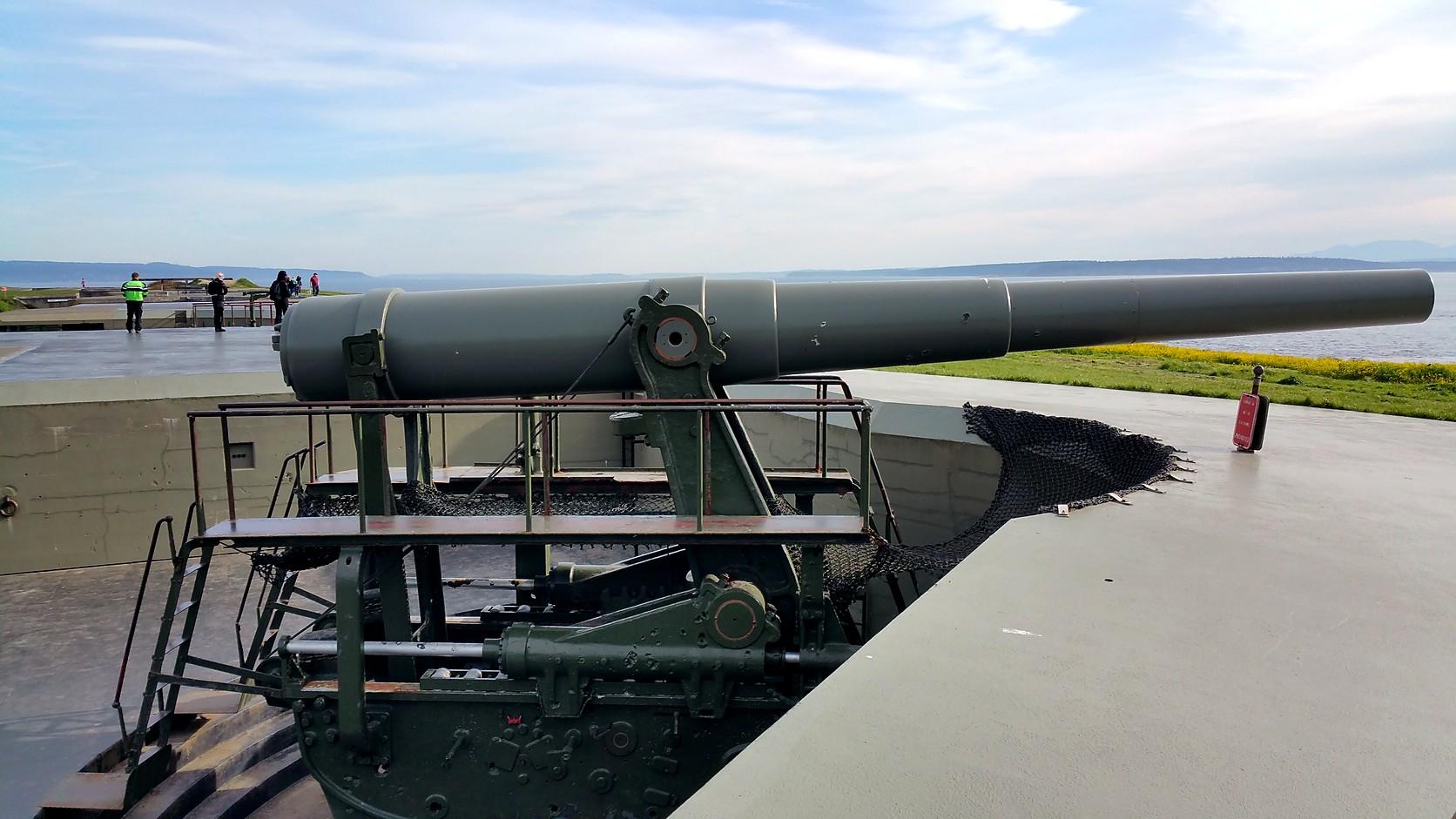
The biggest guns on display at Fort Casey never stood there while the Army ran it. The Army scrapped the fort's 10-inch and 12-inch guns in 1942, and the two 10-inch guns visitors see were brought from the Philippines and dedicated in 1968, after a governor named a month for the cause. State Parks' histories of all three forts say the same of the originals: they were never fired against an enemy.
What was the Triangle of Fire?
It was a plan to cover the mouth of Admiralty Inlet with overlapping gunfire. HistoryLink's essay, which puts the name in quotation marks, says Army engineers returned to Puget Sound in 1896, five years after the Navy's Bremerton station gave them something to protect, and chose three headlands: Point Wilson, Admiralty Head and Marrowstone Island. Congress authorized the Secretary of War to fortify them on June 6, 1896, with an estimated cost of $7 million. HistoryLink says the work sped up after the battleship USS Maine exploded at Havana in February 1898, and puts the finished system at about $7.5 million, complete by the fall of 1905. The State Parks pages do not use the phrase "Triangle of Fire," so the name rests on HistoryLink.
The guns sat behind concrete on carriages that raised them to fire and dropped them from sight to reload, hence the name disappearing guns. By the 1920s, State Parks says, warships carried guns that outranged them and aircraft could carry heavy bombs. All three forts were deactivated on June 30, 1953.
State Parks quotes Eben Eveleth Winslow of the Army Corps of Engineers on its Fort Flagler history page: "a seacoast fortification may be said to have most efficiently performed the function for which it was intended, if it is never called into action at all." A fourth fort, Fort Whitman on Goat Island, guarded the back door at Deception Pass, HistoryLink says, outside the triangle; the park at the pass is in this site's Deception Pass State Park guide.
1. Fort Worden, Port Townsend
Fort Worden, at 202 Eisenhower Avenue, is open from 8 a.m. to dusk in winter and from 6:30 a.m. in summer, according to its State Parks page. It was the largest of the three, with 41 artillery pieces, and the post that came to run the others: State Parks says the harbor defense headquarters moved there from Flagler on September 4, 1904. The fort was activated on May 14, 1902, and named for Admiral John L. Worden, who commanded the Monitor in the Civil War.
State Parks says the Army set up a balloon company here in 1920, found the weather unsuited to launching them and disbanded it soon after the big hangar, which is McCurdy Pavilion, was finished. The state bought many of the buildings in 1957 for a juvenile treatment center, which closed in 1971, and the park was dedicated on August 18, 1973.
The Commanding Officer's Quarters Museum, at 1 Pershing Avenue, is open Saturdays from 11 a.m. to 4 p.m. from November through March. It is a three-story house set up to show how officers, their families and household staff lived between 1904 and 1953. It is self-guided and free, with donations welcome, though parking takes a pass, and the house has no public restrooms. Volunteers staff it, so State Parks says to check Google for temporary closures. Most of the historic batteries are on Artillery Hill, straight ahead through the four-way stop, and the park lists 12 miles of hiking trails. Point Wilson Lighthouse is reached only through the park but stands outside State Parks land; its tour season is in this site's Washington lighthouse guide.
On November 2, 2026, the alerts box listed a Level 2 burn ban through December 31, 2026, which limits wood fires to designated fire pits and allows gas and propane. The boat launch is, in the park's words, "closed indefinitely for safety reasons." The Upper Forest campground loop is closed from October 31 to March 15, and water is off from November 1 to March 15. Beach Campground sites 18 to 50 close for upgrades from March 1, 2027, which matters to anyone booking spring.
2. Fort Casey, Whidbey Island
Fort Casey, at 1280 Engle Road in Coupeville, is open from 8 a.m. to dusk year round. State Parks says construction began in July 1897 and the fort was fully operational on July 19, 1902. It counts 35 artillery pieces, including seven 10-inch disappearing guns; HistoryLink counts 34, with six 10-inch guns, and neither page explains the gap.
The Admiralty Head Lighthouse is the item to check against the calendar. The Army moved the older light north to clear room for its guns, State Parks says, and a new tower by the architect Carl Leick was activated on June 25, 1903. Its 2026 table lists noon to 4 p.m. on Friday through Sunday, November 27 to 29, and on Saturdays and Sundays in December. The winter schedule page adds a special event, "Light Up Your Holidays," on Saturday, November 28, and says the lighthouse is closed in January and February 2027 and that a construction project around it is planned for those months. Only five visitors, or one family group, can be in the tower at once, and the park page says Central Whidbey parks cannot offer guided fort or lighthouse tours. Because the table is headed "In 2026," look for the 2027 table on the same page.
Water at Casey is off from November through March, and the picnic area's parking and restroom are closed from November 1 through March 31. On November 2, 2026, the alerts box listed a Level 1 burn ban, which still allows fires in designated pits and grills. For the rest of central Whidbey, see the Ebey's Landing winter guide.
3. Fort Flagler, Marrowstone Island
Fort Flagler, at 10541 Flagler Road in Nordland, is open from 8 a.m. to dusk in winter and from 6:30 a.m. in summer. It was the first of the three to be activated, on July 27, 1899, and it had the smallest armament, 26 pieces. The contractor, the Pacific Bridge Company of Portland, struggled to keep crews; State Parks says many laborers quit within days to chase the gold strikes in Alaska and the Yukon.
The state bought the land in five parcels between 1957 and 1962, and HistoryLink gives the price as $36,473 for 784 acres and 107 buildings. A summer music camp for the Seattle Youth Symphony Orchestra used the old buildings from 1958 to 1989, State Parks says. The park page lists a hospital and battery tour among its activities with no schedule, so ask before counting on one.
The Fort Flagler Museum fills the old quartermaster storehouse at 42 Marrowstone Point Drive. From November through March it is open Saturdays from 11 a.m. to 4 p.m., weather permitting, and State Parks again points to Google for closures. Exhibits cover the Coast Artillery Corps; entry is free and parking takes the pass. The upper campground is closed from October 1 to April 30, the moorage is closed for winter, and water is off from mid-November to March, with a winter supply at site 82. The Beachcomber Cafe's listed season does not include November. The alerts box lists the Level 2 burn ban Worden has, through December 31, 2026, and, since November 5, several historical buildings closed for repairs through April 2027, the vacation rental houses, Water Way and Hospital Steward among them.
Why are Fort Casey's big guns from the Philippines?
Because the Army scrapped the originals. State Parks says every 10-inch and 12-inch gun at Casey came down in 1942, in what it calls the first large scale scrap drive of World War II. Park staff found six abandoned guns of that type at Fort Wint, Subic Bay. Four 3-inch guns reached Bremerton in 1963, and two went up at Casey on May 7, 1963.
The 10-inch guns cost more. Service-club fundraising fell short even after Daniel J. Evans, then the governor, declared November 1965 "Guns for Fort Casey Month." The Legislature appropriated $20,000 in 1967, the guns left the Philippines in June 1968, and Casey dedicated them on August 11, 1968. HistoryLink dates both the 10-inch and 3-inch guns to 1963; this article follows State Parks, which gives the dedication date.
Do you need a Discover Pass for the Triangle of Fire forts?
Yes, for parking, except on a state free day. State Parks' fee boxes list $45 for the annual pass and $10 for a day. The annual price is set in state law, RCW 79A.80.020, which also tells the Office of Financial Management to review it every four years and recommend an adjustment to the Legislature if one is needed. One pass covers two vehicles but works for only one at a time, and guests staying overnight at a park need no pass there. The museums charge no admission, but their parking still takes a pass. For which pass fits which trailhead near home, see this site's pass guide for the Enumclaw area.
The state land agencies choose the free days each year. State Parks announced the 2026 list on November 12, 2025, and Veterans Day is on it. Free days cover day-use parking only, and every other fee still applies. Check the Discover Pass page for the next list.
What is open at the forts on Veterans Day, November 11, 2026?
The parks are open and parking is free, but the buildings are mostly shut by their own schedules. November 11 falls on a Wednesday. The Worden and Flagler museums run Saturdays only from November through March, and the Admiralty Head Lighthouse opens in November only on the 27th through the 29th. The grounds, batteries and trails are the draw that day. The next museum Saturday is November 14, and that one needs a pass.
How far are the Triangle of Fire forts from Enumclaw?
By a routing service built on OpenStreetMap data, with no traffic or waits, downtown Enumclaw is about 107 miles and 2 hours 40 minutes by road from both Worden and Flagler, and Worden to Flagler is about 20 miles and 42 minutes. These are approximate. Casey is across the inlet. The Washington State Ferries timetable for Port Townsend and Coupeville lists a crossing of about 35 minutes and recommends reservations. It labels the Whidbey terminal Keystone, and State Parks says the Keystone Underwater Dive Park lies off Fort Casey's shore. The ferry system publishes sailings by season, here one schedule for October 5 to December 26, 2026 and another for December 27, 2026 to March 20, 2027; this site's guide to ferry sailing seasons explains how to find the next.
Before you go
Read the alerts box on each park's State Parks page the morning you leave, because burn bans, closures and the lighthouse table change there. Call the park offices ahead about the museums and the lighthouse, which volunteers help staff: Worden at (360) 344-4412, Flagler at (360) 385-1259 and Casey at (360) 678-4519. Dogs must be on a leash at all three, and Worden and Flagler both warn that cougars have been spotted occasionally. Dusk comes early in November, so plan the batteries for daylight.
Story label: Original Story or Guide
Originally published: