

Feature
The war memorial that delivered babies
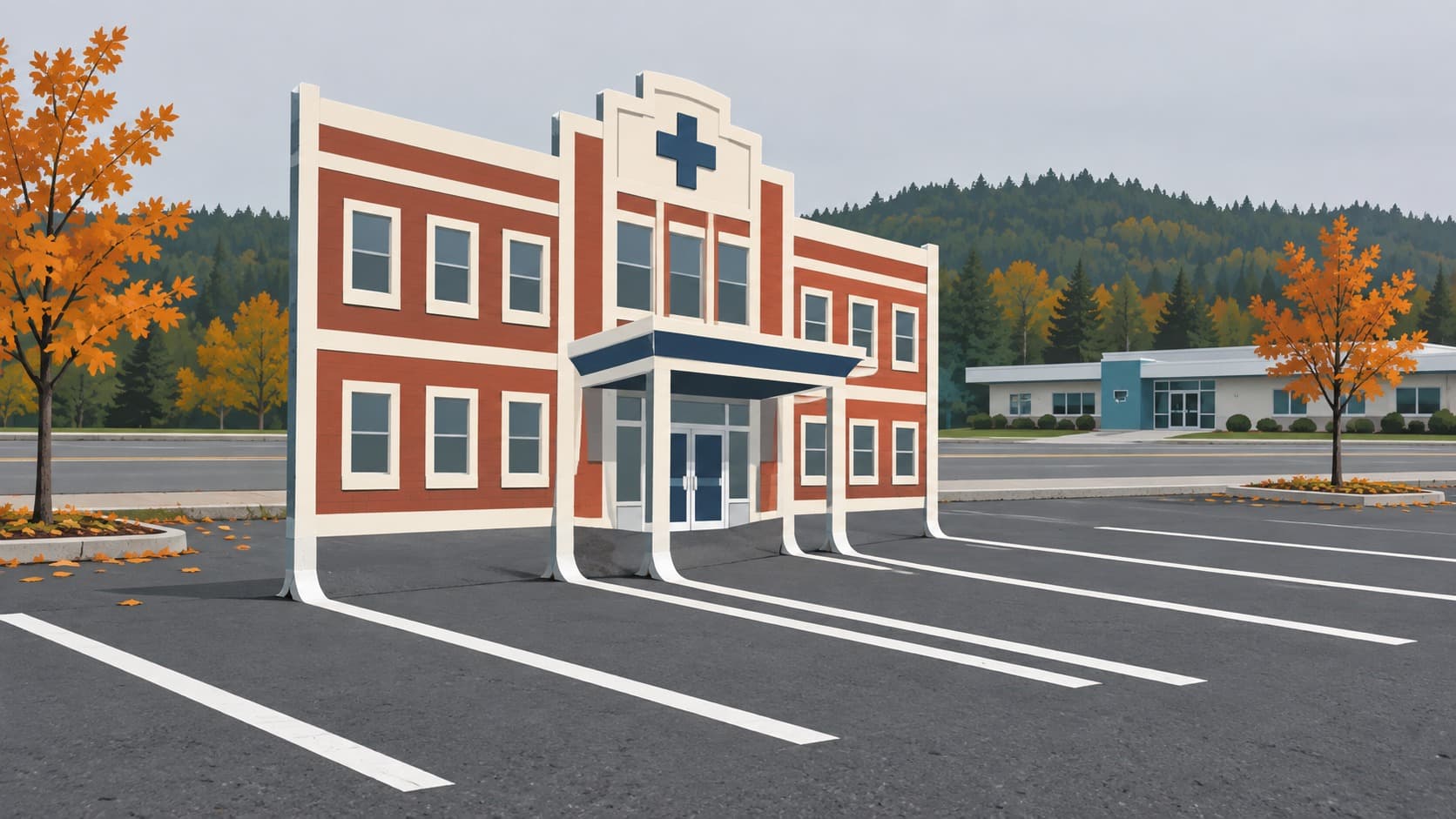
Enumclaw dedicated a hospital to 60 war dead on Memorial Day 1949, then tore it down in 2011 and paved it for 150 cars. Where the plaque with the names went.
The lot on the south side of Battersby Avenue was built to hold about 150 vehicles and was due for completion in June 2011, with an older lot nearby upgraded at the same time for another 35. It serves St. Elizabeth Hospital, directly across the street, and it does what a parking lot does, which is to be unremarkable.
Under the asphalt is the footprint of a building that stood there from 1949 until 2011. It was this town's answer to a question every American town had to answer twice inside one lifetime: what do you put up for the men who do not come home.
Enumclaw did not put up a statue. It put up a hospital, dedicated it on Memorial Day 1949 to 60 people from Enumclaw, Buckley and Black Diamond killed in the two world wars, and then let the memorial spend the next six decades setting bones, running an emergency room and delivering babies. A great many people reading this have parked on it.
A memorial that worked a shift
The decision was made while the war was still on. On January 13, 1944, according to the timeline the Courier-Herald printed for the hospital's sixtieth anniversary, the local Post-War Planning Committee met for the first time and appointed a subcommittee to draw up plans for a community hospital. Not a monument committee. A hospital committee, seated nineteen months before Japan surrendered, on the assumption that the town would still be here afterward and would still be breaking its legs.
This is a place with a long habit of building things out of everybody's money. Clarence Bagley, in his History of King County, credited Enumclaw with "the distinction of having more cooperatives than any other community in the Pacific Northwest," as HistoryLink relays it, among them the Farmers' Mutual Insurance Company of 1898, now Mutual of Enumclaw, whose story we told in your barn burns and the neighbors pay. The hospital belongs in the same column of the ledger, with one difference. The co-ops were built to make the town money. This one was built to spend it.
In March 1947 the planned building was given its name, Community Memorial Hospital, to honor local residents killed in the wars. The naming came before the walls.
The money, in the order it arrived
The first bond sale campaign ran from 1944 to 1948 and netted $17,000 in local pledges. That was seed money, not the building.
On May 30, 1948, a Memorial Day that fell on a Sunday, the town held a ceremony on the site. Here the two published accounts split. The Courier-Herald's 2009 timeline has the site dedicated that day and construction beginning in October 1948. The same paper's 2016 retrospective says construction began on Memorial Day itself. Both cannot be right, and we have not read the 1948 pages, so take the ceremony as certain and the digging as unsettled.
What the paper wrote three days before that ceremony survives, quoted in the 2016 piece. The dedication, a Courier-Herald report said on May 27, 1948, "marks us as a community which is as forward looking and progressive socially as we are commercially." Small towns are not often caught arguing in print that a hospital is a form of civic vanity, and this one was right.
The building was formally dedicated on May 30, 1949. The authority for that day is not a newspaper but a hospital history written by Violet V. Cass, who served several years as secretary of the hospital planning committee, quoted by the Courier-Herald in 2009. In her account the hospital was dedicated to "the boys who lost their lives in World Wars I and II," and "The Veterans of Foreign Wars unveiled its beautiful plaque bearing the names of the war heroes in whose memory the hospital was dedicated."
The costs were reported on June 17, 1949. Construction came to $152,995.43, and equipping the place to treat patients another $42,621.42. The 2016 account rounds the two to about $196,000, which is what they come to.
June 15, 1949
The hospital opened with 22 beds. Its first patient, the Courier-Herald reported in 2016, was Margaret Frederickson, who fell and broke her leg early that Wednesday morning and was treated a few hours after the doors opened. The detail that gives the enterprise its point is the next line: without the new building she would have been driven to Auburn.
The first baby arrived the following afternoon at 3:30, a girl, named in the 2016 account as Karen Francis.
So the memorial was open one day before it delivered its first child. The people named on the plaque had been gone somewhere between four and thirty years.
What a memorial does for 61 years
Very little of what follows is dramatic, which is the point of it.
In 1968 the building got a wing and a basement. In December 1998 the Gates Foundation gave it $2,000, a rounding error in that organization's history, to drive low income elderly and disabled people to appointments. In 1999 it added outpatient chemotherapy and imaging and became Enumclaw Community Hospital. In 2001 the research firm Solucient named it one of the top 100 hospitals in the country. In 2003 the emergency department went over to electronic records; in 2004 it was designated a Level V emergency center and a critical access facility; in 2005 a heliport went on the roof. In January 2006 it became Enumclaw Regional Hospital, a change Dennis Popp, then the administrator, said was meant to "reflect our desire to emphasize the hospital's broad service area." In May 2007 it joined the Tacoma based Franciscan Health System.
By its sixtieth year the memorial was licensed for 38 beds and was handling more than 12,000 emergency visits and more than 1,100 admissions a year.
The most exact measure of what the building did came from a nurse. Nancy Caldwell, who started there when it was still Community Memorial and had been at it three decades by 2016, told the Courier-Herald: "I've seen families have their children and grandchildren delivered at the hospital and five of my own grandchildren were born at the hospital."
Five weeks in 2011
The end was announced early and without ceremony. Ground was broken on a new hospital across Battersby in September 2008, budgeted at $65 million, and the 2009 anniversary article closed by telling readers, in the same tone it used for the heliport, that the old building "will eventually be razed to make room for a parking lot."
St. Elizabeth Hospital opened on February 2, 2011, on the north side of the street. Nine days later the old building held a sale. Several hundred Franciscan employees and members of the public turned up over February 11 and 12 and bought desks, tables, chairs, mirrors, clocks, plants and a flagpole, raising about $17,500 for a fund to buy artwork for the new hospital. In unadjusted dollars, selling off the contents of the memorial brought in slightly more than the campaign that started it.
Rhine Demolition Co. of Tacoma began taking the building apart on February 24, with completion scheduled by March 30. Excavators with jaws bit into the structure and sorted the materials as they went, with water sprayed for dust and the streets swept. Concrete, asphalt, steel, copper wiring, glass, gypsum board and the light tubes were hauled off to be recycled. The asbestos and the ethylene glycol out of the heating and cooling system were not. Dennis Popp, by then president of St. Elizabeth, put the target plainly: "Our goal is that less than 5 percent of the materials and contents from the old facility will end up in landfills."
The detail worth keeping is what left through the doors rather than the dumpsters. The kitchen equipment went to the city of Buckley, for the community center at Buckley Hall. The three large emergency power generators went to Enumclaw, Buckley and Vashon Island. Two towns out of three got their memorial back as a generator, which is either a coincidence or the most Enumclaw thing that has ever happened.
Then the lot was paved.
Where the names are
This is the part we cannot finish for you.
The roll of 60 names was never the building. It was the plaque the VFW unveiled in 1949, and the plaque outlived the walls. In February 2016 Scott Thompson, then a hospital spokesman, told the Courier-Herald that it "is currently with the local Veterans of Foreign Wars post in town." That is the most recent public word we can find, and it is ten years old.
The post is VFW Post 1949, chartered in 1937, in a hall on 244th Avenue Southeast that its members finished building in 1967. The number and the year are a coincidence; the post had it a dozen years before the hospital existed. Post 1949 also puts on the town's Memorial Day service.
We have not seen the plaque, and we will not print names we have not read off it. They appear nowhere online that we could find, and a roll of war dead rebuilt from search results is not a roll of war dead. There are two doors. One is the post hall. The other is the Enumclaw Plateau Historical Society Museum at 1837 Marion Street, open Thursdays and Sundays from 1 to 4 p.m., the likeliest home of Cass's history and of any surviving photograph of the 1949 building.
Our historic buildings walking tour is about what is still standing. This is the other kind of story. The memorial is not a building anymore and is not on a map, and the only surviving object carrying the 60 names sits in a hall most residents have never been inside.
Veterans Day falls on Wednesday, November 11. If the plaque is still at the post hall, that is the day to ask. Call ahead, and tell us what you find.
Story label: Original Story or Guide
Originally published: