

Feature
Great Seattle Fire of 1889, and the streets built over it
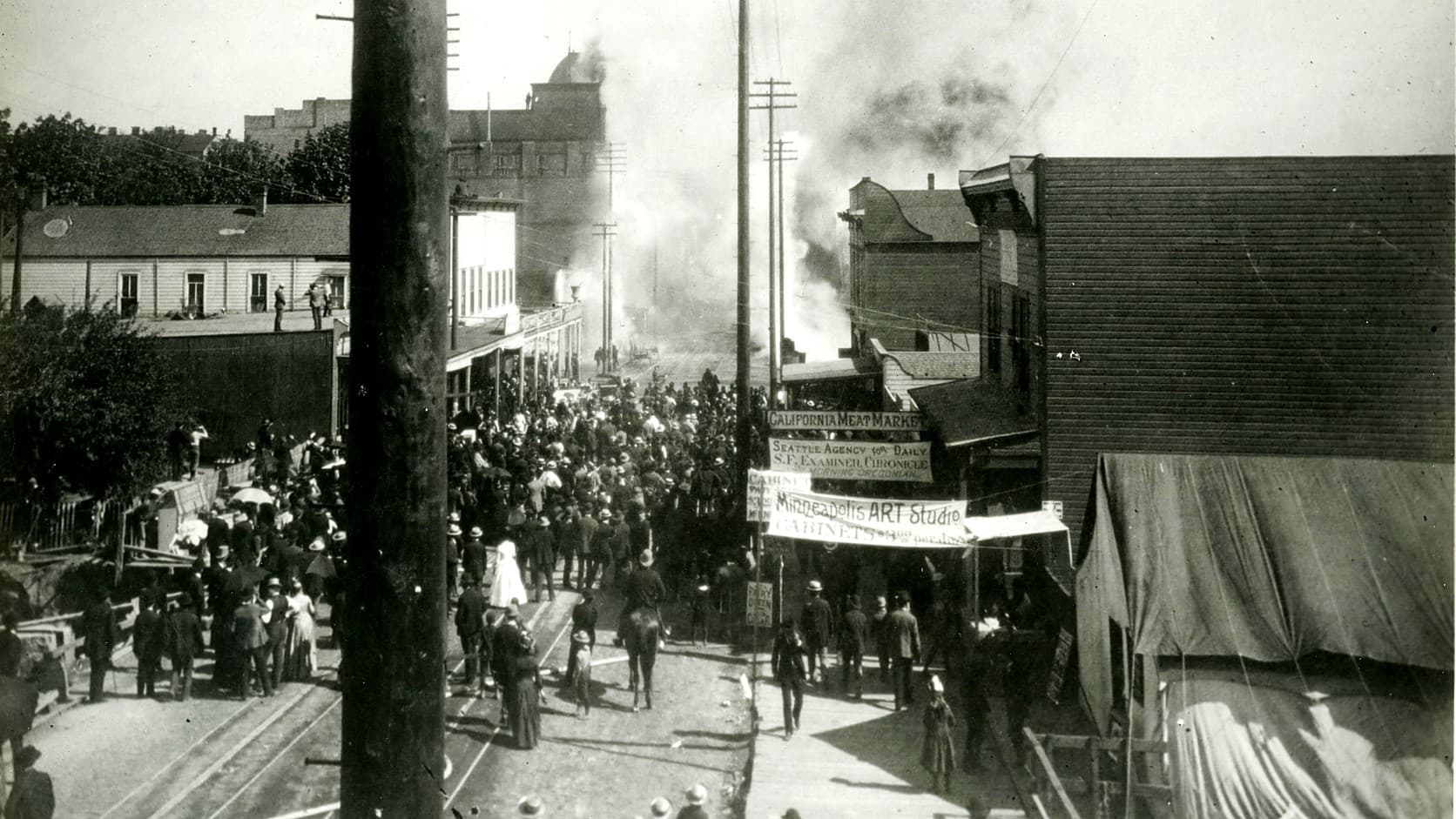
The Great Seattle Fire of 1889 began about 2:30 p.m. on June 6. What caused it, how many acres burned, why Seattle raised its streets and what to see.
The Great Seattle Fire began on June 6, 1889, at about 2:30 in the afternoon, when a pot of glue caught fire in a basement cabinet shop at Front Street (the name First Avenue carried then) and Madison Street. By sunset, HistoryLink says, some 64 acres of downtown and waterfront lay in ruins and no lives had been lost, though other sources count a larger burn. The city rebuilt in brick and stone and raised its streets over the ruins, which is why Pioneer Square, about 40 miles from Enumclaw by road, has old storefronts below its sidewalks.
For almost a century, Seattle's histories blamed the wrong man. The first newspaper reports named James McGough, a painter whose shop sat a level above the fire's real starting place, and the error survived in books into the 1970s. The man who set it off, a young worker named John Back, gave his own account to the Seattle Post-Intelligencer within about two weeks. Historian James Warren noticed the correction and moved the origin in his 1989 book, The Day Seattle Burned.
When did the Great Seattle Fire start, and how long did it burn?
About 2:30 p.m. is the safest answer, because the sources differ by minutes. One HistoryLink essay says about 2:30, its two longer essays say about 2:45, and the Seattle City Archives says 2:30.
The flames ran unseen through basements and under planked streets before breaking into the open. The historian Clarence Bagley, quoted by HistoryLink, wrote that the fire had run out of fuel by 9:30 that night, while the City Archives says it swept across the district over 18 hours.
What caused the Great Seattle Fire?
A glue pot, in a town with every other fire risk. The Northwest historian Paul Dorpat put it in words HistoryLink quotes: "It takes a conspiracy of coincidences to turn an ordinary fire into a great one." His list included a heat wave, a north wind, a fire chief out of town, almost no water pressure and a business district of clapboard. The water came from a private company through mains made of hollowed logs.
The spark itself was ordinary. By his own account in the Post-Intelligencer of June 22, 1889, John Back, a Swedish immigrant in his mid-20s who worked for the cabinetmaker Victor Clairmont, was melting hard glue on a stove fed with turpentine-soaked wood shavings when the pot overheated and ignited. Back threw cold water on it. "When I throw the water on, the glue flew all over the shop into the shavings and everything take fire," he told the paper.
Clairmont's shop was the lower of two basement levels in the Pontius Building, a wooden structure built out over tideland at 921-923 Front Street. McGough's paint business was on the level above. The City Archives summary calls the starting place a paint and woodwork shop; HistoryLink, citing the 1889 correction, puts the origin in the cabinet shop below it.
How many acres burned in the Great Seattle Fire, and did anyone die?
HistoryLink's fire essays all report that nobody died, but the acreage depends on who is counting. HistoryLink's short essay says some 64 acres lay in ruins by sunset. The City Archives says the fire swept across 100 acres of business district and waterfront and puts the loss at $20 million. A book published within months, by C. W. Austin and H. S. Scott, counted 116 acres, as 40 blocks plus 18 waterfront blocks, and HistoryLink's longer essays quote it while noting that accounts vary widely.
Of roughly 30 brick buildings in the commercial district, only the Boston Block, at Second Street and Columbia Street, survived. Rudyard Kipling passed through by ship within weeks and wrote of the business quarter: "I know now what being wiped out means." Insurance investigators blamed the city's water supply and fire department, and the city passed an ordinance on October 17, 1889 for a paid, professional department, which hired 32 men three days later.
Why did Seattle raise its streets after the fire?
Mainly for drainage. Seattle's sewers emptied into Elliott Bay and backed up at high tide, HistoryLink explains, and the burned district was a chance to lift the streets above that. The idea came up at a public meeting on June 7, the morning after the fire, where more than 600 people, mostly businessmen, voted to ban wooden buildings from the burned zone. The banker Jacob Furth told them, "The time is not far distant when we will look upon yesterday's fire as an actual benefit to Seattle."
A citizens' committee issued a replatting plan on June 10. On June 21 the council passed ordinances saying which streets would rise and by how much. Crews built retaining walls of stone or timber along the curbs, filled the space between and laid roadways, often of heavy timbers, on top. Ordinance 1147, passed July 1, was Seattle's first comprehensive building code, and HistoryLink quotes its opening words: "All buildings hereafter erected within the fire limits of the City of Seattle shall be made and constructed of brick or stone."
Is the Seattle Underground the city that burned?
Not quite: it is the first rebuilt city, buried by the new street grade. Owners put up new buildings on the old ground soon after the fire, before the streets were lifted, so the first and sometimes the second stories of many ended up below the new street. New sidewalks soon cut off light and access, and the lower levels were mostly abandoned, HistoryLink says. The city sealed them during a typhoid scare in 1907, and parts reopened in the mid-1960s for commercial tours.
Those tours began after a Seattle Times item of August 3, 1964 brought the journalist Bill Speidel, by his later count, 300 letters; he ran a regular tour by May 1965, HistoryLink reports. As of October 2026, the company that carries his name, Bill Speidel's Underground Tour, says on its website that its 75-minute tour starts on the hour from 10 a.m. to 6 p.m. every day except Thanksgiving Day and Christmas Day, with shorter hours on December 24 and extra half-hour departures from June through September that are sold only at its box office. It warns of flights of stairs, uneven ground and spotty lighting and calls the route "moderately rugged." Its pages give no ticket price, so the price has to come from the company's ticket page. A private company sets and can change its hours and prices.
What can you see for free in Pioneer Square?
The neighborhood's streets and old brick buildings cost nothing to look at, and a free indoor stop is the National Park Service's Klondike Gold Rush visitor center at 319 Second Avenue South, in the former Cadillac Hotel. The Park Service's basic information page says the site is fee-free year-round, with no entrance fee or pass required. As of October 2026, it lists hours of 10 a.m. to 5 p.m. Wednesday through Sunday, and closings on Mondays (so it is closed on Monday, November 2, 2026), Tuesdays, Veterans Day (November 11, 2026), Thanksgiving Day (November 26, 2026) and Christmas Day. Its subject is the Klondike gold rush and Seattle's part in it, not the fire.
Outdoors, Pioneer Place, the small park at First Avenue and Yesler Way, holds the iron-and-glass pergola, built in 1909, struck by a truck and brought down on January 15, 2001, and reopened after restoration on August 17, 2002. HistoryLink says the pergola and the Pioneer Building nearby became national landmarks in 1977. KOMO News reported that revelers broke some of the pergola's glass and left graffiti on its iron columns after the Seahawks' Super Bowl win in February 2026, and an appeal for donations to the Seattle Parks Foundation followed, but no notice of finished repairs turned up for this article. The Pioneer Building, which Elmer H. Fisher designed for Henry Yesler after the fire, still stands, HistoryLink says. The district's brick has been tested since: the 2001 Nisqually earthquake brought brick down on its sidewalks, as the photograph in our guide to Washington's biggest earthquakes shows.
From home, the Seattle Municipal Archives posts digital copies of 1889 city records, including the replatting committee's report of June 10 and a November 22 policy on tents inside the fire limits, on its Great Seattle Fire page.
How do you get from Enumclaw to Pioneer Square?
By road it is about 40 miles and roughly an hour without traffic, by the estimate of an OpenStreetMap-based routing service. By transit it takes two rides, because there is no direct bus from Enumclaw to Seattle. Our guide to Enumclaw to Seattle by bus and train lays out the usual route: Metro's route 915 to Auburn Station, then a Sounder train or Sound Transit's 578 bus.
The Sounder S Line runs weekdays only as of October 2026, and Sound Transit's holiday schedule lists no Sounder service on Thanksgiving Day or the day after. King Street Station is at 303 South Jackson Street, on the same street as the Park Service center. The Underground Tour's ticket counter, by the company's page, is at 614 First Avenue.
Is there an Enumclaw connection to the 1889 fire?
None of the sources read for this article connects Enumclaw to the Seattle fire. On February 17, 1898, nine years after Seattle burned, Farmers Mutual Insurance Company filed its articles of incorporation with the state. HistoryLink says the firm, later renamed Mutual of Enumclaw, was first set up to shield farmers from fire losses, and the company says a group of Enumclaw residents founded it. Our downtown Enumclaw walking tour stops at the company.
Enumclaw had a fire of its own. By our history of the Courier-Herald, a coal oil lamp set the paper's Railroad Avenue office and its press ablaze in the fall of 1903, and the paper was back on the street on December 4.
Before you go
Check three pages that change. The tour company's page gives its hours and ticket price, the Park Service's page gives the visitor center's hours and holiday closings, and Sound Transit's page gives the Sounder timetable. The Park Service describes Seattle's weather as warm and dry from mid-July through mid-September and mainly rainy and cool the rest of the year, so dress for rain.
Story label: Original Story or Guide
Originally published: