

Feature
Mount St. Helens in winter, with Johnston Ridge closed
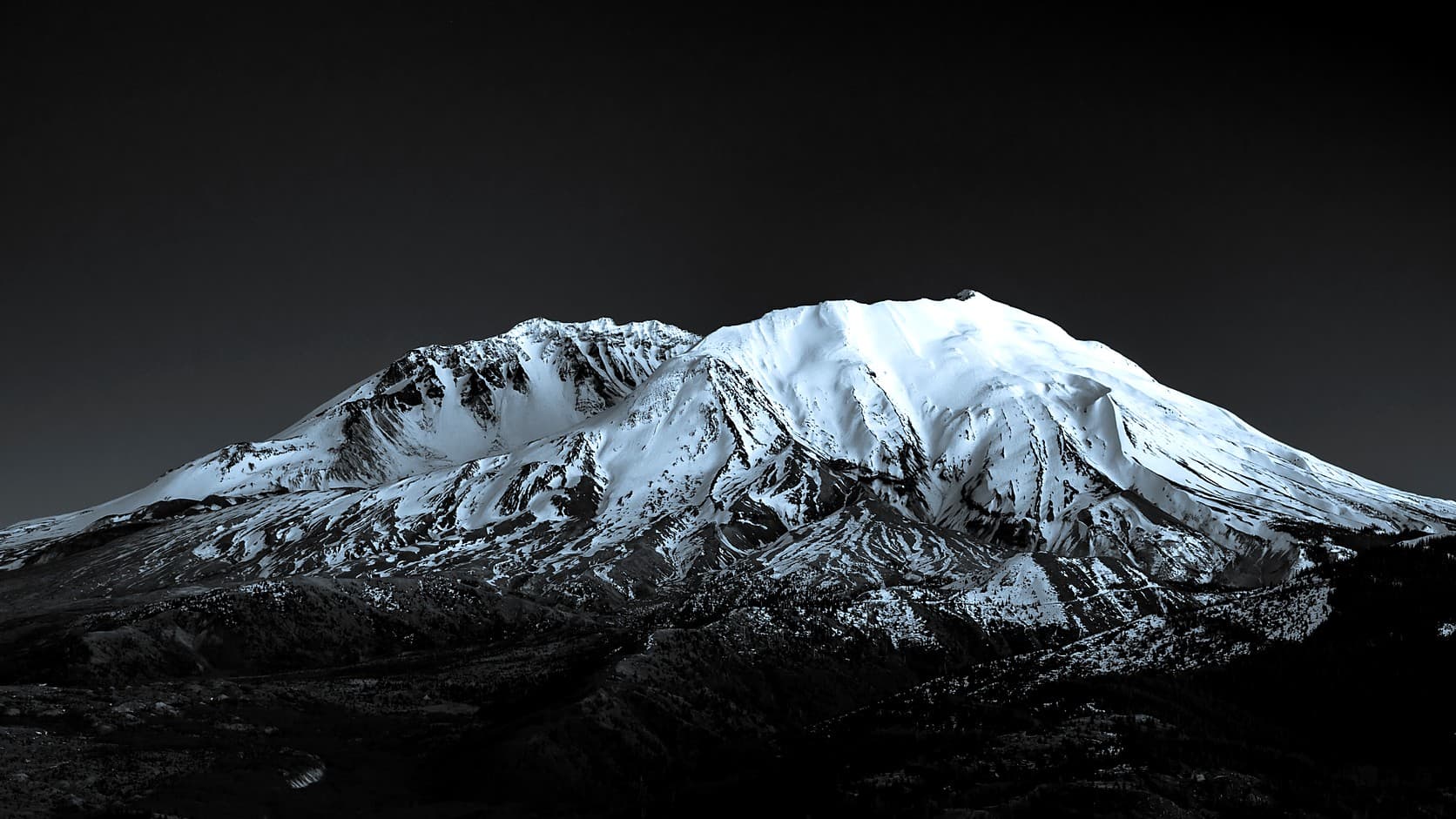
Mount St. Helens in winter: Johnston Ridge is closed and two agencies differ on the Coldwater center's hours. What is open, what it costs.
Johnston Ridge Observatory, the visitor center about five and a half miles from the crater by the state's measure, is closed through the winter of 2026 to 2027, and the Forest Service says it may reopen in 2027. Below the locked gate at milepost 45.2 on State Route 504, a few stops stay open: Seaquest State Park and the Mount St. Helens Visitor Center near Castle Rock, Castle Lake Viewpoint, Coldwater Lake and the Hummocks Trailhead. From Enumclaw it is roughly 140 miles each way to the Science and Learning Center at Coldwater, about 3 hours 25 minutes by one routing service's estimate. All hours and fees here are as of October 2026.
The observatory has been unreachable by road since the night of May 14, 2023, when, by the Washington State Department of Transportation's (WSDOT) account, a hillside gave way, sent more than 300,000 cubic yards of debris roughly 2,000 feet downslope and destroyed an 85-foot bridge. A temporary road built that summer failed after four months. The permanent bridge is under construction, and the Science and Learning Center at Coldwater, a couple of miles below the gate, is where the two agencies that run the mountain contradict each other.
1. Is Johnston Ridge Observatory open in winter?
It is closed, and the closure does not end with the season. The Forest Service's observatory page, in a note dated January 2026, says: "It is estimated that Johnston Ridge may be open in 2027, depending on repair work progress by WSDOT." WSDOT's project page says a contractor began work on a permanent bridge and roadway on April 27, 2026, and that "Construction will pause for the winter before resuming in spring 2027". Paving and the finish come after that.
A finished road would not by itself mean an open building. WSDOT's text says the Forest Service will then begin restoring the observatory, power included, before it can reopen. Its own timeline table, meanwhile, lists both the upper road and the observatory as expected to reopen in spring 2027. Take those as estimates from two agencies, not a date. The Forest Service page also carries a per-person fee and an older milepost in its hours text, neither of which describes a building that is shut.
For what the mountain did in 1980 and where it ranks among Washington's volcanoes, see our guide to the state's volcanoes.
2. When is the Science and Learning Center at Coldwater open?
Daily from 10 a.m. to 4 p.m. through November 17, 2026, then it depends on whose page you read. The Forest Service's page for the center, which it marked as last updated September 30, 2026, says: "Closed to public: November 18th-Spring of 2027". The Mount St. Helens Institute's visit page lists the center at 10 a.m. to 4 p.m. on "Saturdays and Sundays November through mid-June", with a note that schedules vary and can change.
The Institute is the nonprofit that runs programs at the center under a special use permit from the Forest Service, so neither page is obviously the stale one. Both agree that the seven-day schedule ends November 17, 2026. This desk could not settle the weekend question from a third source. Call the center at 360-274-2131, the number on the Forest Service page, before driving, or the Monument office at 360-449-7800.
The center is at milepost 43, with a view over Coldwater Lake and the valley, a short interpretive trail and a 20-minute film, the Institute says. The Forest Service charges $5 per vehicle per day or $30 for an annual pass, and it says the building's restrooms and drinking water are available only while it is open. Through November 17 the lot gate is locked at 4:05 p.m.
3. Can you visit Coldwater Lake and the Hummocks Trail in winter?
Both stay open for day use, from sunrise to sunset by the Forest Service's wording, with a $5 per vehicle federal day pass or an annual pass. The Institute adds that in winter the road may not be plowed, so a visit to Coldwater Lake may need snowshoes. The lake itself was made when the 1980 debris avalanche dammed Coldwater Creek, the Forest Service says, and a 0.6-mile boardwalk trail beside it explains how.
The Hummocks parking lot has no view of the mountain, the Institute notes; seeing it takes a walk of about one mile round trip. The South Coldwater Trailhead sits beyond the gate, so it is reached on foot from Hummocks. The Institute's warning is plain: do not pass the barriers to continue up the highway.
4. Is Castle Lake Viewpoint open in winter?
It is open all year and free, but snow can stop you. The Institute says access may be limited by snow, and the Forest Service says the viewpoint can occasionally be inaccessible when the road is not plowed. It lies about 40 miles east of Castle Rock, with benches, interpretive signs, ample parking and a short trail, and it looks at the mountain, Castle Lake and the landslide deposit left in 1980. There are no restrooms. Elk Rock Viewpoint, 37 miles from I-5 by the Institute's count, follows the same year-round, snow-limited rule.
5. What is open at Seaquest State Park and the Mount St. Helens Visitor Center?
Both are open in winter, at different hours. Seaquest State Park lists 8 a.m. to dusk year round, a $10 one-day or $45 annual Discover Pass, and more than 12 miles of trails. A short pedestrian tunnel joins it to the visitor center across the highway.
Washington State Parks' visitor center page gives the schedule: daily 9 a.m. to 4 p.m. from October 1, then "November thru March 2027, the Visitor Center will be open Wednesday thru Sunday 10 a.m. to 4 p.m." Admission is $5 for ages 18 and older, $2.50 for ages 7 to 17, free for ages 6 and younger, and $15 for a family. Dogs may not enter the building. The Institute's table lists the center only for mid-May through September, though the same page says the visitor centers run reduced winter hours and sends readers to State Parks; State Parks runs the building, so its hours are the ones printed here. The phone is 360-274-0962.
6. What about the Sediment Retention Structure?
It is the Army Corps of Engineers structure on the Toutle River that holds back the eruption's sediment, and the Institute lists it as open year round from sunrise to sunset, with no fee, vault toilets and no wheelchair access. The U.S. Army Corps of Engineers finished it in 1989, and the Corps says it holds hundreds of millions of cubic yards of sediment that would otherwise wash downriver, where it would cause flooding and navigation trouble. The Institute lists approaches from both I-5 exit 49 and exit 63, about 22 miles in.
7. What is open on the south and east sides of Mount St. Helens in winter?
Less, and the gates are the point. Ape Cave is closed to the public from November 1 to May 17. Blue Lake, Goat Marsh, June Lake, the Lahar Viewpoint and the Climber's Bivouac are listed by the Institute as inaccessible by road in winter. Marble Mountain Sno-Park stays open for winter recreation, and from December 1 to March 31 parking there needs a Washington Sno-Park permit, which the Institute lists alongside the federal day pass, while the Trail of Two Forests asks for one in place of it. State Parks sells them from November 1 to April 30 at $25 for one day or $50 for the season; our Sno-Park permit guide explains the rules. The Institute says there is no recreational sledding at Marble Mountain and no mountain view from its lot.
The east side, with Windy Ridge, is out of reach for the winter. Forest Road 99 is closed for snow, the Institute says, and typically closes in mid-November and opens in late June or early July.
How far is Mount St. Helens from Enumclaw, and how did the road get there?
The Institute's directions send drivers from Seattle, Tacoma and Olympia to exit 63 at Toledo and State Route 505; drivers from Portland take exit 49 at Castle Rock. The OSRM routing service, which uses OpenStreetMap data, put the drive from Enumclaw to the Science and Learning Center at about 140 miles and 3 hours 25 minutes without traffic, and to Seaquest at about 113 miles and 2 hours 25 minutes. Those are estimates from a point near downtown on October 26, 2026; a winter storm will not appear in them. Enumclaw's own volcano is much closer: the lahar-zone guide covers Mount Rainier's hazard map for town, and the Rainier winter guide covers what is open on the nearer mountain.
None of this road is old. By WSDOT's history, the 1980 eruption buried State Route 504 beyond Toutle, the Monument was designated in 1982, and the Silver Lake visitor center opened in 1987. A highway reconstruction began in 1988, the Science and Learning Center opened in 1993 and the observatory in 1997, after the road was extended by about 30 miles. In winter 2026 to 2027 the public road ends at the gate at milepost 45.2, a couple of miles past the Science and Learning Center and short of the observatory at the end of the highway.
Before you go
Check three pages on the morning you leave: the Forest Service's current conditions page for closures, WSDOT's project page for the road, and State Parks for the visitor center. Whoever sets a number can change it; hours, permit prices and the reopening estimate all change from season to season, and the pages above are where the change shows up first.
Plan the day around supplies. Drew's Grocery in Toutle is the last food and gas the Institute lists, and it says that "During the late fall, winter, and early spring, there are no public restrooms available past Toutle." The Forest Service, for its part, lists restrooms at the Science and Learning Center during open hours and on the boat-launch side of Coldwater Lake as of a January 2026 note. Plan for both possibilities. Bring a day pass or an annual one, and snowshoes if the trip is to Coldwater Lake.
Story label: Original Story or Guide
Originally published: