

Feature
Northern lights in Washington, when and where to look
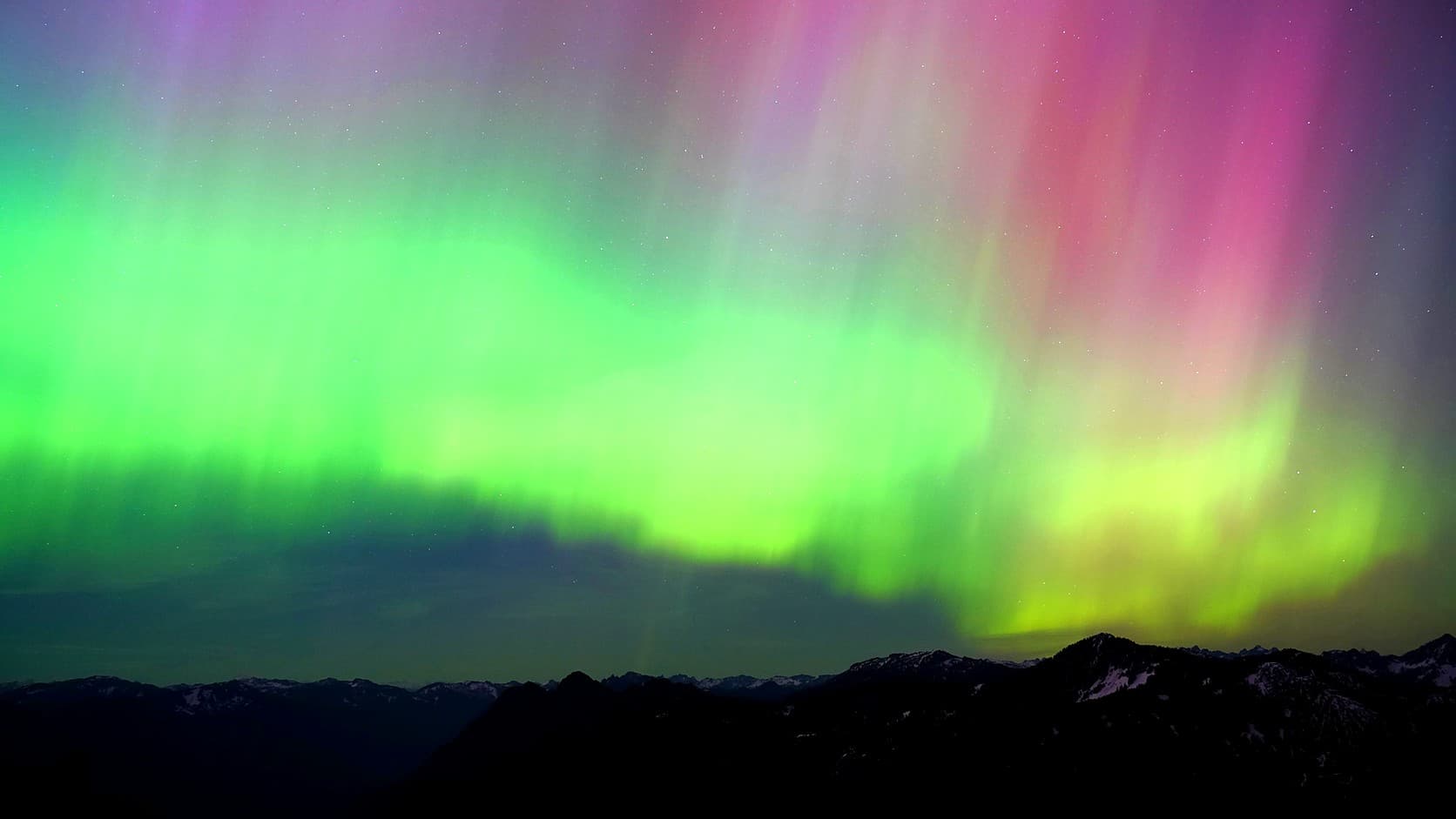
Northern lights in Washington: the Kp to watch, the hours and season that count, how to read the forecast, and where near Enumclaw you may be after dark.
Yes, you can see the northern lights in Washington, Enumclaw included, but only when a geomagnetic storm of at least moderate strength, a clear sky and full darkness arrive at the same hour. By the storm scale of NOAA's Space Weather Prediction Center (SWPC), the aurora has been seen as far south as Idaho and New York in a G2 storm, a planetary K index (Kp) of 6, and as far as Oregon in a G3, Kp 7. Watch for a Kp of 6 or more, and look north between 10 p.m. and 2 a.m., away from lights.
An alert is only half of it, and Saturday, October 10, 2026 showed the other half. A coronal mass ejection, an eruption of solar plasma, reached Earth that morning, and SWPC reported G3, or strong, storm levels from 10:58 a.m. Pacific time. By the agency's own three-hour record the index peaked at 7 between 8 and 11 a.m., and from 8 p.m. on it stayed below 4, through all the hours SWPC calls best. For Washington, the storm spent its strength in daylight.
What Kp do you need to see the northern lights in Washington?
Six or more, by SWPC's guidance, and each of the three Washington displays described below was photographed with the index at 7 or higher. Kp, the planetary K index, rates the disturbance of Earth's magnetic field over three hours on a scale of 0 to 9, and SWPC counts 5 or more as a storm. Its G scale names the levels: Kp 5 is G1, minor; 6 is G2, moderate; 7 is G3, strong; 8 is G4, severe; a full 9 is G5, extreme. SWPC's scales say the aurora "has been seen as low as Illinois and Oregon" at G3, and as low as New York and Idaho at G2. Its Tips on Viewing the Aurora say that at Kp 6 to 7 "it might be possible to see the aurora from the northern edge of the United States." At 8 to 9 it may be overhead in the northern states.
The same page maps how far south the aurora may be seen at several levels, drawing the Kp 7 line across southern Washington, south of Puget Sound, and the Kp 5 line through British Columbia. The lines mark where the lights might be glimpsed in the distance, not where they hang overhead. Over the Sun's roughly 11-year cycle, the scales count on average about 200 G3 storms on some 130 days and about 100 G4 storms on 60 days, but G5 conditions on just four.
What time of night is best?
Within an hour or two of midnight, between 10 p.m. and 2 a.m. local time, by SWPC's tips, and the window stretches toward evening and morning as a storm grows. SWPC's forecasts and records count Kp in three-hour blocks of Universal Time, UT. Subtract seven hours while Pacific Daylight Time is in force and eight in standard time, from early November into March. The block that best covers that window is 06-09 UT: 11 p.m. to 2 a.m. in daylight time, 10 p.m. to 1 a.m. in winter. That arithmetic is the whole story of October 10, 2026, when the strongest block was 15-18 UT, or 8 to 11 in the morning here.
When is the best season for the northern lights?
Around the spring and fall equinoxes, SWPC says, because the way the solar wind meets Earth's magnetic field makes larger storms likelier then. Washington's long nights favor the months between the fall and spring equinoxes, the longest coming at the December solstice, the National Weather Service notes. A full moon dims the display to the eye, SWPC adds. NASA and NOAA announced on October 15, 2024 that the Sun had reached the maximum period of its 11-year cycle, expected to last another year or so before the declining phase, and NASA added that scientists often see fairly significant storms in the decline, if less often. SWPC recorded G4 levels on January 19, 2026, 15 months later.
How do you know if the northern lights will be visible tonight?
Start with SWPC, a division of the National Weather Service, which calls itself the official source of space weather forecasts and warnings. Its experimental Aurora Dashboard puts forecast maps for tonight and tomorrow night, a 30-minute forecast and the latest Kp on one page; the 30-minute forecast, built on solar wind measured about a million miles upstream of Earth, looks 30 to 90 minutes ahead.
SWPC's bulletins come in three grades. A watch can go out up to three days ahead, since a coronal mass ejection typically takes days to arrive, but it carries less confidence in timing and strength, SWPC says. A warning, based on measurements of the solar wind, usually comes minutes to a couple of hours ahead. An alert means a level has been reached. All three can come by email to subscribers. Then check the clouds, because a G4 above solid overcast is only a rumor.
Which way do you look, and why does a camera see more?
North, and usually low. SWPC advises an open view to the north, ideally a hilltop, from which a person can see aurora as much as 1,000 km, about 600 miles, farther north. The same page adds: "Get away from city lights." Unless the index reaches 8 or 9, expect it toward the northern horizon.
Photographs will still beat your eyes, and the National Park Service, writing for aurora watchers at Denali in Alaska, explains why: a camera on a long exposure leaves its lens open for several seconds, collecting more light, so the picture looks brighter than the sky did. Faint aurora may look mostly white, because the eye sees little color in dim light; at moderate activity you will likely make out green, and the Park Service calls reds and purples extremely rare. Give your eyes at least 30 minutes in the dark, with flashlights and phone screens off.
When has Washington seen the northern lights?
Washington saw them on May 10, 2024, October 10, 2024 and January 20, 2026, among other nights, and each photograph named here was made while the index stood at 7 or higher, by the record of the German Research Centre for Geosciences, GFZ, whose Kp page SWPC calls the official one. On May 10, 2024, SWPC first observed G5, extreme, conditions at 3:54 p.m. Pacific, in what NASA later described as the strongest geomagnetic storm to reach Earth in 20 years. Photographs on Wikimedia Commons put the lights that night over Seattle, Edmonds, Monroe, Bellingham and Othello, and above the mountains seen from Mailbox Peak, near North Bend, at 10:13 p.m., in the picture at the top.
On October 10, 2024, SWPC reported G4, severe, levels, and a KOMO News photo gallery from that evening includes a photograph taken in Enumclaw, with others from Tipsoo Lake and Mount Rainier. On January 19, 2026, G4 levels arrived at 11:38 a.m. Pacific, in daylight, but the index climbed back above 7 after 10 p.m. and stayed high into the next night, when a photographer in Whatcom County caught a green glow over a lake at 10:16 p.m. on January 20.
Can you watch from Mount Peak or a park in Enumclaw?
Not legally, in the hours that count. As of October 2026, Enumclaw's municipal code opens city parks half an hour before sunrise and closes them half an hour after sunset; its one standing exception is Boise Creek Park, open until 10 p.m. on nights when ball games are scheduled. King County's code sets the same half-hour-after-sunset closing for county parks, and that takes in Pinnacle Peak Park, home of the steel lookout tower flown onto Mount Peak in 2021. State parks close at times posted at each entrance, and under WAC 352-32-050 no one may be in one after closing except registered campers in a campsite, their guests until 10 p.m., and a few listed cases such as an approved special event. A violation is an infraction.
Where can you watch the northern lights near Enumclaw after dark?
From ground you are allowed to stand on at midnight. The simplest is private: your own yard, or a field whose owner has said yes, with no porch light or streetlight between you and the northern horizon. One public place that stays open all night is Mount Rainier National Park, which the Park Service keeps "open all year, 24 hours a day." A private vehicle pays $30 for seven days; the Park Service sets that fee and posts it on the park's fees page. Arrive after dark and you buy the pass at the next staffed entrance, by card.
The calendar narrows the choice. Tipsoo Lake, at Chinook Pass on the park's east edge, is within reach by car only until the state closes SR 410 over the pass for the winter, on no fixed date and usually in November, though it closed in October in three of the four years from 2022 through 2025, as the guide to when Chinook Pass closes explains, and the park's Tipsoo Lake page gives the road season as June to October; on October 15, 2026 the state's pass report showed no restrictions. The Sunrise road closes for the winter by mid-October or earlier, the park says, and in 2026 fire had already shut it to cars, as the Enumclaw to Sunrise guide reported. The road from Longmire up to Paradise is gated nightly through the winter, typically from late October or early November, as the Mount Rainier winter guide sets out.
Before you go
On the day, read SWPC's dashboard and three-day forecast, convert the UT blocks to Pacific time, and look for a watch or a warning. Then check the Moon and the clouds; Rainier brews some of its own, as the guide to Rainier's lenticular clouds explains. Bound for the park, read its Alerts and road status pages and WSDOT's Chinook Pass report. Dress for standing still, and point a camera north before deciding the sky is empty. And if every block after dark stays below 6, as each one did on October 10, 2026, go to bed.
Story label: Original Story or Guide
Originally published: