

Feature
Old Enumclaw High School on Porter Street, built in 1921
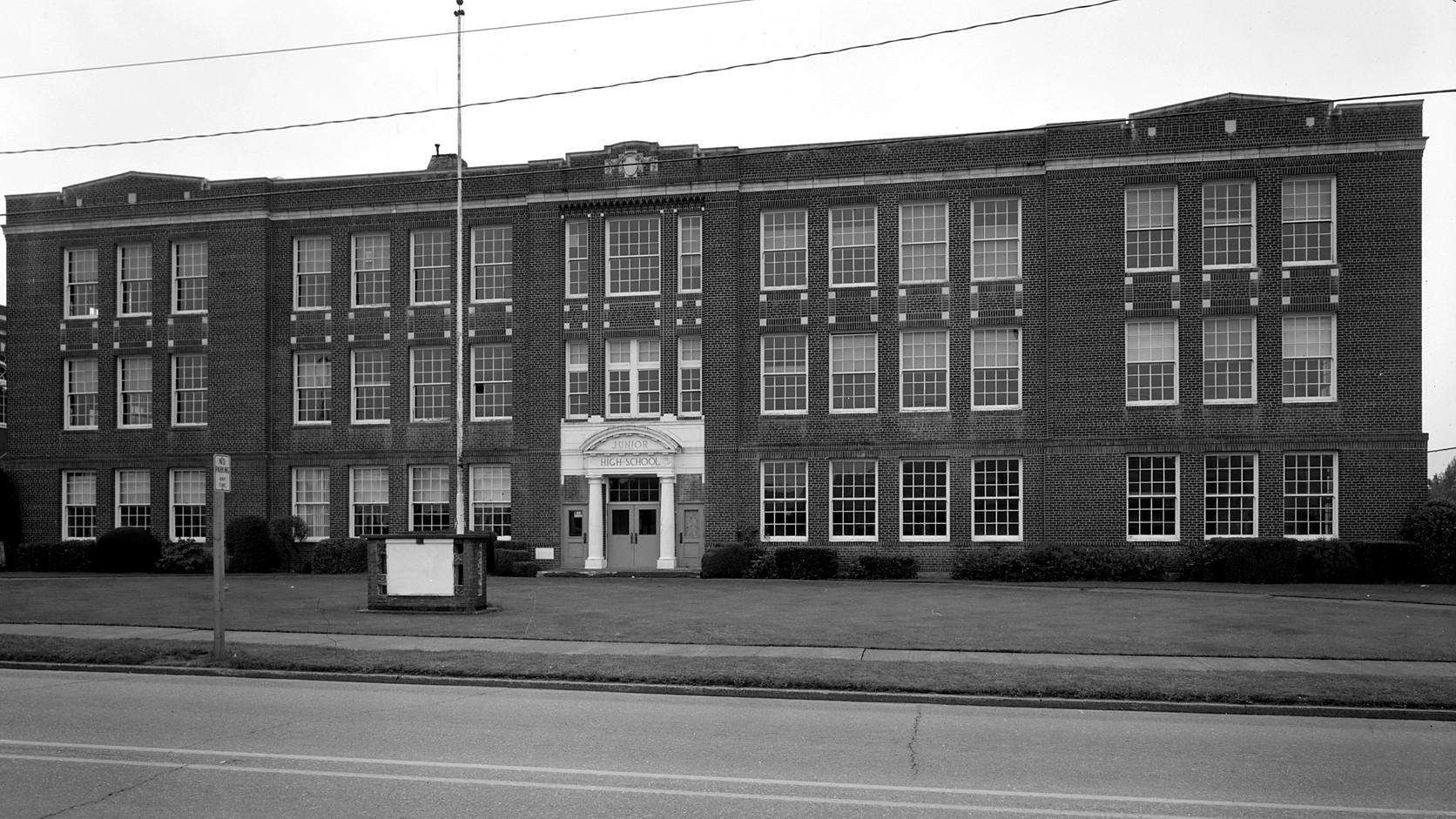
Enumclaw High School history: the 1921 school at 2222 Porter Street, its cemetery site, Depression additions, the 1986 survey photos and Dwight Garrett Park.
The old Enumclaw High School stood at 2222 Porter Street. It was designed by the Seattle architect Harlan Thomas, built by Peter Woeck of Seattle, and dedicated in September 1921. The district's high school students left it in 1963, and by one database's estimate it was demolished around 1990. The site is Dwight Garrett Park, a city park with ball fields, courts and a skate park, as of November 2026.
The land is the part people do not expect. The school district bought it from the Catholic Diocese for $5,000 in 1920, and the roughly five acres held a cemetery that had to be relocated. The building that went up on it was, the survey says, by far the largest in town when erected, and a Depression-era addition gave Enumclaw an auditorium with 1,312 seats, in a district that had counted 725 students in 1921.
When was the old Enumclaw High School built?
Construction finished in September 1921, according to the Pacific Coast Architecture Database, a University of Washington library project that catalogs buildings by architect. The Historic American Buildings Survey, a National Park Service program that records old buildings before they change or vanish, says the school was dedicated that same month. Its history of the building cites a newspaper issue of September 30, 1921, which is the issue to look for if you want the dedication coverage itself (the survey calls the paper the Courier Herald, but that name dates from the 1933 merger of the Courier and the Herald). The history of the Courier-Herald explains how that paper came to be the town's record.
The survey says the dedication drew the U.S. Commissioner of Education and the state superintendent, who had come to honor the consolidation of the greater Enumclaw School District. Before consolidation, a small town had a small school with little choice of teachers or subjects. The guide to the plateau's one-room schools covers the districts that were folded in over the following decades.
Who designed it, and what did it look like?
Harlan Thomas, a prominent Seattle architect who later became dean of the University of Washington's architecture school, drew the plans. The survey says he specified a reinforced concrete frame faced in red brick, three stories, with a symmetrical front of five sections and a columned entrance. Ornament was restrained and borrowed from the Colonial Revival style. The windows are what you notice in the 1986 photographs: tall banks of twelve-over-twelve wood sash, so many that the survey says they seem to take up more of the front than the brickwork does.
Over the entrance, the words "High School" were cut into the frieze, and the word "Junior" was added later. Beside the door was a marble plaque. The Pacific Coast Architecture Database records its motto as "Knowledge Is the Only Fountain of Human Liberty."
Thomas had already designed the J. J. Smith School in Enumclaw, which the survey says he used as a model. The survey says that building was demolished in the 1950s, and when it was written in the 1980s it called the high school the only historic school building remaining in town.
What was on the land before the school?
A cemetery. Both the survey and the Library of Congress record say the site was bought from the Catholic Diocese for $5,000 in 1920, that it covered about five acres, and that the cemetery on it was relocated. Neither says where the graves went, who handled the move, or how many there were, and nothing opened for this article answers those questions. The survey's bibliography lists a history of Sacred Heart Parish held in the Catholic church archives, which is the obvious place to look next.
How did the school grow after 1921?
In four steps, with some disagreement about the dates. The survey's data form lists work in 1921, 1928, 1935 and 1938, while the Library of Congress record and the Pacific Coast Architecture Database both add 1984.
The 1928 north wing along Kibler Avenue was also by Thomas, with a detached garage for school buses. The 1935 addition was much larger, designed by William Mallis, and the survey says it was built with federal assistance. It added a 1,312-seat auditorium, a cafeteria, a boys' gymnasium and locker rooms. The survey sets the scene: many people on the plateau were out of work, a hunger strike was planned to join a march to the state capitol in Olympia, and the county welfare board was handing out seeds for spring planting. For unemployed construction workers, the school project was a relief. The 1938 addition, also by Mallis, copied Thomas's front and carried a metal plaque saying the money came from the Works Progress Administration, the New Deal jobs agency.
One former student remembered the order differently. Jim Merritt, who grew up in Enumclaw and wrote a booklet about the school that HistoryLink later published, placed the junior high wing in the early 1930s and the new gym and auditorium in the mid 1930s. His is a memory written decades later, so the survey's dates, which it took from a National Register nomination, are the ones used here.
What was it like to go there?
By Merritt's account, which covers the 1920s through the 1940s, it was the town's stage as well as its school. The sports teams were the Enumclaw Tigers. The yearbook was Tiger Tales and the student paper was the Hi-Mercury. Students could join a Thespian society, a ham radio club, a women's rifle club, a chess club and a Future Farmers chapter. Basketball games, assemblies, dances and operettas shared the gym until the auditorium opened. Rivalry with Buckley, he wrote, could get emotional enough that a school's letters and colors were sometimes found painted on a rival's doors before a big game.
The survey makes the same point in its own words. The school stayed the community's center for cultural, social, educational and sports activities for many decades, and the building was "Enumclaw's sole reminder of its long educational heritage." The auditorium was the area's main performance hall for decades, and the survey says practically any important secular event was held there.
When did students leave Porter Street, and when was it torn down?
High school students moved to a new location in 1963, according to the survey. The building then served only as a junior high until the junior high students also moved to a newer building. Enumclaw High School is at 226 Semanski Street South, per the school's own page. Wikipedia gives 1961 as that school's founding year; the survey says 1963 for the move, and this article follows the survey.
The record is thinner for what came next. The survey form says the building had been abandoned since 1984 and was slated for demolition, while its narrative says the junior high students left in the spring of the year it was written. The survey's photographs are dated April 1986. The Pacific Coast Architecture Database says the school was demolished around 1990 and that the district sold the site to the city in June 1990 for $250,000. That is the only source found for the sale and the demolition year, so treat "around 1990" as that database's estimate, not an official date.
The state required the photographs. The Washington Office of Archaeology and Historic Preservation asked for documentation under the State Environmental Policy Act, and the result is 19 photographs, exterior and interior, now in the Library of Congress. The library's record says: "No known restrictions on images made by the U.S. Government; images copied from other sources may be restricted."
What is on the site now?
Dwight Garrett Park, at the same address, 2222 Porter Street. The Courier-Herald's December 2008 obituary of Dwight Garrett, an inventor and businessman, put it plainly: "The former school site on Porter Street is now Dwight Garrett Park," followed by the renaming of Second Street as Garrett Street. The Pacific Coast Architecture Database says the city named it for him.
The City of Enumclaw's facility page, read November 2, 2026, lists baseball and softball, a basketball court, an open field, picnic tables, a skate park and a tennis court. It lists a city contact and phone number, 360-802-0235, but no hours. The city decides which facilities a park has and can change them, so that page, not this one, is the thing to trust for the list. The park occupies the school's former grounds, which the survey describes as including a large playing field running west from the building.
Nothing of the 1921 building is described as surviving. For standing buildings from the same decades, the Enumclaw historic buildings walking tour is the better route.
Before you go
To see the school as it was, open the Library of Congress record for HABS WA-175, which carries the photographs and the written history. The library's own site has sometimes asked visitors to pass a security check before loading, so allow a moment or try again. The Pacific Coast Architecture Database entry gives the demolition and park history, and HistoryLink's Enumclaw High School Days is Merritt's reminiscence in full.
To visit the park, check the city's facility page above for what is there and call the number it lists about hours or closures. How big the district is has changed a great deal since 1921; the piece on the district's October count day shows where that number stands.
Story label: Original Story or Guide
Originally published: