

Feature
First bugle to first frost: the six weeks when the plateau does everything at once
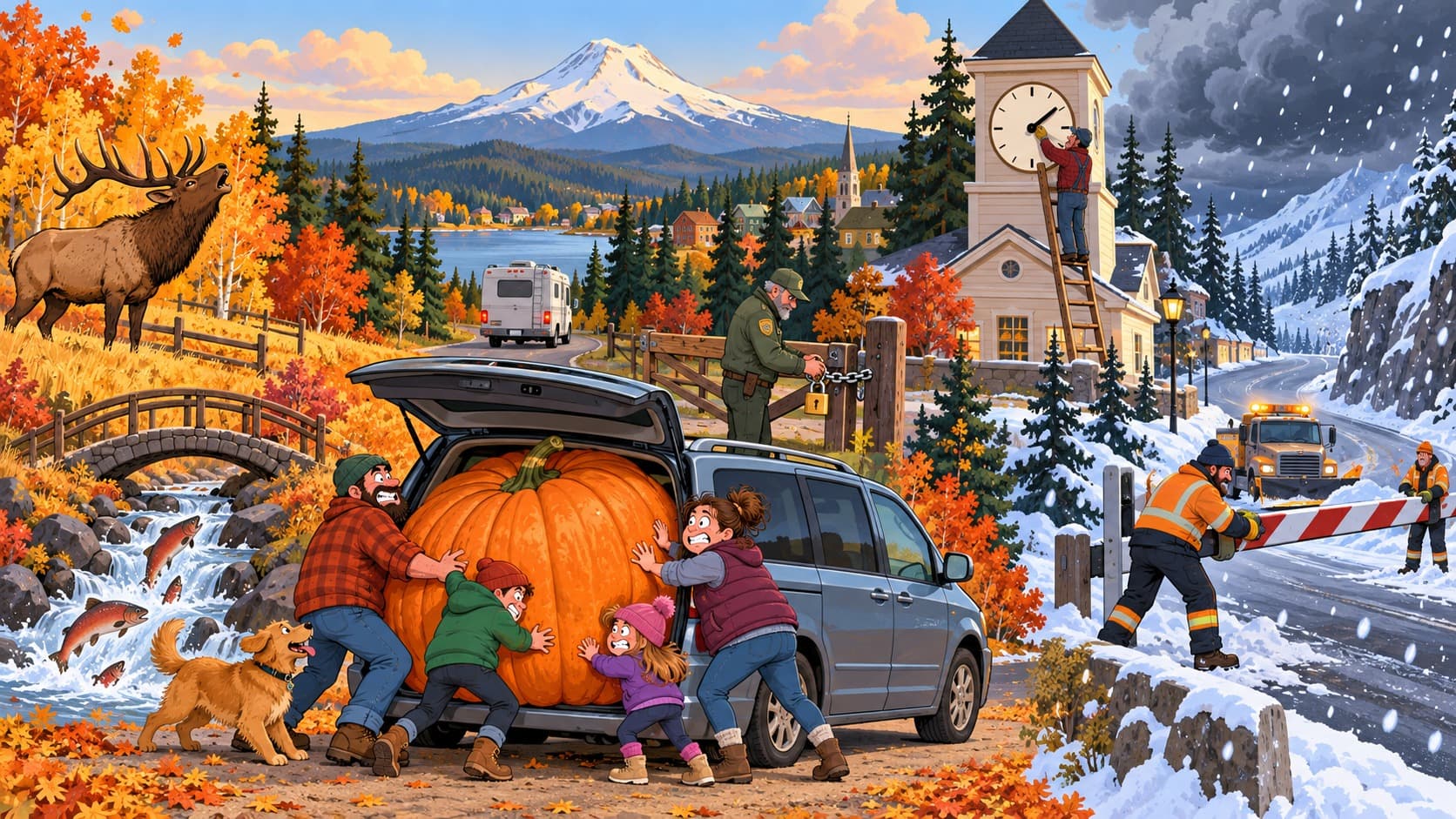
Week by week, mid September to November 1: elk rut, Boise Creek salmon, pumpkin patches, Sunrise Road, Chinook Pass closing, first frost, sunset times.
For about forty six weeks of the year the Enumclaw plateau runs on a sensible schedule. Something happens, then something else happens, and there is time in between to talk about it at Safeway. The other six weeks are these. Starting roughly now and ending when the clocks fall back, the plateau tries to do everything at the same time: the elk go into rut, the Chinook spawn, the pumpkin farms open, the campground shuts, the mountain pass closes, the first frost lands, the rain returns and the sun, which sets at 7:15 this evening, will be gone by ten to five on the first of November. None of it is coordinated. All of it can be dated.
Week one, September 17 to 23: the last of the light
The sun sets at 7:15 tonight, per timeanddate's table for Enumclaw. From here the plateau loses roughly two minutes of evening a day, which does not sound like much until you add it up in November.
Up the hill, Crystal Mountain's front page says the gondola runs weekends only through September 20, then stops until ski season. Last call for 6,872 feet without skis.
At the same time the elk are getting loud. The Washington Department of Fish and Wildlife's species page puts the rut "in late September and October," when the bulls "are battling each other over females and are not as concerned about being seen," and their bugles carry "near dawn and dusk."
The fish are already here. King County's spawn timing has Chinook in its streams from September through mid December, and the densest wild Chinook spawning in the Puyallup watershed is in a ditch south of town. Boise Creek, from the mouth to the SR 410 crossing, is closed waters for all species in the current pamphlet. Look from the Foothills Trail bridge, stay out of the water, leash the dog, and read the fuller guide first: https://www.enumclaw.com/stories/boise-creek-salmon.
Week two, September 24 to 30: pumpkins and the huckleberries
Saturday, September 26, is the official start of pumpkin season on the plateau. Thomasson Family Farm's 2026 page lists September 26 through October 30, 9:30 to 5:30, with a ten acre patch and a five acre maze, and the farm is closed on Halloween itself. Maris Farms in Buckley runs "select dates, Sept. 26 to Oct. 31." Days, prices and which lot fills: https://www.enumclaw.com/stories/pumpkin-patches-corn-mazes-enumclaw-fall-2026.
This is also the week the high country turns. Visit Rainier's fall color guide says the huckleberry, vine maple and larch "begin turning in late September," with the best display between Sunrise and Chinook Pass. In an ordinary year this is when Sunrise Road starts closing nightly at the White River Campground junction. This is not an ordinary year. The park's road status, updated September 15, has Sunrise Road "closed to vehicles due to the Grand Park 2 and Wonderland Complex Fires until further notice," open to pedestrians and bicyclists only, with no potable water at Sunrise from September 16. The Grand Park 2 fire, 168 acres, is fully contained, the Courier-Herald reported September 4, and White River Road and the campground reopened the next day. So the huckleberries at Sunrise are red, and they are yours if you will walk or ride the road to get there. The drive, for when it comes back: https://www.enumclaw.com/stories/enumclaw-to-sunrise. Chinook Pass, meanwhile, is open, and the same colors line the Naches Peak loop at Tipsoo Lake.
Sunset on the 26th is 6:57. By the 30th it is 6:49.
Week three, October 1 to 7: the campground packs up
The White River Campground, 88 sites at 4,400 feet, is listed by the park as "open until early October, weather permitting. Exact date TBD."
The elk are watching the same forecast. WDFW's North Rainier herd plan says the descent to winter range "is triggered by the first snowfall, generally in early October," down the West Fork White River, Buck Creek, Haller Pass and Huckleberry Creek. Which means that the animals bugling in the park this week will be standing in a hayfield off SR 164 by Thanksgiving, and that the state keeps conflict staff on the Enumclaw and Buckley plateau for a reason.
Sunset October 1: 6:47.
Week four, October 8 to 14: the rain comes home
Enumclaw's climate summaries do not agree on the annual total. US Climate Data puts it at 57.78 inches, Weather Spark at about 53.7, Plantmaps at 50.75. What they agree on is the shape. September averages under three inches, October around five, and November, the wettest month in every table, between seven and nine. Weather Spark, which leans on Thun Field, dates the start of the wetter season to October 9. Circle it.
The coho arrive with the water. King County's timing for coho is mid October through early January, so from this week Boise Creek has two runs in it at once. Same rules: after a rain, from the bridge, eyes only.
In the park, this is historically when the White River Road shuts for the winter; in 2024 it closed at 1 p.m. on October 14. And by mid October, per WDFW, breeding "ceases" and the bulls leave the cow groups. The shouting stops. The walking starts.
Sunset October 12: 6:25.
Week five and the days after, October 15 to 24: frost, and the gate
The Old Farmer's Almanac, using NOAA's 1991 to 2020 normals for the Buckley 1 NE station, puts the first fall frost on October 20, with a three in ten chance it comes earlier. Plantmaps gives October 21 to 31. So somewhere in this week or the next, the hayfields go white before the sun clears the mountain, and the pumpkins nobody picked start to look sorry about it.
This is also the week to watch WSDOT. The state closes SR 410 over Chinook Pass, from Crystal Mountain Boulevard to Morse Creek, and SR 123 over Cayuse, "typically" from mid November to late May. Its table of closing dates runs back to 1935. The latest closure in it is December 15, which has happened three times, in 1939, 1941 and 2008. The earliest for the season, as far as I can read the table, is last year's: October 24, 2025, when early snow shut the gate. In ninety years the pass has closed in October six times, counting a temporary one in 2019, and four of those have come since 2019. WSDOT's wording last year was "earlier than usual." The word "usual" appears to be under review.
Sunset October 19: 6:12.
The last stretch, October 25 to November 1: Halloween, and the hour
The chamber's 2026 calendar lists Trick or Treat on Cole for October 31, 4 to 6 p.m. In past years the city has closed Cole Street from Monroe to Marshall for it. Sunset on Halloween is 5:52. The candy is handed out in daylight because there is barely any left.
Then the plateau's six weeks end on a technicality. At 2 a.m. on Sunday, November 1, per NIST, daylight saving time ends and the hour repeats. Sunset that evening is 4:50. The elk are down, the coho are in, the campground is empty, the pass is shut or about to be, the frost has been, the rain is here to stay. Crystal Mountain's projected opening, per OnTheSnow, is December 4; last year the resort planned on November 28 and did not fully open until December 24, after the December floods took out SR 410. The resort itself has not published a date, so treat December 4 as a hope with a spreadsheet behind it.
What it adds up to
Forty six weeks a year, the plateau lets you take things one at a time. For these six it does not. Go stand on the Boise Creek bridge on a wet morning in the second week of October. Above you the elk are coming down. Below you the Chinook are finishing and the coho are starting. Behind you the pumpkins are going into a minivan, and up the highway a maintenance crew is reading a forecast and deciding whether this is the year the gate shuts early. All of it at once, none of it waiting for you, and the whole show over by the time the clocks go back. The mountain, as usual, keeps its own hours. For six weeks, so does everything else.
Story label: Original Story or Guide
Originally published: