

Feature
Spanish flu in Washington state, 1918, and its mask orders
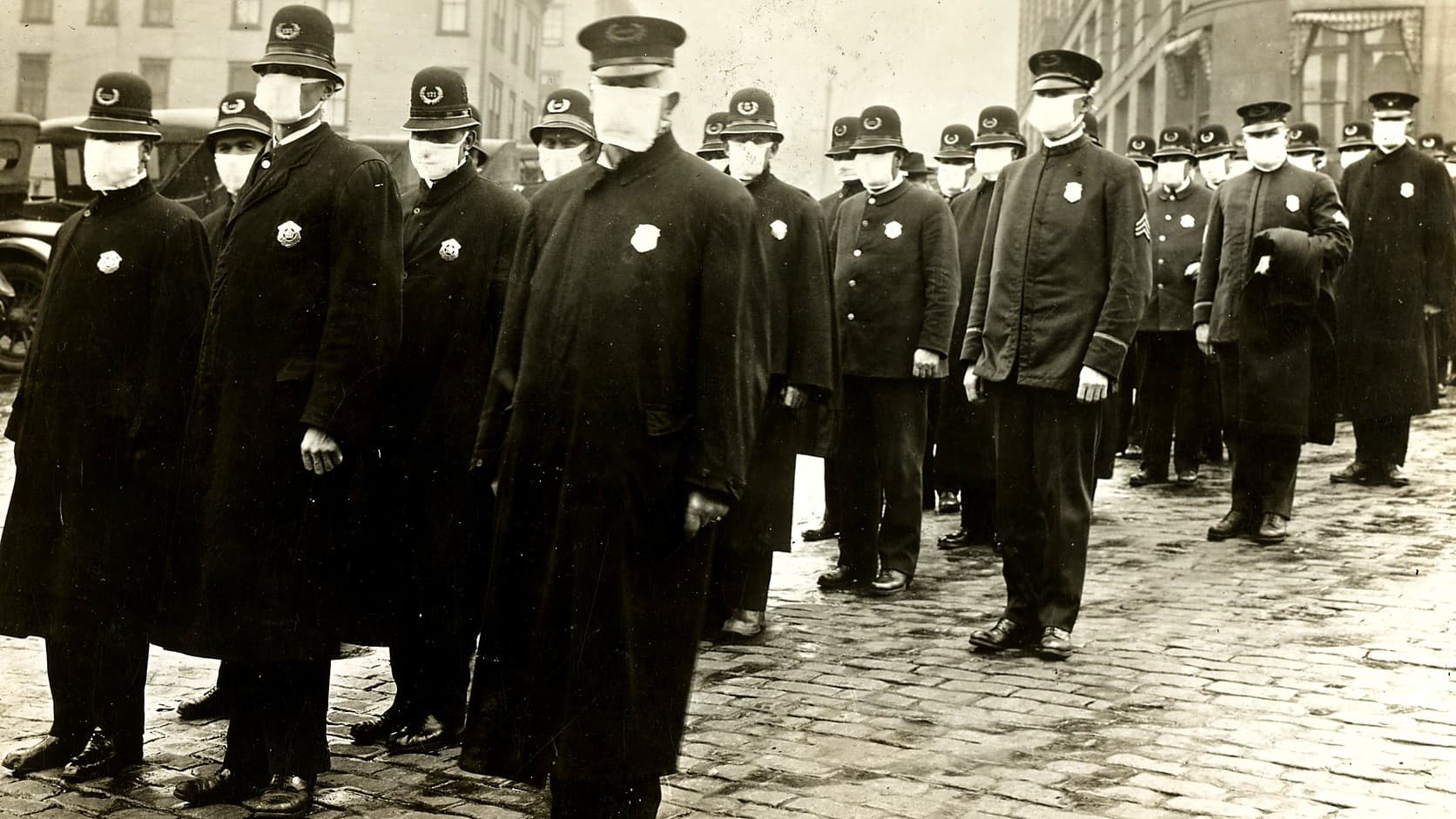
Spanish flu in Washington state, 1918: when it arrived, HistoryLink's death count, and the Seattle and state mask orders, with the dates sources dispute.
The Spanish flu reached Washington in September 1918, when Camp Lewis near Tacoma reported 11 cases on September 21, and it spread through Seattle and the rest of the state in October. HistoryLink, the free online encyclopedia of Washington history, counts 4,879 deaths from influenza in the state in 1918, a figure it takes from federal mortality tables. Seattle required masks in public from October 29, 1918, and a statewide order from the State Board of Health, signed November 4, 1918, followed. None of the flu sources opened for this piece mentions Enumclaw.
The state's mask order did not last. By the account in the University of Michigan's Influenza Encyclopedia, the board withdrew it about an hour before Seattle lifted its bans on the morning of November 12, because the state health commissioner judged it unenforceable when prosecutors in most counties would not back the health department. HistoryLink's essay on Spokane puts the withdrawal at the Armistice instead. Either way, the order ended little more than a week after it was signed, as Seattle's streets filled with Armistice crowds.
When did the Spanish flu reach Washington?
The first cases were reported at Camp Lewis near Tacoma on September 21, 1918, and Seattle followed in early October. HistoryLink says the 11 sick men at Camp Lewis, the Army's training camp, had arrived from camps in the East and South. The State Board of Health's own report, written in December 1918, instead pointed to about 1,500 men shipped from Pennsylvania to the naval training station at Bremerton. The accounts do not quite agree.
HistoryLink dates the epidemic's arrival in Seattle to October 3, with one death and about 700 cases at the Navy's training station on the University of Washington campus. The "Spanish" label was a misnomer, HistoryLink explains elsewhere: Spain stayed out of the war and reported its outbreak openly, while the nations fighting it tried to conceal theirs.
How many people died of the Spanish flu in Washington?
HistoryLink counts 4,879 deaths attributed to influenza in Washington in 1918, citing the U.S. Census Bureau's Mortality Statistics 1918, a federal report covering the 30 states the bureau judged to keep reasonably reliable records. It warns that the bureau lumped influenza and pneumonia together, so every figure carries some uncertainty. Just over half of the dead, 2,461 people, were young adults, though HistoryLink's essays give the age band as 20 to 39 in one place and 20 to 49 in another.
City figures depend on the page. One HistoryLink essay, drawing on the same tables, counts 1,441 flu deaths in Seattle between October 12, 1918, and March 15, 1919, and 428 in Spokane. A second says some 1,600 people died in Seattle over six months. A third puts the city's toll at 1,772 and says the epidemic lasted until May 1919. The spans differ, and this article does not pick one. For scale, the Wellington avalanche of 1910 killed 96 people.
What did Washington do to stop the Spanish flu?
In late September 1918 the State Board of Health decided against mandatory quarantines. On September 25, 1918, Dr. Thomas D. Tuttle, then the state health commissioner, telegraphed Rupert Blue, then the U.S. Surgeon General, about quarantining cases within the state, and HistoryLink prints the one-line reply from the board's report: "Service does not recommend quarantine against influenza." By HistoryLink's account the board's only preventive rule applied statewide was the November mask order. Closing public places fell to cities and counties, though the Anacortes American reported on October 10 that its city did so on the board's instructions.
Vancouver's council ordered schools, churches and dances closed on October 7, and HistoryLink lists assembly bans in Seattle on October 6, Spokane on October 8 and Pullman on October 10. The Influenza Encyclopedia adds that the King County Board of Health ordered all public assemblies in the county prohibited in early October. Doctors then believed bacteria caused influenza; HistoryLink says the viral cause was not identified until the 1930s.
When did Washington require masks in 1918?
Seattle required masks from October 29, 1918, and the state followed in early November. Dr. J. S. McBride, then the city's health commissioner, and Ole Hanson, then its mayor, announced the Seattle order on Monday, October 28, the Influenza Encyclopedia says. Anyone in a store, on a streetcar or in any public place near other people needed a mask. Hanson told commuters to get one from the Red Cross's stock of 250,000, "or tomorrow morning they will walk to work." On the first morning, the encyclopedia adds, at least ten people were arrested for riding a streetcar without one and had to post $5 bail.
The state's order is harder to date. One HistoryLink essay says masks were required throughout the state the day after Seattle's began, October 30. Three other HistoryLink essays give November 3. The order itself, as the Anacortes American printed it on November 7, 1918, and as the City of Anacortes has transcribed it, is signed "this 4th day of November, 1918" by J. R. Brown, then president of the State Board of Health, and T. D. Tuttle, its secretary. The Michigan encyclopedia says the board met and voted the day after Seattle issued its order, with the measure effective November 4. The Anacortes paper of October 31 quoted the city's health officer calling masks "not compulsory" for the general public, which fits November better than October 30. No source explains the gap between November 3 and 4, so this article uses the signed date.
The order demanded masks of at least six layers of surgical gauze, "entirely covering the mouth and nose," in streetcars and other public conveyances, the corridors and lobbies of public buildings, stores, offices that dealt with the public, restaurants (except while eating), barber shops and laundries. It made breaking it unlawful and ran until the state health commissioner revoked it.
Why did the mask order end so soon?
The withdrawal came as Armistice crowds filled the streets, though the reason on record is Tuttle's own: by the Influenza Encyclopedia's account, he judged the order unenforceable. Crowds filled Seattle's streets on November 11, 1918, and Hanson, quoted by The Seattle Times that day, said: "The lid is off: Everybody get out today and celebrate in the open air! Give me my coat! I'm going to get in it myself!" The next day, HistoryLink says, the city lifted nearly all its limits on gatherings. The state's mask rule went at about the same time, and McBride said that, had he known, the closures would have stayed.
Accounts differ on Seattle's own mask rule. HistoryLink's essay on the city's epidemic says it was lifted the next day, another HistoryLink essay says masks stayed required at gatherings, and the Influenza Encyclopedia says McBride called the city's order unenforceable once the state dropped its own.
Did the flu come back after the Armistice?
The flu returned within weeks. The board's report to the governor, delivered January 1, 1919, said the disease made rapid progress again within two to three weeks of the end of the gathering limits. Seattle's council acted in the first week of December to let health officers isolate suspected cases and placard homes, and nearly 1,000 placards were up by December 10, the Influenza Encyclopedia says. HistoryLink says Seattle's deaths peaked on December 9, 1918.
For the whole state, HistoryLink counts 1.9 deaths per 1,000 residents from influenza and pneumonia in 1919, more than twice the normal rate, against 4.1 per 1,000 in 1918. The virus began to fade in the late spring of 1919.
What happened in Enumclaw during the Spanish flu?
No record of Enumclaw's 1918 flu turned up in the sources opened for this article. HistoryLink's flu essays, the Influenza Encyclopedia and the Anacortes newspaper transcriptions do not mention Enumclaw, Buckley or Black Diamond, and HistoryLink says no county-by-county tally of cases or deaths appears to exist.
What can be said is about the setting. Enumclaw was a five-year-old city in the fall of 1918: it incorporated on February 1, 1913, and had 1,129 people by 1910, HistoryLink says. The state epidemiologist wrote in the board's report that city health officers outside Seattle, Tacoma, Spokane and Yakima were part-time men, often paid nothing or five dollars a month. By that wording, a city health officer in Enumclaw would have been a part-time man, but the report does not say whether the city had one or who held the job, and no local record was found.
The Courier-Herald's own history has the Herald opening in 1909 alongside the Courier and the two merging in 1933, and our piece on the Courier-Herald and its archive tells it in full. The paper says the records it donated to the Enumclaw Historical Society go back to 1923, five years after the epidemic. If the flu was written down in Enumclaw, the best place to look is the Courier's and the Herald's issues from October to December 1918, which were not seen.
Our walking tour of the historic buildings traces the Historical Society's museum to a Masonic hall built in 1909, so the building stood then. The public library did not: Enumclaw's first library began in a City Hall room in 1923.
Where can you read the 1918 records, in Enumclaw or online?
HistoryLink's flu essays are free online, and the Influenza Encyclopedia's Seattle essay has a day-by-day timeline. The City of Anacortes publishes transcriptions of its newspaper's 1918 coverage, including the state's mask order in full.
For Enumclaw, the Enumclaw Plateau Historical Society's museum at 1837 Marion Street is open Thursday and Sunday from 1 to 4 p.m., with free admission, as of October 2026, and off-hours group tours by appointment, according to its contact page. The society sets those hours, so check the page before you go. Its research page lists indexed newspaper-clipping catalogs from 1930 and earlier; whether any touch 1918 was not checked.
Story label: Original Story or Guide
Originally published: