

Feature
Tacoma Narrows Bridge collapse timeline, November 7, 1940
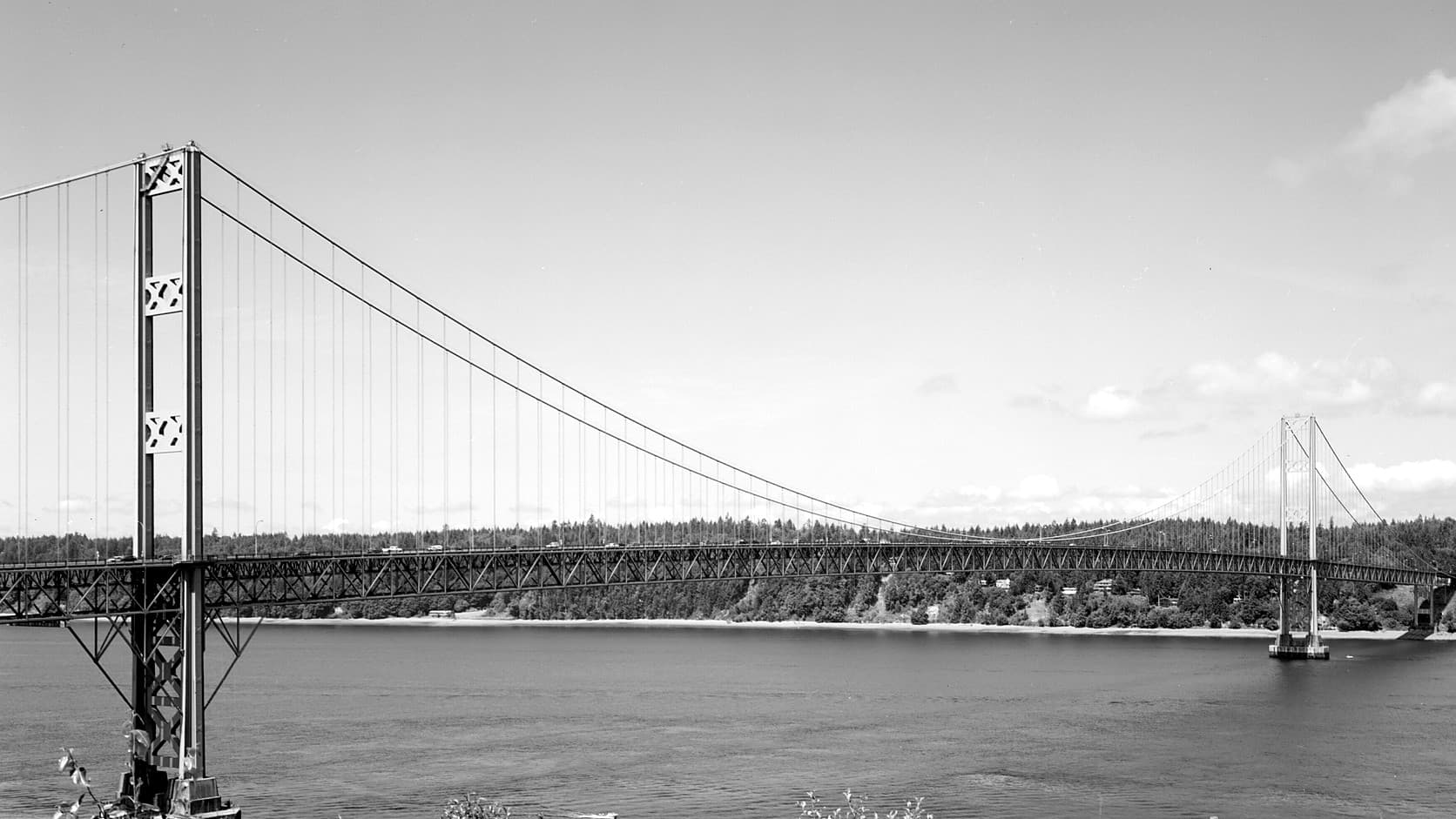
Tacoma Narrows Bridge collapse, November 7, 1940: twisting from 10:03 a.m., final section down at 11:08, by WSDOT's timeline. The only known victim was a dog.
The Tacoma Narrows Bridge, nicknamed Galloping Gertie, collapsed on Thursday, November 7, 1940, 129 days after it opened, in a wind of about 42 miles per hour. By the Washington State Department of Transportation's timeline, the deck began to twist at 10:03 a.m., a 600-foot section of roadway fell at 11:02 and the final section at 11:08. No person died; the only known victim was a cocker spaniel named Tubby, left in a car on the span. As of October 2026, two later bridges, opened in 1950 and 2007, carry State Route 16 across the Narrows, about 33 miles by road from Enumclaw.
What brought it down was not a hurricane. The Historic American Engineering Record (HAER), the National Park Service's survey of engineering works, says the bridge was designed for a static wind pressure, a steady push, of 50 pounds per square foot, and that the gale that morning pressed with about five. And the video versions of the collapse footage that physics teachers have used show the twisting about 50 percent faster than it happened, a 2015 study found.
What time did the Tacoma Narrows Bridge collapse?
It came apart over about an hour, and the sources keep slightly different clocks. WSDOT's timeline starts at 7:30 a.m. with the wind at 38 miles per hour and has it at 42 by 9:30, the deck rolling in waves 2 to 5 feet high. The report of the federal board of engineers that investigated the collapse quotes a report by project engineer L. R. Durkee that puts the 42 at about 9:00 and adds that Professor F. B. Farquharson of the University of Washington believed the wind was higher when the span went down.
Clark Eldridge, then the Washington State Toll Bridge Authority's bridge engineer, wrote in a statement the board printed that the day before he and others had agreed to start streamlining the south side of the main span. At 10:03, by WSDOT's clock, the roadway began to twist, and by 10:07 it was tilting up to 28 feet on one side and then the other, at angles up to 45 degrees. The board puts the start at about 10:00. Kenneth Arkin, who was counting the deck's cycles, wrote that the call to the radio patrol office came at exactly 10:07, about three minutes after the odd motion began.
WSDOT has a large chunk of concrete falling at 10:30, a 600-foot section of roadway breaking free at 11:02 and the final section dropping at 11:08. The board has those last two falls at about 11:00 and 11:10, and the University of Washington Libraries' film notes say around 11:02 and by 11:10.
Did anyone die in the Tacoma Narrows Bridge collapse?
No person died in the collapse. WSDOT, HistoryLink and the University of Washington Libraries each name a dog, Tubby, as the only fatality. Tubby was a black cocker spaniel that belonged to the daughter of Leonard Coatsworth of the Tacoma News Tribune, WSDOT says, and he was in the back seat when Coatsworth's car stopped about 450 feet past the east tower. Coatsworth crawled most of the way back to the towers and, he wrote, saw his car plunge into the Narrows. According to WSDOT, he and his colleague Howard Clifford, a photographer, each tried to reach the dog and could not, and Farquharson got to the car and was bitten while trying to coax Tubby out. Farquharson's account, which WSDOT reproduces, has the section under him dropping 30 feet; then, he said, "I kneeled on the roadway and stayed to complete the picture."
Coatsworth's wife, Ethel, told a newspaper in 1975 that Tubby "had three legs and was paralyzed." The Toll Bridge Authority paid Coatsworth $450 for the car and $364.40 for its contents, which would have included Tubby, WSDOT's Tubby page says. Building and painting the bridge had cost two lives earlier in 1940, WSDOT's timeline records: carpenter Fred Wilde in June and painter Hugh Meiklejohn in September.
Why did the Tacoma Narrows Bridge collapse, and was it resonance?
The board, three engineers appointed by the Federal Works Agency, reported on March 28, 1941 that the bridge was well designed for the static forces, wind included, usually considered in designing such structures, and that it failed from excessive oscillations caused by the wind. Those were made possible, it wrote, by "the extraordinary degree of flexibility" of the structure. It thought it reasonably certain that the first failure was the slipping of the band that tied the north main cable to the deck at mid span, which probably started the twisting. Its design figures differ in detail from HAER's: it says the design assumed a wind pressure of 30 pounds per square foot on one and a half times the deck's frontal area, a drag it equated with a 108-mile-an-hour wind, and its table gives 6.2 pounds per square foot of girder at 40 miles an hour. Eldridge's original design had deck-stiffening trusses 25 feet deep, HAER says; the cheaper redesign by Leon Moisseiff used solid steel girders 8 feet deep, HistoryLink says.
Was it resonance? Many undergraduate physics textbooks have presented it that way, and Farquharson, testing a model in a wind tunnel, concluded early on that the bridge went into "intense resonant oscillation," HAER reports. In 1991 two engineers, K. Yusuf Billah and Robert H. Scanlan, called the textbook account an oversimplification in the American Journal of Physics. They calculated that vortex shedding, the swirls a blunt deck sheds in the wind, would have run close to once a second at 42 mph, about five times faster than the 12 cycles a minute Farquharson timed, and concluded it was not the cause. They described the failure as self-excitation, the wind's force tied to the deck's own motion. WSDOT's history site lists torsional flutter, a self-induced twisting vibration, as the main explanation and says experts disagree on some aspects, calling the exact cause a mystery; Billah and Scanlan wrote that no "puzzle" or "mystery" is involved.
Who filmed the Tacoma Narrows Bridge collapse?
Four people made the original 16-millimeter record, according to a 2015 Physics Today article by researchers at Texas State and East Carolina universities: bridge official Walter Miles, Barney Elliott and Harbine Monroe of Tacoma's Camera Shop, and Farquharson. The researchers found the video copies show the twisting about 50 percent too fast, because film shot at 16 frames a second was converted as if it had run at 24; Farquharson's stopwatch put the true pace at 12 cycles a minute. The falling roadway, filmed by Monroe, does play at true speed, they found.
What happened to the wreckage and the insurance money?
The wreckage of the center span lies on the Narrows seabed, WSDOT says. Its history site calls the wreck one of the world's largest man-made reefs and says the National Register of Historic Places listed it in 1992 as protection against salvagers; the National Park Service's register database carries it as Tacoma Narrows Bridge Ruins, published August 31, 1992. HAER says the 1950 bridge was built on the piers laid in 1938 and 1939.
The University of Washington Libraries counts 22 insurance policies on the bridge, and WSDOT's timeline has the state and 22 insurers settling for $4 million in August 1941. One policy led to a criminal case. WSDOT says Hallett R. French, a Seattle agent for the Merchants' Fire Assurance Company, a New York insurer, wrote the state an $800,000 policy and deposited the $8,000 premium in his bank account without telling his firm. He was arrested on December 2, 1940, pleaded guilty on February 7, 1941 and was sentenced to 15 years at Walla Walla; he served two.
What did the 1949 earthquake do to the new bridge and to Enumclaw?
On April 13, 1949, the Olympia earthquake struck while the replacement bridge's east tower was nearly finished. The 1951 federal report on the quake says it threw a 23-ton cable saddle, the steel seat on top of a tower that holds a main cable, from a tower of the Tacoma Narrows bridge; WSDOT's timeline puts the saddle at 28 tons and says it fell through a barge below. The same federal report found Enumclaw with a few damaged chimneys and cracked plaster and part of Buckley's high school building on the ground, as our guide to Washington's biggest earthquakes explains.
How far is the Tacoma Narrows Bridge from Enumclaw?
A routing check on OpenStreetMap data puts the bridge's east end about 33 miles from Enumclaw City Hall, roughly 50 minutes without traffic: State Route 164 to Auburn, SR 18, Interstate 5 and SR 16. SR 164 is one of the numbered state highways out of Enumclaw. For Enumclaw drivers heading across the Narrows to Gig Harbor, Kitsap County or Hurricane Ridge, whose route the ski-area guide gives as across the Tacoma Narrows and Hood Canal bridges, the crossing is free on the way out, because WSDOT says tolls are collected only on trips headed to Tacoma. The toll comes on the way home. For the plateau's own wind, see our guide to the east wind off Stampede Pass.
Before you go
The Washington State Transportation Commission, designated in law as the State Tolling Authority, sets Tacoma Narrows rates, and its page for the bridge says they are reviewed for possible adjustment every year. It lists a two-axle vehicle at $4.50 with a Good To Go! pass, $5.50 at the toll booth and $6.50 by Pay By Mail, effective October 1, 2022. WSDOT's tolling page, which links to its traffic app and real-time travel data, is the one to check before you leave. The commission cites RCW 47.46.110: tolls continue until the bridge's construction obligations and state advances are repaid, then it must be toll-free. The statute gives no date.
In Gig Harbor, the Harbor History Museum shows a color film of the collapse in its main gallery. As of October 2026 the museum is open Wednesday through Saturday, 11 a.m. to 4 p.m., with admission of $10 for adults and $5 for students 5 to 17, and free on second Saturdays. The 86th anniversary of the collapse falls on Saturday, November 7, 2026.
Story label: Original Story or Guide
Originally published: