

Feature
Ballard Locks hours, parking and fish ladder in winter
Ballard Locks hours as of November 2026: grounds 7 a.m. to 9 p.m., visitor center Wed to Sun 10 to 3, $2 an hour parking, and whether salmon run.
As of November 2026, the U.S. Army Corps of Engineers lists the grounds at the Hiram M. Chittenden Locks, which Seattle calls the Ballard Locks, as open from 7 a.m. to 9 p.m., with the room for watching the fish ladder open from 7 a.m. to 8:45 p.m. The visitor center is open Wednesday through Sunday, 10 a.m. to 3 p.m., from October 1, 2026 to April 30, 2027, and closed Monday and Tuesday. Parking in the city's lot is $2 an hour, with a four-hour limit. For anyone driving up from Enumclaw, those are the numbers that decide the trip.
The locks were carrying boats long before anyone cut a ribbon. By the official opening on July 4, 1917, HistoryLink reports, more than 16,000 vessels had already gone through, hauling more than 300,000 tons of goods, from logs to hay to coal. The place that looks like a park with a boat problem was working as a machine first.
What are the Ballard Locks hours from October 2026 to April 2027?
The Corps' page for the locks gives three separate sets of hours. Boat traffic is listed as 24 hours a day, seven days a week, though the Corps' closure schedule page, in a July 2026 archived copy, lists the large lock as closed for its annual maintenance from November 2 to November 20, 2026, which covers the day this guide publishes; check that page before you go. The grounds are listed as 7 a.m. to 9 p.m. The room for watching the fish ladder is listed as 7 a.m. to 8:45 p.m. The page gives no separate winter and summer hours for the grounds or the viewing room, so these are the figures it prints year-round. It was read on November 2, 2026.
The Corps sets these hours, so its page is the place to check. The address is 3015 NW 54th Street, Seattle.
Is the Ballard Locks visitor center open in winter?
It is open five days a week, Wednesday through Sunday, from 10 a.m. to 3 p.m., for the stretch from October 1, 2026 to April 30, 2027. Monday and Tuesday it is closed. The page lists longer summer hours, 10 a.m. to 6 p.m. on the same five days, for May 1 to September 30, 2027. The Corps writes its schedule in a half-year block like this, so the dates will move each spring and fall, and the page itself is the only place that will have the next block.
The page does not say whether the visitor center keeps these hours on federal holidays, and Thanksgiving (Thursday, November 26, 2026) falls on a day it would normally be open. A phone call or a look at the page that morning settles it.
Are there free tours at the Ballard Locks in winter?
Not for individuals. The Corps offers a free tour at 2 p.m. on Wednesdays, Thursdays and Fridays, lasting about an hour from the visitor center, but only between May 1 and September 30. Groups of eight or more can book an organized tour of the locks, the fish ladder and the garden any time from January 1 to December 31. The Corps says it contacts a group within 72 business hours of a request.
Can you still see salmon at the fish ladder in November?
Possibly, and the Corps does not promise it. The ladder has 21 steps, called weirs, which let fish climb a gradual slope between the lakes and Puget Sound. The Corps' fish page names its best viewing months as July through November for Chinook, August through November for coho and June through October for sockeye. November is the last month in the first two windows and past the third.
The page also carries a count table, and the newest row, for the week ending October 27, 2026, listed 231 Chinook and 2,902 coho for that week, with season totals of 14,675 Chinook, 13,337 coho and 31,302 sockeye. Those are the Corps' published figures, which it calls preliminary and subject to change, and it says staff of the state's fish and wildlife department and the Muckleshoot Indian Tribe do the counting, and it adds that locks counts have run much higher than what reaches the hatcheries and spawning grounds, for reasons it calls unknown. Treat the table as a rough guide to what swam past through late October 2026. Run totals differ from year to year, and so does timing, so the table is the thing to read before you drive.
The viewing room itself reopened on August 16, 2021, after a renovation the Corps carried out with The Corps Foundation and Discover Your Northwest.
How much is parking at the Ballard Locks?
The north lot beside the locks belongs to the city of Seattle, not the Corps. The rate is $2 an hour for a maximum of four hours, and the pay stations take debit cards, credit cards and coins. From October through April, the Corps' page says, you pay from 8 a.m. to 6 p.m. Monday through Saturday; from May through September the paid window runs 8 a.m. to 8 p.m. The same sentence says Sundays and holidays are free, though it does not say which holidays. The lot is city-owned, and the city's parking program page, or (206) 684-ROAD, is where the Corps points for pay-station information.
A fast visit fits easily in four hours. The rule is aimed at all-day parkers who are not visiting the locks, according to the Corps' page.
What is there to see in winter besides the fish?
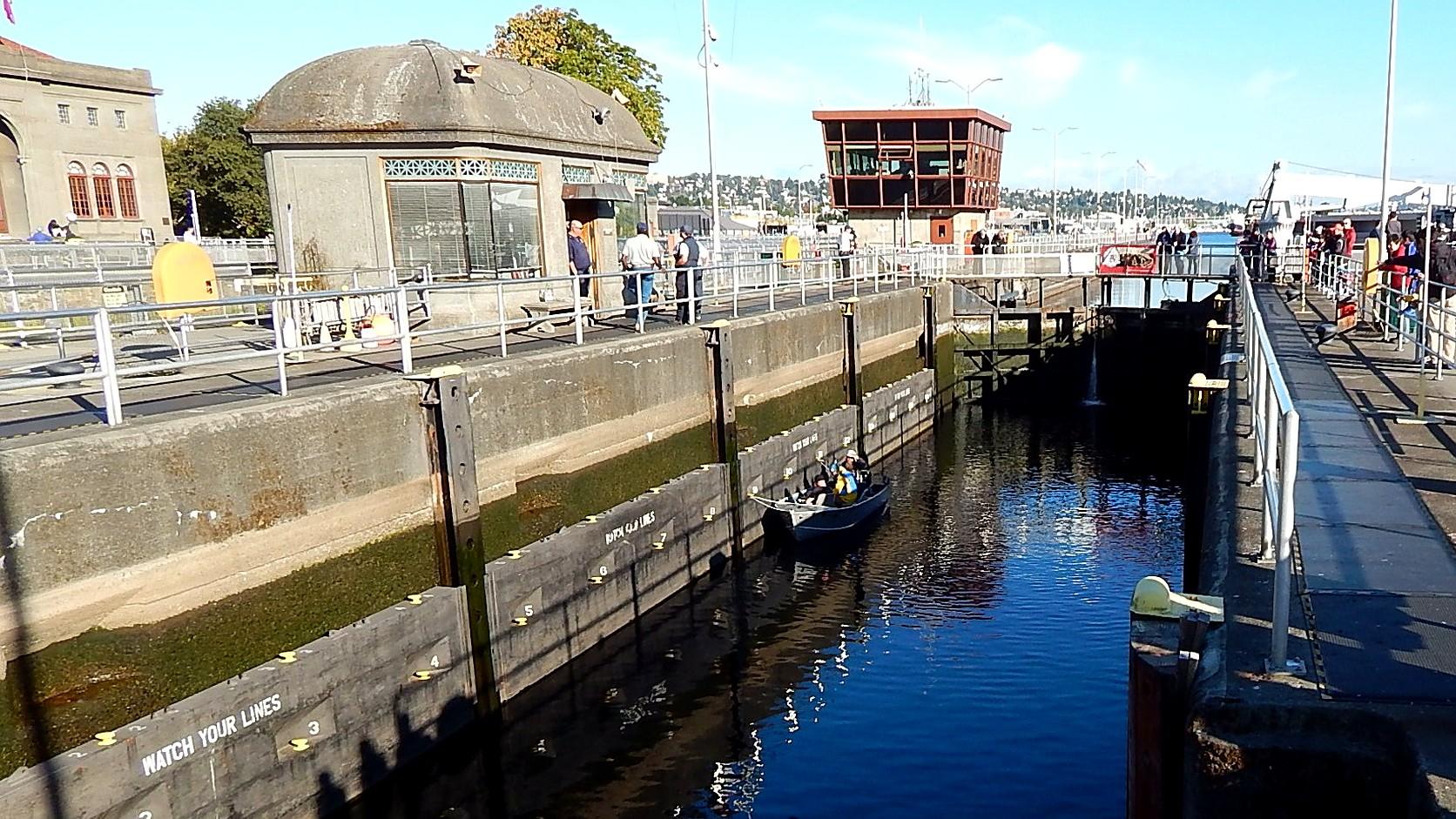
The boats, first. By the Corps' main page the large lock is 80 by 825 feet and the small one 30 by 150, though its closure page lists the usable lengths as 760 feet and 123 feet, and a vessel locked through is lifted or dropped between the level of the lakes and the level of Puget Sound. The Corps lists three jobs for the whole arrangement: moving boats, keeping both lakes between 20 and 22 feet above sea level, and keeping salt water from Puget Sound out of the lakes. A 235-foot spillway with six gates helps control the water level.
The second thing is the Carl S. English Jr. Botanical Garden on the same grounds. By the Corps' garden page, English spent 43 years with the Corps turning bare lawn into a collection of more than 570 species and 1,500 varieties. His best-known catch is the dawn redwood, a tree known only as a fossil until it turned up growing in China; he arranged to receive some of the first seeds shipped to the United States, and eight grow there, the Corps says. The page says the garden offers something all year, and its photo gallery includes a snow-covered tree there. The Corps' garden page was read from an archived copy, so the grounds hours above are the figures to rely on.
Why do the locks exist, and why did the lake drop?
Lake Washington once stood nearly nine feet higher than it did after 1916. After the final cut at Montlake in 1916, HistoryLink says, the lake fell by almost nine feet over three months. Chittenden's plan, HistoryLink says, was a pair of locks near Ballard and none at Montlake, so Lake Washington would fall to the level of Lake Union once the two were joined. The locks then had to hold that level and, by the Corps' account, keep salt water out of the lakes.
Chittenden, whom the Corps lists as Seattle District Engineer from April 1906 to September 1908, did not live to see the locks named for him. HistoryLink says they were called the Government Locks until 1956. The first ship passed on August 3, 1916, the Corps says, and the National Register of Historic Places added the locks in 1978.
What does an Enumclaw reader have to do with it?
The Corps runs more than this one. The Seattle District's own menu for locks and dams lists Mud Mountain Dam, the dam on the White River about five miles southeast of Enumclaw. The two sit at opposite ends of one problem: fish and the structures built across their routes. At Ballard the fish climb a ladder built into the works, and the viewing room lets people watch. At Mud Mountain the dam blocks the river entirely, and this site's Mud Mountain Dam guide tells how trucks carry salmon past it. The older diversion at Buckley has its own fish story in the White River diversion piece, and the Boise Creek salmon guide covers a stream in town where salmon spawn on their own.
How do you get to the Ballard Locks from Enumclaw?
By car, the Corps gives directions from downtown, north Seattle, south Seattle and the Eastside, using Interstate 5 exits 172 and 169 and NW Market Street through Ballard. From the Eastside it says to take Interstate 90 or Highway 520, which is a toll road, to Interstate 5 north and exit at 169. It does not give transit directions. If you would rather leave the car in Enumclaw, Enumclaw to Seattle by bus and train covers the two-ride trip to downtown Seattle, but that only brings you to King Street Station, not to the locks.
Before you go
Check the Corps' Chittenden Locks page the morning you leave, for three things: the visitor center days, any closure notice, and whether a holiday changes anything. The main page, read on November 2, 2026, carried no closure notice, but the Corps keeps a separate closure schedule page for the locks, which in a July 2026 archived copy lists the large lock chamber closed for annual maintenance from November 2 to November 20, 2026. A federal site can also change its operations on short notice, so a page read days ahead can be out of date. The fish page has the count table, and the city's parking program page has the pay-station rules.
Story label: Original Story or Guide
Originally published: