

Feature
Ginkgo Petrified Forest State Park hours in winter
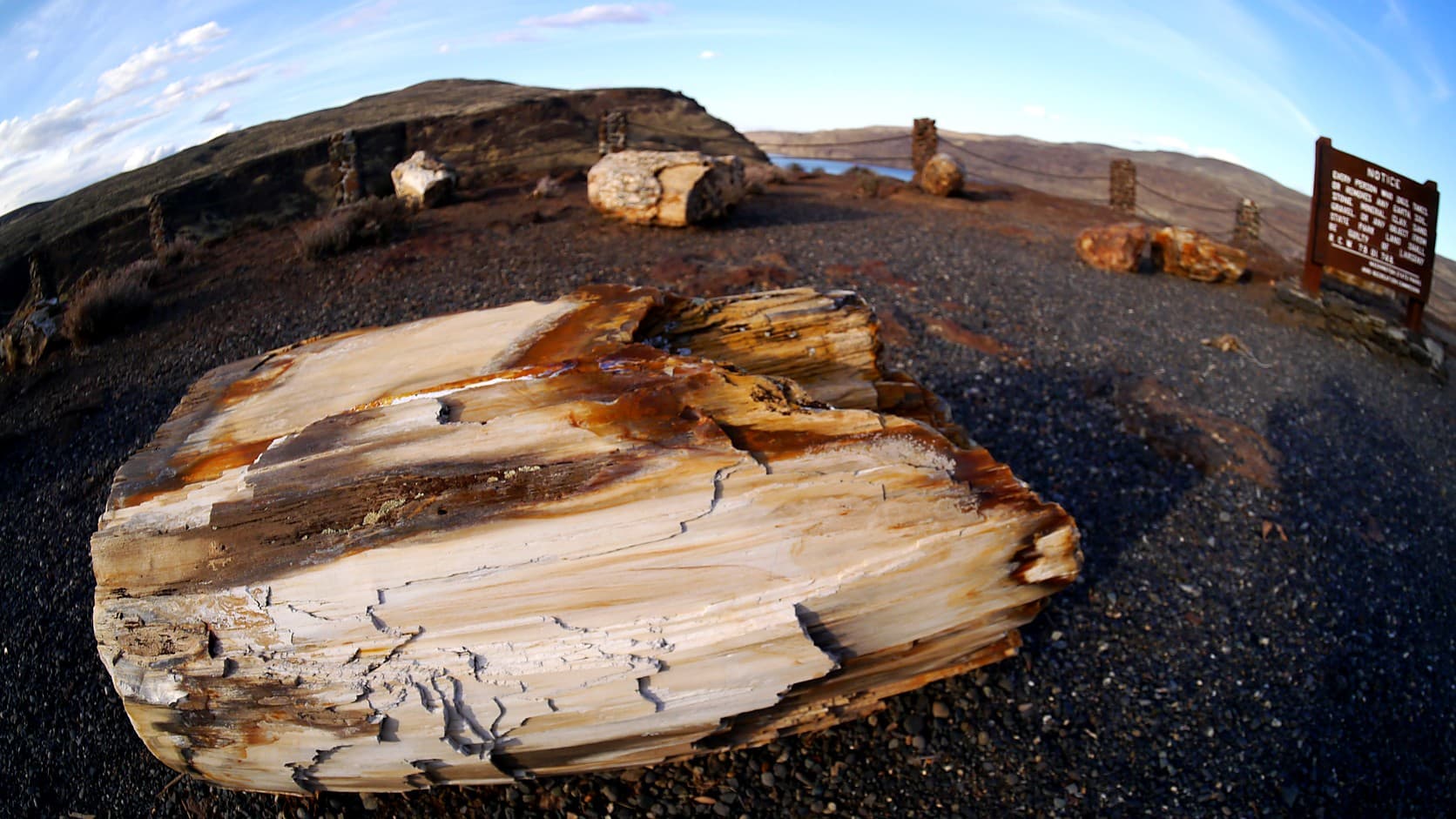
Ginkgo Petrified Forest State Park is open 8 a.m. to dusk in winter, as of October 2026. Interpretive center hours, the pass, and the drive from Enumclaw.
Ginkgo Petrified Forest State Park, on the Columbia River at Vantage, is open from 8 a.m. to dusk in winter, according to Washington State Parks, and as of October 2026 it takes a Discover Pass ($45 for a year, $10 for a day). The interpretive center keeps a shorter schedule: 10 a.m. to 4 p.m. Friday through Sunday until December 23, 2026, then Sundays only, so it is closed on Wednesday, November 4, and its next open day is Friday, November 6. From Enumclaw the park is about 139 miles by Interstate 90 over Snoqualmie Pass, about 2 hours 47 minutes without stops.
In October 1958, with Wanapum Dam about to raise the river over a set of carved basalt columns, a retired mason and stone cutter named Bob Atwell and a nearby resident began cutting the carvings out of the rock. By State Parks' history of the park, they lowered the pieces onto a raft, floated them across the Columbia and hauled them back over the highway bridge to the museum, and some pieces went overboard on the way. The winter schedule is less adventurous, but State Parks has published it in two places that do not quite agree.
What are Ginkgo Petrified Forest State Park's winter hours?
State Parks' park page, read on October 28, 2026, lists winter hours of 8 a.m. to dusk and summer hours of 6:30 a.m. to dusk. It does not say which dates count as winter. A State Parks brochure revised in 2022 put the winter day-use hours at October 1 to March 31, but the rule behind every listing is WAC 352-32-050: the agency sets each park's open and closed times and has to post them at the park entrance and office. Under that rule a visitor is bound by the posted closing time, so go by the sign.
On that date the alerts box held one notice, a Burn Ban Level 2 posted September 25, 2026: "Wood fires restricted to fire pits in designated areas. Gas and propane allowed. Charcoal may be restricted." The park's entry on State Parks' Winter Schedule page shows the day-use area open and lists no campground or boat launch at Ginkgo itself. Questions about seasonal closures go to the park at (509) 856-2290 or to State Parks' Information Center at (360) 902-8844.
Is the Ginkgo Petrified Forest interpretive center open in winter?
On a short schedule. The center's page lists 10 a.m. to 4 p.m. on Fridays through Sundays from November 2 to December 23, 2026, closed October 31 and November 1, and Sundays only, again 10 a.m. to 4 p.m., from December 24, 2026 to March 31, 2027. The Winter Schedule page gives the same Friday-to-Sunday hours through December 23, then says Sundays only from December 24 to March 17, opening at 9 a.m. instead of 10. Phone before planning around a Sunday morning in January or March.
A 2022 brochure that the park page still links says something else again: the center is "Open by appointment only through Winter." The same brochure lists the annual Discover Pass at $30, which the statute sets at $45, so treat it as out of date and the two web pages as the schedule. The center page lists no admission charge and describes displays, videos and park staff inside, with a picnic area outside where visitors can touch petrified wood.
Do you need a Discover Pass at Ginkgo Petrified Forest?
To park, yes. The park page lists the Discover Pass at $45 for a year or $10 for a day. The rule behind the price is RCW 79A.80.020, which requires a pass on any motor vehicle parked at or driven on a recreation site and sets the annual price at $45, with the Office of Financial Management reviewing it every four years and recommending any change to the Legislature. RCW 79A.80.030 sets the day permit at $10. Parking without one is a $99 natural resource infraction under RCW 79A.80.080, cut to $59 with proof of purchase within 15 days of the notice.
The Discover Pass site lists November 11, 2026, Veterans Day, as the last free day of 2026, and free days cover day-use parking only. Its list is for 2026, so the 2027 dates will have to be read there. Our guide to which pass you need near Enumclaw explains how the Discover Pass differs from the Forest Service passes.
How far is Ginkgo Petrified Forest from Enumclaw?
About 139 miles, and about 2 hours 47 minutes without stops. A routing service built on OpenStreetMap data (OSRM), asked on October 28, 2026 for a trip from central Enumclaw to the interpretive center's coordinates on State Parks' page, returned State Route 169, State Route 18 and Interstate 90 east over Snoqualmie Pass, with the park's brochure map marking the Vantage exit as Exit 136. Treat the time as an estimate for open roads and no chain stops.
WSDOT's Snoqualmie Pass page lists the summit at 3,022 feet and carries the conditions. The chain rules are in our Enumclaw to Yakima winter guide, and the studded tires guide has the season dates for studs.
What is petrified at Ginkgo, and how old is it?
Thousands of logs, by the Park Service's count, sealed in lava over a swamp landscape that State Parks dates to 15 to 16 million years ago. The National Park Service lists the site as a National Natural Landmark designated in 1965 and calls it North America's most diverse site for petrified wood of the Miocene, with over 40 wood types. The Miocene is a geologic epoch, and the U.S. Geological Survey's entry for the Ginkgo lava flow gives that age too.
State Parks says the forest was warm and swampy, with ginkgo among its trees, and that about 15.4 million years ago lava called the Ginkgo Flow hit the swamp water, hardened into rounded masses geologists call pillow lava and sealed the logs while silica from the basalt replaced the wood cells. The ginkgo is the rarity: the Park Service's 2020 landmark brief calls it "rarely found as fossil wood," and State Parks says Professor George Beck of Ellensburg and four students found what they judged the first complete ginkgo log on record on November 29, 1932.
The state gem is the whole category, not the tree. RCW 1.20.090, adopted in 1975, reads: "Petrified wood is hereby designated as the official gem of the state of Washington." On foot, State Parks lists a 1.25-mile Trees of Stone Interpretive Trail among three miles of trails, with the trailhead about two miles west of the center. HistoryLink, in 2005, gave the interpretive trail as 1.5 miles.
Can you bring a dog, or take home petrified wood?
Dogs are allowed on a leash, the park page says. WAC 352-32-060 sets the leash at no more than eight feet and bars pets from public buildings unless posted otherwise, so ask before bringing one into the center. Taking wood is a different matter. The 2022 brochure says: "Wildlife, plants, petrified wood and all park buildings, signs, tables and other structures are protected; removal or damage of any kind is prohibited." Touching the wood outside the center is what the page invites; carrying it off is what the brochure forbids.
What does an Enumclaw mudflow have to do with a fossil forest?
In both places, moving water and mud rearranged the ground. The U.S. Geological Survey says Enumclaw sits partly on the Osceola Mudflow, rock from Mount Rainier's summit and northeast slope that slid away, ran down the White River 5,600 years ago and reached Puget Sound near Auburn. State Parks says the Ginkgo logs have been called a "rafted forest": streams, rivers and volcanic mudflows called lahars carried the trees down from higher ground into the swamp. The Park Service's brief reads the missing roots, limbs and bark as wear from floodwater or a mudflow.
The two events are about 15 million years apart, and nothing opened for this article ties them to the same volcano. Our lahar-zone guide covers the ground under town; At Ginkgo, State Parks says streams, rivers and lahars carried the logs down into the swamp, and the Park Service says floodwater or a mudflow wore them smooth.
How did the petroglyphs end up beside the interpretive center?
By raft, on a deadline. State Parks says a women's group nearby proposed moving the rocks before Wanapum Dam's reservoir covered the site, and the State Parks Commission approved. Atwell, with help from Clarence Scammon, started in October 1958, and by September 1959, State Parks says, rocks with nearly 100 images had been moved.
HistoryLink counts differently: more than 300 figures at the site and about 60 salvaged, carved by the Wanapum. State Parks does not say which people made them. It says the park lies in the traditional territory of Sahaptian and Inland Salish people, whose descendants include Yakama Nation members and members of the Colville Reservation's confederated tribes, and that rock images were made there especially along the Columbia. Neither source says which pieces are on display on a given winter day.
Before you leave Enumclaw
Open the park page and the Winter Schedule page the morning you go, read the alerts box, and phone (509) 856-2290 if the center's Sunday hours matter. Check WSDOT's Snoqualmie Pass report before the climb. If you planned to camp or launch a boat, the Winter Schedule lists Wanapum Recreation Area, the camping and water-access park down the road, as closed from November 1, 2026 to March 1, 2027 for campground, day use and launch, while the Wanapum page lists winter hours of 8 a.m. to dusk, so call (509) 856-2700 first.
No source opened for this article says what the Trees of Stone trail is like in snow or ice, and nobody can promise what the walk will show. For another eastern Washington state park's winter hours, our Palouse Falls guide covers the pass, the closures and the drive.
Story label: Original Story or Guide
Originally published: