

Feature
Maryhill Stonehenge is open daily 7 a.m. to dusk, and free
Maryhill Stonehenge hours: the museum's page says open daily 7 a.m. to dusk, free, even after the museum closes on November 15. History and what to check.
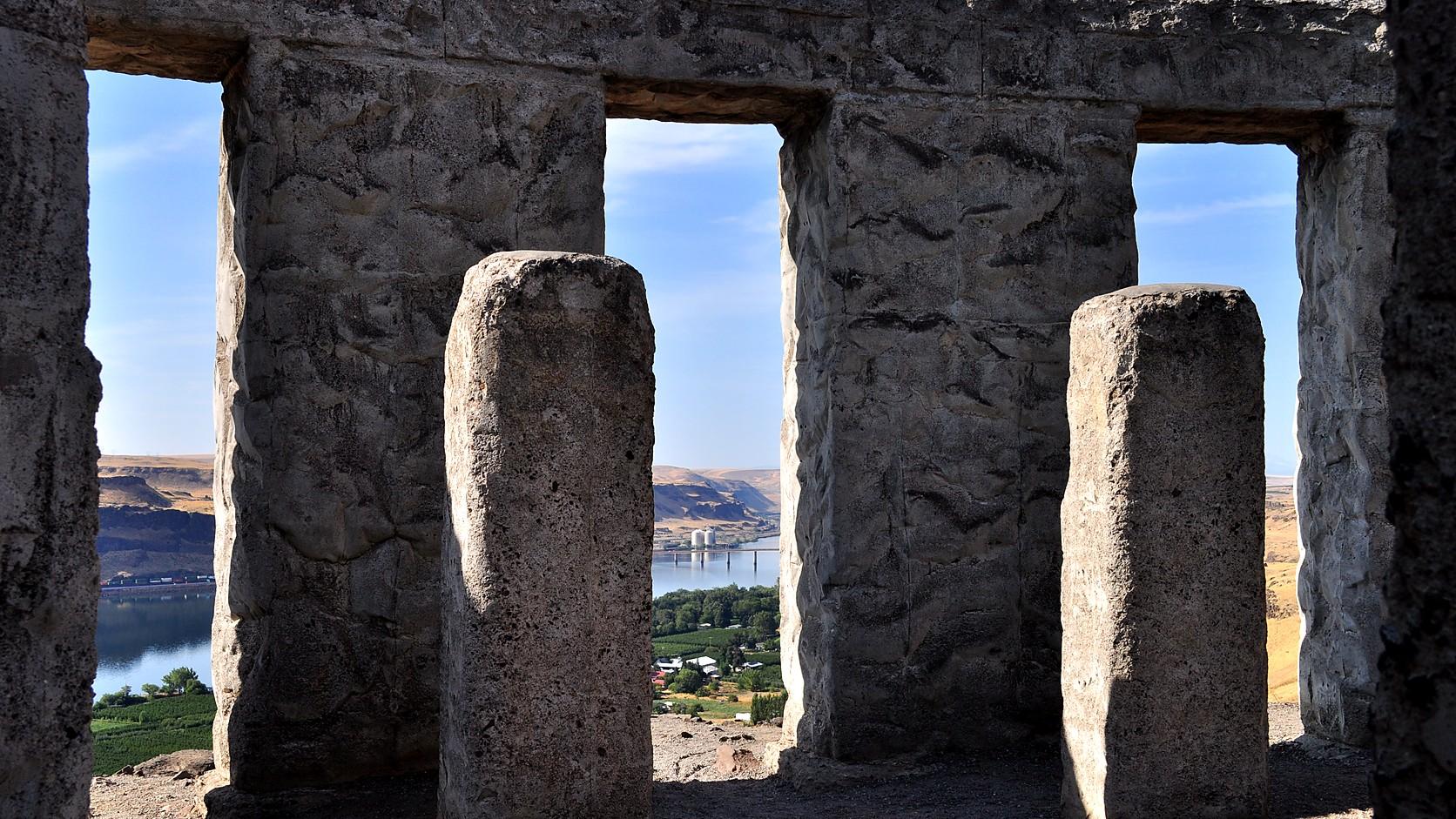
Maryhill Stonehenge, the full-size concrete replica on a bluff above the Columbia River in Klickitat County, is open every day from 7 a.m. to dusk, and it costs nothing to walk in. As of November 2026, that is what the Maryhill Museum of Art says on its page for the Stonehenge Memorial, which lists no winter exception even though the museum itself closes for the season after November 15 each year. For a reader in Enumclaw the trip starts with a Cascade pass crossing, which the site's guide to winter driving from Enumclaw to Yakima covers.
The hook is who placed the center stone. Sam Hill, the Seattle road-builder who put the monument up, had it set in July 1918 with a plaque to the county's dead while the war was still being fought, and the man he asked to fix its position was an astronomer who had come to Klickitat County to watch a solar eclipse. The count of names on it also differs from one source to the next, and this page reports each version.
Is Maryhill Stonehenge open in winter?
By the museum's own page, yes: it says the circle and the neighboring county veterans memorial are "open daily 7 a.m. to dusk." The page does not tie that to the museum's season and carries no alert or closure notice. The museum is a separate matter. Its visit page says it is open from March 15 to November 15, daily, 10 a.m. to 5 p.m., including federal holidays, so from mid-November to mid-March the building is shut while the monument is not.
Dusk moves through the year, and the page gives no clock time, so look up the sunset for your date before you drive.
How much does it cost, and where is it?
Admission to the memorial is free, according to the museum. The page puts the monument three miles east of the museum, on the original Maryhill town site, just off Highway 14. The museum's own address, 35 Maryhill Museum Drive, Goldendale, WA 98620, is not the monument's.
Hill's crypt is a short walk southwest of the circle on a bluff above the river, according to the same page. The museum says his ashes were placed in a crypt just below the memorial after his death in 1931, that the first crypt deteriorated, and that a granite monument replaced it in 1955 with the epitaph "Samuel Hill: Amid nature's great unrest, he sought rest." HistoryLink, the state's online encyclopedia, says he died on February 25, 1931, in Portland, and that his ashes were entombed near the memorial.
When does Maryhill Museum reopen?
The museum's page states a season, March 15 to November 15, and says its tours run between those dates every year. It does not print a 2027 opening date, and as of November 2026 its tour paragraph still carries wording about the winter of 2025 and 2026. So the pattern is a mid-March opening, but the museum has not published the 2027 date on the pages read for this article.
The rule is the museum's: it sets its own season and its own hours, and its visit page is the place to confirm them before a spring trip. The museum lists the phone number (509) 773-3733. Admission as listed in November 2026 is $23 for adults, $21 for seniors 65 and over, $16 for college students with ID, $10 for ages 7 to 18, $55 for a family of two adults and two youth, and free for members and for children 6 and under. The museum asks visitors to buy tickets in advance. Those prices are the museum's to change, so check them in the spring.
Why did Sam Hill build a Stonehenge in Washington?
He built it for peace, by his own account. Hill was a Quaker, and HistoryLink says that after a 1915 visit to Stonehenge in England he reasoned that modern war was needless human sacrifice, like the sacrifices he believed the ancients made there. The museum notes that he was mistaken about the sacrifices, and HistoryLink says the idea has since fallen out of favor. HistoryLink quotes his biographer John Tuhy as saying Hill built the memorial "to remind my fellow man of [that] incredible folly."
The museum calls it the nation's first memorial to the First World War, dedicated in 1918 to Klickitat County servicemen. HistoryLink calls it the first American memorial for the dead of that war, and quotes the Goldendale Sentinel, which said the county was the first in America "so far as reported." Treat the first as the museum's and HistoryLink's claim, not a settled record.
The eclipse is the odd detail. A total eclipse of the sun was predicted for June 8, 1918, with the best viewing near Goldendale, so some of the day's leading astronomers were in the county. The museum says Lick Observatory's Professor Campbell, of the University of California, took on the job of fixing where the altar stone would stand, and the stone was dedicated on July 4, 1918. The sources differ on what he fixed it to. The museum says the stone follows the astronomical horizon instead of the true midsummer sunrise, a three degree difference from England's circle, and that the surrounding hills make the monument hard to use as a calendar. HistoryLink says the placement rested on Campbell's calculations of where summer solstice sunrise would be. Neither source says the circle works as an observatory.
How big is Maryhill Stonehenge, and what is it made of?
It is reinforced concrete, not stone. The museum says Hill first meant to use local rock, but it proved unsatisfactory, and that the rough, hand-hewn look came from lining the wooden forms with crumpled tin. HistoryLink gives the layout: two concentric circles, an inner ring of 40 pillars each 9 feet high and an outer ring of 30 pillars each 16 feet high, with five trilithons in the middle. A trilithon is two upright stones carrying a third across the top. The altar stone is listed there as 6 by 18 feet.
The completion date depends on where you read. The museum puts the finish in 1929, with a second dedication that Memorial Day, and HistoryLink's essay on the dedication gives May 30, 1929. HistoryLink's biography of Hill says it was not completed until 1930. This page uses 1929, the date the museum and the dedication essay share, and flags the later one.
Whose names are on the Maryhill Stonehenge?
They are Klickitat County servicemen who died in the First World War. The museum lists 14, here in reverse of its order: Robert F. Venable, Henry O. Piendl, Edward Lindblad, Carl A. Lester, Louis Leidl, Robert F. Graham, Harry Gotfredson, James D. Duncan, Evan Childs, William O. Clary, John W. Cheshier, Dewey V. Bromley, Charles Auer and James Henry Allyn. All served in the American Expeditionary Force, the museum says, in the Army, Marines and Navy.
HistoryLink's dedication essay counts differently. It says that by the Sentinel's report of July 11, 1918, six names had been inscribed on the monument, and seven more joined them by the armistice of November 11, 1918, which is 13 names without Piendl, and it prints Duncan's middle initial as B where the museum prints D. HistoryLink's biography of Hill says the 1918 monument honored three men, with nine more names to be added, which makes 12. The sources do not say why the numbers differ. The plaque on the altar stone reads, in the museum's transcription, "To the memory of the soldiers and sailors of Klickitat County who gave their lives in defense of their country."
In 1995 a second memorial went up nearby, honoring Klickitat County's dead from later wars. The museum calls it the Klickitat County Veterans Memorial and says it was a project of the museum and the county's veterans association. HistoryLink says a county committee raised $37,500 to repair the weathered concrete the same year, and that both were dedicated on August 22, 1995.
What is closer to Enumclaw for Veterans Day?
Maryhill is a long way east, and the nearer options are on this site. The Veterans Day closures guide says what shuts and what is free on November 11 in the Enumclaw area. The Tahoma National Cemetery guide covers hours and eligibility at the Kent cemetery, and the Washington Soldiers Home in Orting piece tells how that state veterans home began.
Hill's other Washington monument is closer to the Canadian line. HistoryLink says he built the Peace Arch at Blaine at his own expense, completed in 1921. The trail up Beacon Rock, another Columbia River Gorge landmark, was paid for by one man, according to the Beacon Rock trail closure guide.
Before you go
Check three things on the day. First, the sunset for your date, since the memorial closes at dusk and the museum page gives no clock time. Second, the road: Highway 14 is a state route, and the Washington State Department of Transportation is the agency that posts its closures. Third, if you want the museum, its season and ticket prices on the visit page, which the museum sets and can change from one year to the next.
For the monument itself, as the museum describes it, you need no ticket and no pass. The museum's page for the memorial and its visit page are the two to open before you leave. The plaque on the altar stone is there in every season.
Story label: Original Story or Guide
Originally published: