

Feature
Mount Rainier snowfall at Paradise averages 53 feet a year
Mount Rainier snowfall at Paradise averages 637 inches a year, the park says. The record is 1,122 inches, the low 266, and 2025-26 brought 479.
Paradise, the meadows at 5,400 feet on Mount Rainier's south side, averages 637 inches of snow a year, about 53 feet, by the National Park Service's average of the winters on its record there, which begins in 1920. The most on the park's table of annual snowfall totals is 1,122 inches, in 1971-72; the least is 266, in 2014-15; and the winter of 2025-26 brought 479. For scale, the old weather station at Buckley, on the plateau beside Enumclaw, averaged about a foot a year.
The leanest of those winters was not a dry one. The park's climbing rangers, in their report on the 2015 season, wrote that precipitation had been average but "it came as rain, not snow," and that their own measurements between 9,000 and 11,000 feet showed average to above-average snow. A warm winter, in other words, can send the Paradise total to a record low while the mountain above it carries on much as usual.
How much snow fell at Paradise in 2025-26?
Paradise got 479 inches, just under 40 feet, in the season that ended June 30, 2026. By this site's count of the park's table, that is the 14th-lowest of the 96 winters with a total, and the smallest total the park has posted since 2014-15. The 2023-24 season has no total: the park says snowfall in November and December 2023 was not accurately measured.
Since the record low, the table reads 698 inches for 2015-16 (an estimate, as the park marks it), 703 for 2016-17, 738 for 2017-18, 543 for 2018-19, 530 for 2019-20, 672 for 2020-21, 708 for 2021-22, 624 for 2022-23, no total for 2023-24, 587 for 2024-25 and 479 for 2025-26. The park counts a snow year from July 1 to June 30, so each total is posted after its season closes; the table was last updated July 13, 2026.
What is the Mount Rainier snowfall record?
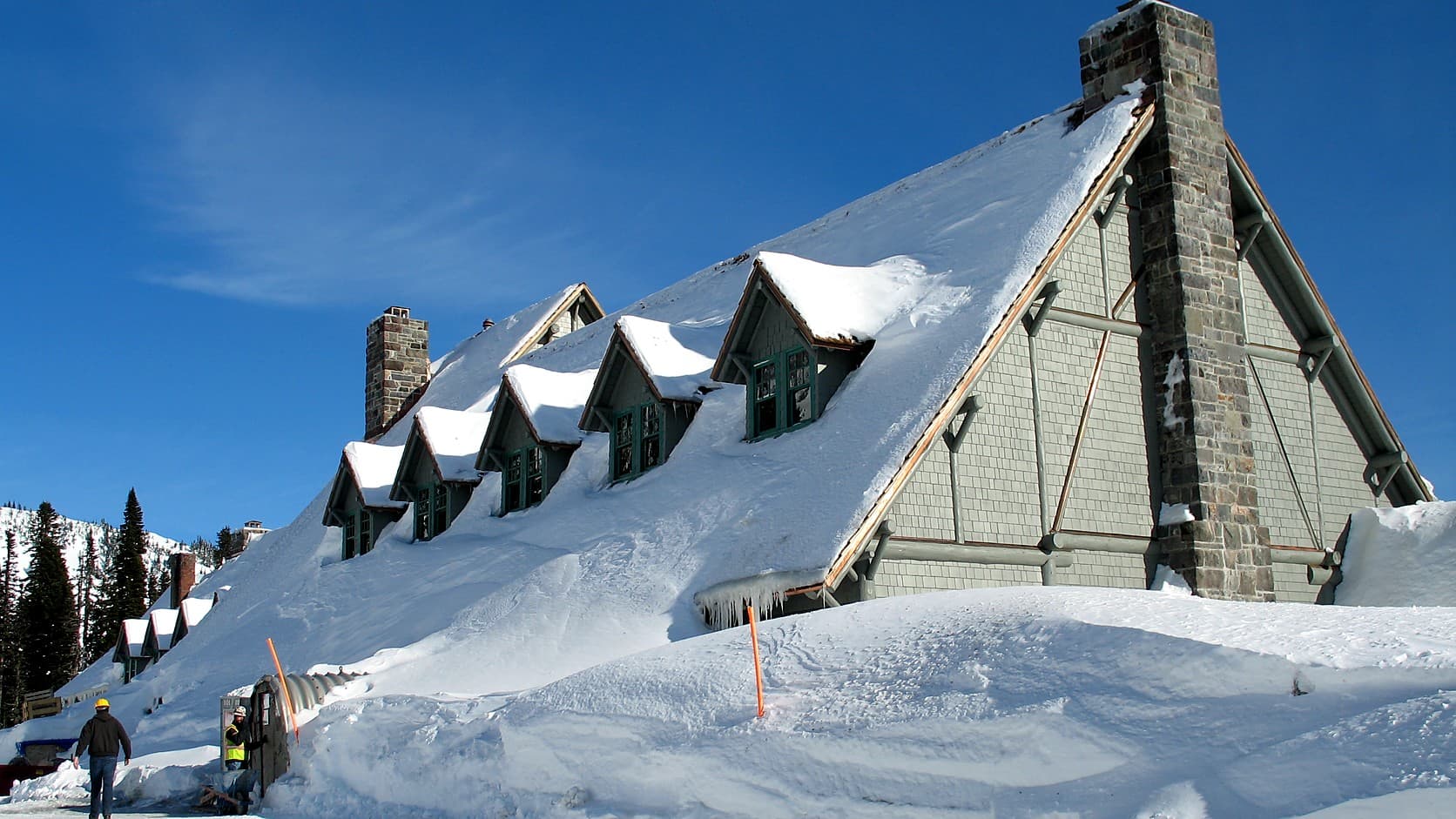
The record at Paradise is 1,122 inches, or 93.5 feet, in the winter of 1971-72, which the park says was the world record for measured snowfall in a single year. Three other winters reached 1,000: 1,000 in 1955-56 on the park's table, 1,070 in 1973-74 and 1,032.5 in 1998-99. None has since; the nearest was 2007-08, estimated at 947, the winter of the photograph at the top of this page.
The record went north in 1999. The Mount Baker Ski Area measured 1,140 inches from July 1, 1998 through June 30, 1999, and on August 2, 1999, the National Oceanic and Atmospheric Administration declared it a record on the advice of the National Climate Extremes Committee, a panel of climatologists. The Seattle Times reported the next day that the total was "the most ever measured in the United States in a single season" and also counted as the world record, 18 inches past the Paradise mark. The park still calls Paradise "one of the snowiest places on Earth where snowfall is measured regularly."
When did Paradise get the least snow?
The least was 266 inches, in 2014-15, by the park's table; the climbing rangers' report on the 2015 season gave 260. Either figure broke the old low of 313, set in 1939-40. The rangers added that January ran 10 degrees warmer than normal, that the snow on the ground never got much past 70 inches, and that the sledding area at Paradise never opened. Sixteen winters on the table came in under 500 inches, seven of them before 1943.
Two lean winters show up in the state's records for Chinook Pass on State Route 410, the highway out of Enumclaw. In 1976-77, Paradise's eighth-lowest winter at 414 inches, WSDOT's table of pass dates shows the pass opening on June 11, 1976 and not closing until November 15, 1977. After the record low, the state reopened it on April 2, 2015, the earliest opening on a table that runs back to 1935.
Is Paradise getting less snow?
Not in a straight line. By this site's arithmetic from the park's table, the leanest decades are the earliest: about 549 inches a winter in the 1920s, 537 in the 1930s and 539 in the five measured winters of the 1940s. The snowiest decade was the 1970s, at about 757. After the 1990s, at about 715, each decade has come in lower than the one before: 670 in the 2000s, 641 in the 2010s and 614 for the five winters of the 2020s that have totals. The table does not say why, and decade averages from a record with holes are rough.
The road to Paradise was closed during World War II, and the park's table has no records for 1943 to 1946 or for 1948 to 1954. The Western Regional Climate Center, which archives the station's record, gets a higher average from its monthly figures for 1916 to 2016: about 655 inches a year.
How deep does the snow get at Paradise?
The snow on the ground is deepest in spring, not midwinter: about 14 feet in an average April. Snowfall is the sum of every new snow in a season; snow depth is what lies on the ground on a given day, after settling and melt. In the climate center's monthly averages for the Paradise station, the depth climbs from 69 inches in December to 167 in March and peaks at 172 in April; July still averages 22.
The deepest ever measured there, and the state record, was 367 inches, about 30 and a half feet, on March 9 and 10, 1956, according to the Washington State Climate Office's list of state records. The park's FAQ gives a different figure, 357 inches in March 1955. The park says the area is snow-free in most years only from about mid-July through late September, the window in which the Skyline Loop's trailhead parking fills fast.
Why does Paradise get so much snow?
The mountain stands in the storms' way. The park's exhibit overlooking the Paradise Inn calls Rainier "a magnet for storms": this close to the coast, moist Pacific air is forced steeply up its slopes, cools, and drops its moisture there. The same exhibit credits that snowfall with building the enormous glaciers that radiate from the summit, the Emmons among them, where the White River that runs past Enumclaw begins.
The inn's steep roof, the exhibit notes, is designed to shed heavy snow. A Park Service history of the building, which opened on July 1, 1917, says the snow piled against it was slowly pushing it downhill, so braces were added to the timbers to help it resist the strain each winter. Floyd Schmoe, later the park's first full-time naturalist, spent six months of 1920 in the buried inn with his wife, Ruth, by HistoryLink's account, and the exhibit quotes him: "It often happened that our first evidence of a storm outside was to wake up at eight o'clock in the morning in midnight darkness."
How does Enumclaw's snow compare?
The plateau gets about a fiftieth as much. The Buckley 1 NE weather station averaged 12.1 inches of snow a year from 1913 to 2012 in the Western Regional Climate Center's summary, against Paradise's 637. This site's comparison of Enumclaw and Seattle snow explains why winter on the plateau is more about cold and ice than depth.
Washington's snow records are split three ways, and one of them is up the road. The state climate office lists the most snow in a season as Mount Baker's 1,140 inches, which it calls a U.S. record; the deepest as Paradise's 367; and the most in 24 hours as 65 inches at Crystal Mountain, the ski area up State Route 410 from Enumclaw, on February 24, 1994. The Seattle Times reported that day that it broke a state record of 52 inches set at Winthrop in 1935.
Before you head up from Enumclaw
As of October 2026, the road to Paradise is open. Stevens Canyon Road is scheduled to close for the winter on October 26, 2026, a date the park says may change. After that the only way in by car is the Nisqually Entrance near Ashford, which makes the drive from Enumclaw to Paradise about 80 miles by a routing engine's measure. At October 2026 prices, entry is $30 a car for seven days or $55 for the park's annual pass, and no timed-entry reservation is needed, a system the park dropped for 2026. From November 1 to May 1, every vehicle in the park, four-wheel drive included, must carry tire chains.
In winter the road above Longmire is gated. On the park's typical schedule the gate opens at 9 a.m., uphill traffic stops at 4 p.m. and the downhill gate closes at 5, and the road can open late or not at all. The park posts each day's status on its Alerts page, and its winter travel page suggests checking after 4 p.m. the day before and after 7 a.m. on the day. Nightly closures typically begin in late October or early November.
The days a week the road opens have varied: Fridays through Mondays in 2024-25, by the park's release, and seven days a week in 2025-26, the Seattle Times reported in late December 2025. The sledding area did not open in 2025-26, and as of October 2026 the park has not posted plans for 2026-27. For current snow, the park's weather page links to the SNOTEL snow station at Paradise.
Story label: Original Story or Guide
Originally published: