

Feature
When did Washington become a state? November 11, 1889
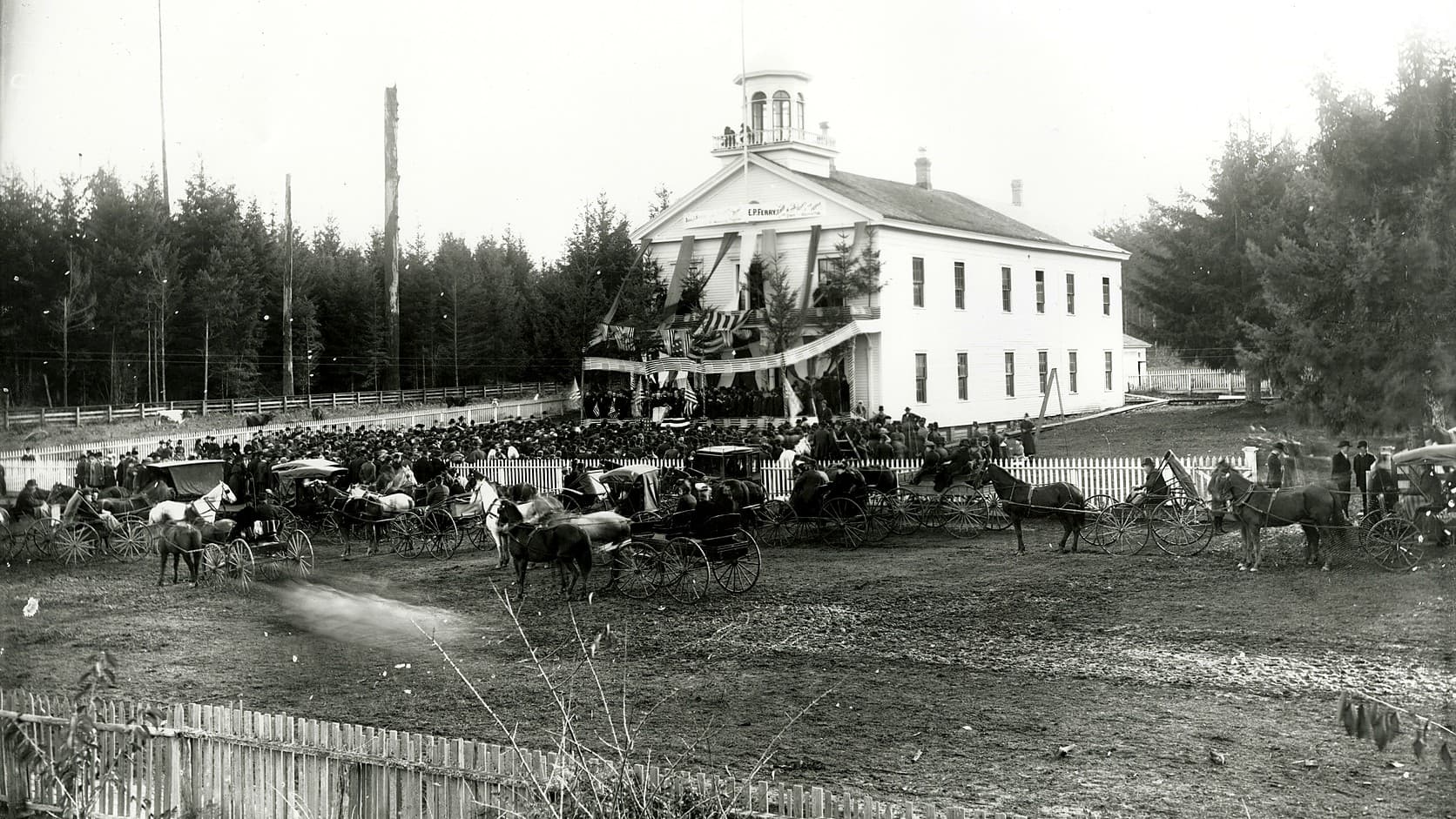
When did Washington become a state? November 11, 1889, by President Harrison's proclamation. Why it took 36 years, and what the Enumclaw plateau was then.
Washington became the 42nd state on November 11, 1889, when President Benjamin Harrison signed a proclamation declaring its admission to the Union complete. Enumclaw, in King County, was then a railroad townsite about four years old.
The date almost slipped. On November 4, 1889, a message reached Olympia saying the president would not act on the paperwork he had been sent, and a corrected copy had to be sent across the country. Then, on the day itself, HistoryLink reports that messengers spent over six hours at the White House before it came out that the proclamation was still at the Secretary of State's house.
Who was president when Washington became a state?
Benjamin Harrison, a Republican, who had beaten the incumbent Grover Cleveland in the 1888 election and, HistoryLink notes, did not take office until March 1889. Cleveland was still president on February 22, 1889, the day he signed the law that started Washington's road to statehood. Harrison's proclamation, number 294 in the American Presidency Project's collection, is dated November 11, 1889, and was countersigned by his Secretary of State, James G. Blaine. Its operative sentence says that "the admission of the said State into the Union is now complete."
What was the Enabling Act of 1889?
It was the federal law that told four territories how to become states. Congress passed it on February 20, 1889, according to HistoryLink's essay on statehood, and it carries the date February 22, 1889, in the Washington Legislature's published copy. Its title covers the division of Dakota into two states and the steps for North Dakota, South Dakota, Montana and Washington "to be admitted into the Union on an equal footing with the original States."
The act was a procedure more than a promise. Voters in each territory would elect delegates, the delegates would meet on July 4, 1889, write a constitution, and put it to a popular vote. The Dakotas were admitted on November 2 and Montana on November 8, a few days ahead of Washington, per HistoryLink.
How did Washington write and approve its constitution?
Seventy-five delegates, three from each of 25 districts, were elected on May 14, 1889, and met at the Territorial Capitol in Olympia on July 4. The Washington State Archives says they worked through the summer. Sources disagree on the day the convention finished: the Archives' constitution page says August 23, the Washington Digital Archives says August 22 and HistoryLink says August 24. Late August is as exact as the record allows here.
On October 1, 1889, voters approved the constitution 40,152 to 11,879, the State Archives reports. Only men could vote. Separate questions on woman suffrage and on prohibition were both rejected, and no city won a majority in the vote on the capital, so Olympia stayed the capital until a run-off the next year, which HistoryLink says it won (the Digital Archives page simplifies this and says Olympia was simply selected). Elisha P. Ferry, a Republican who had been territorial governor in the 1870s, was elected the first state governor.
Why did statehood take until November 11?
A certificate. The Enabling Act required the territorial governor to certify the constitution to the president, and the timeline, as HistoryLink reconstructs it from 1889 newspapers, went like this. Storms downed telegraph wires and delayed the count until October 21. Territorial Governor Miles C. Moore certified the results by letter on October 23, but the copy of the constitution carried only the territorial secretary's certificate. A messenger left Olympia on October 25. On November 3, Moore and the governor-elect telegraphed Harrison asking him to issue the proclamation. On November 4 Harrison answered that the governor himself had to certify the copy.
The two accounts frame the defect a little differently. HistoryLink says the president wanted the governor's certification attached to the copy of the constitution. The State Archives says that a message came on November 4 reporting that "Governor Moore forgot to sign the Constitution," and that a new copy was prepared overnight and sent by courier the next day.
The new papers reached Washington, D.C., on Monday, November 11. HistoryLink, citing the Seattle Post-Intelligencer of November 12, 1889, says the messenger and Washington's representative-elect spent over six hours at the White House before it came out that the proclamation was still at Blaine's house. Blaine then walked it over, and Harrison signed at 5:27 p.m. Eastern time, with "a pen of gold from the Washington mines." That time is HistoryLink's, resting on the newspaper; the State Archives pages used here give no hour.
Why did Washington stay a territory for 36 years?
Congress created Washington Territory in 1853. By HistoryLink's count, its 36 years as a territory were longer than those of any of the 41 states admitted before it. Five later states, Utah, New Mexico, Arizona, Alaska and Hawaii, waited longer.
HistoryLink gives several reasons. Many early settlers, busy with homes and businesses, had little interest in statehood, and voters rejected calls for a constitutional convention at least four times between the late 1860s and the early 1870s. When a convention did write a constitution in 1878, a Democratic Congress, in no hurry to add a reliably Republican state, did not act on it. The State Archives says that document was used extensively in drafting the 1889 constitution.
The biggest political obstacle to statehood, HistoryLink says, citing the historian Robert Ficken, was geography: "The complete lack of communications over the Cascades prevented unity, in politics and economics." For much of the territory's life there were no wagon roads or rail lines across the mountains. That changed in 1887 with a Northern Pacific line over Stampede Pass to Tacoma, and statehood followed within two years.
What was the Enumclaw plateau like in 1889?
Young, and mostly farms. HistoryLink's thumbnail history dates the town to 1885: the Northern Pacific Railroad ran its line across a plateau homestead, and the owners had offered cleared, level land for a siding. At that time, it says, only a few settlers lived on the plateau. The plat was filed with the King County auditor that autumn.
The same essay records a hop craze in the 1880s and early 1890s, which we cover in the story of the plateau's hop boom, and says farm produce sold to railroad crews and to the coal-mining towns of Franklin, Cumberland and Black Diamond that border the plateau. The turn to dairy came afterward, as the plateau's dairy history describes. The first federal census to count Enumclaw was the one of 1900, which found 483 people, so no census number exists for the year of statehood.
No source opened for this article says how the plateau voted on October 1, 1889, or how it took the news on November 11. Our history of the Courier-Herald, the plateau's long-running paper, starts its account in 1900, so it cannot fill the gap. For what the town built later, see the walking tour of Enumclaw's historic buildings and the oldest things still open in Enumclaw.
What happened in Olympia when the news came?
The news went out by telegraph, from Washington, D.C., to Olympia, where the legislature's two houses were meeting. HistoryLink quotes the writer Gordon Newell's account: the announcement in the senate chamber brought silence and then "a roar which shook the ancient wooden capitol." Cannon that had been loaded for days were fired, and the celebration spread down Main Street.
The formal ceremonies came a week later. HistoryLink dates the inauguration of Governor Ferry and the other new state officers, and the official celebration of statehood, to November 18, 1889. That is the date that matters for the photograph at the top of this page. The Washington State Archives photograph, now on Wikimedia Commons, shows the Territorial Capitol dressed with flags and evergreens on November 18. One other file of the same scene on Commons carries a file name with November 11 in it, but that file's source record at the State Archives and HistoryLink both give the later date.
Is November 11 Veterans Day because of statehood?
No. The two have separate histories that happen to share a date. The federal GovInfo site says Veterans Day, formerly Armistice Day, honors the end of World War I, which it dates to November 11, 1918. Congress made November 11 a legal holiday in 1938, and in 1954 amended that law to replace "Armistice" with "Veterans" so the day honored veterans of all wars.
In 2026, November 11 falls on a Wednesday, a week after this article. Washington's statehood anniversary is a historical date. The holiday's own observances are set by the people who run them, not by the statehood record.
Before you go
The documents are easy to read for yourself. The Washington State Archives offers the 1889 constitution as color and black-and-white PDFs on its constitution page, as of October 2026, and the American Presidency Project publishes the full text of Proclamation 294. The HistoryLink essay by Kit Oldham is the fullest account of the days between October 1 and November 18, 1889, and names its newspaper sources.
If you are planning anything for November 11, 2026, confirm hours with the office or business concerned. Holiday schedules are set by each employer, and nothing in the statehood record changes them.
Story label: Original Story or Guide
Originally published: