

Feature
Mount Baker snowfall record, 1,140 inches in 1998-99
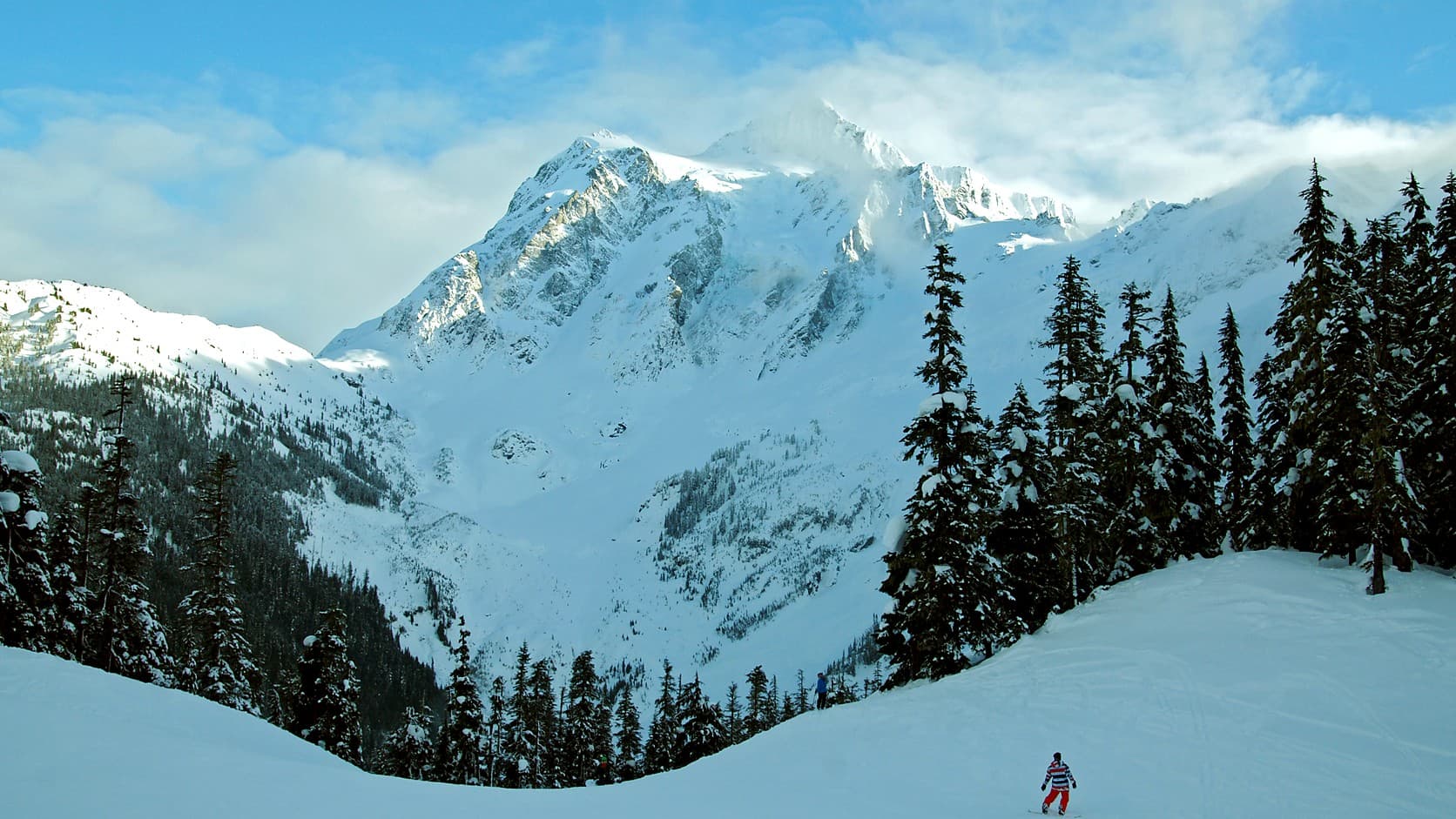
The Mount Baker snowfall record is 1,140 inches in 1998-99, accepted by NOAA on August 2, 1999. How it was measured, audited and what it beat.
The Mount Baker snowfall record is 1,140 inches, or 95 feet, measured at the Mt. Baker Ski Area, about 4,200 feet up in the Cascades of northwest Washington, between July 1, 1998 and June 30, 1999. The National Oceanic and Atmospheric Administration (NOAA) accepted it on August 2, 1999 as the official U.S. record for a single snowfall season. It took the mark from Paradise, on the south side of Mount Rainier, the mountain above Enumclaw, where 1,122 inches fell in 1971-72. As of October 2026, no season in the ski area's own table of totals since has come within 270 inches of it.
The odd part is who measured it. The 1,140 came from four ski area employees with rulers, yardsticks and tape measures, working in the resort's asphalt parking lot beside the employee housing, and a ski area has an obvious reason to like a big number. The committee NOAA called in to judge it said as much in its own report, then went out to the site and checked the log sheets. The ski area had announced 1,141. The committee trimmed it.
How was the record certified?
NOAA's National Climatic Data Center, now part of the National Centers for Environmental Information, accepted it on the unanimous advice of the National Climate Extremes Committee. The committee, formed in 1997 to judge claims that challenge national records, was chaired by Robert Leffler of the National Weather Service for this case, and it included Kelly Redmond of the Western Regional Climate Center. Its members visited the site and photographed it on June 8, 1999. The committee's paper says a NOAA press release on the decision went out the same day, and the Seattle Times carried it on August 3.
The committee's findings, published in the National Weather Service's National Weather Digest in June 2001, found the method sound on the points that matter. Observations were taken daily at about 5 a.m. local time, the snow surface was brushed clean each time, and where wind had drifted the snow the observers averaged depths from several spots, the accepted practice. Only one reading a day was counted, though up to four were allowed, so the committee reasoned the total could easily have been higher. It also cut two daily entries by half an inch each, because they had been rounded up to reach the 1,141 the ski area had announced.
Where at Mount Baker was the snow measured?
At the ski area's base, in the parking lot next to employee housing, about 9 miles northeast of the volcano's summit and 10 miles south of the Canadian border, by the committee's paper. It is not on the mountain's upper slopes. The observers measured new snow on the plowed asphalt, and when temperatures hovered near freezing they used a snowboard, a board laid on the surface so each fall could be read without melting into the ground below.
Two details complicate the picture. As the snowpack deepened, the plowed lot, roughly 100 by 200 feet, turned into a pit that reached a depth of 20 to 25 feet. And the total depth on the ground, as opposed to the new snow that fell, was read from a stake in a semi-open meadow a few hundred feet east. The paper says the stake was reportedly the same equipment, in the same place, used in the 1920s when the Weather Bureau first made the spot a cooperative weather station. None of the four observers had formal National Weather Service snow measurement training, though their experience in the job ran from 10 to 33 years.
The Washington State Department of Transportation, which plows the highway to the ski area, took its own snowfall readings that winter. They ran 10 to 29 percent lower than the ski area's in every month the committee could compare. Some members were uneasy about that. The paper says the department itself deferred to the ski area's numbers as an accurate reflection of the mountain, and the committee decided the highway crew's readings were too uncertain to weigh against them.
What did 95 feet of snow do to the mountain?
It shut the lifts and snapped old trees. The ski area closed on February 23 and 24, 1999, the first time in its 33-year history that it had closed for too much snow, according to the committee's paper, so crews could dig out the chairlifts and parking areas. The Seattle Times reported that the ski area used 200 percent more avalanche-control dynamite than in a normal season. The snow on the ground peaked at 318 inches on March 30, 1999, per the committee, and when its members visited on June 8 the level ground still held 19.5 feet. Ten days later the state reported the highway at Galena, near the ski area, still closed for avalanche danger, the latest date anyone could remember.
Trees told the same story. Interviews with ski area staff who had up to 30 years in the area, the paper says, made clear that the number of trees snapped by avalanches or by snow creep, the slow downhill movement of a heavy snowpack, was unprecedented. State highway workers found 120-year-old trees broken off about 3 miles from the ski area. The Seattle Times credited La Nina, a Pacific weather pattern that brought more wet weather across the Northwest, for the season.
Did Mount Baker really beat Mount Rainier's Paradise record?
By 18 inches on paper, and by more than that in the same winter. The National Park Service says Paradise held the world record for measured snowfall in a single year at 1,122 inches in 1971-72, on a record it keeps from July 1 to June 30. The 1998-99 total at Paradise was about 1,035 inches in the committee's paper, 1,032.5 on the park's own table of totals as of its July 13, 2026 update, so Baker out-snowed Paradise that winter by roughly 105 inches. The two sources differ by 2.5 inches, and this desk could not tell which is right, so both are given.
Paradise is the benchmark for snow on Mount Rainier, the mountain above Enumclaw. This site's guide to Paradise snowfall by year has the whole table, including the winters when Rainier came close and the one the park skipped. The Baker ski area's own table, which shows 1970-71 at 1,063 inches and 1971-72 at 1,008, says those 1970 to 1990 numbers were recorded by the state highway department and are unofficial.
Is it really a world record?
NOAA's decision, as the committee's paper tells it, made 1,140 inches the new official national record, and the paper's authors remark that the figure also stands as a world record. The ski area's page says the same, "verified by NOAA as the World Record of snowfall during a single winter season". The Washington State Climate Office's list of state records is more cautious: it calls the total a "U.S. record".
The Seattle Times of August 3, 1999 put the catch plainly. It called the total "the most ever measured in the United States in a single season," also accepted as a world record, but only for snowfall that can be verified, and then added that "the record comes with an asterisk": experts think the Himalayas get more, though nobody is there with a ruler. There is a second asterisk inside the number. The committee noted that October snow was left out of the 1,140, and said Baker staff thought another 10 inches or so might have fallen that month, while its own regional climate analysis put the figure nearer 20 to 30 inches.
How much snow does Mount Baker get in a normal winter?
About 625 inches, by this site's arithmetic of the ski area's table, which averages the 35 seasons from 1990-91 through 2025-26 other than 1998-99. The record winter was about 1.8 times that. Among those 35 seasons the lowest total is 303 inches in 2014-15, and the highest since the record is 866 inches in 2016-17. The most recent winter on the table, 2025-26, came in at 502, a figure the ski area labels unofficial.
For readers outside the mountains, 625 inches is itself a lot, about 52 feet. It is the slope's own normal, and Enumclaw's is a different world: this site's comparison of Enumclaw and Seattle snow explains why the plateau's winters are about cold and ice more than depth, and the guide to Washington's atmospheric rivers covers the wet Pacific storms that feed winters like 1998-99.
What does it have to do with Enumclaw?
Three of Washington's snow records belong to three different mountains, and one of them is up State Route 410. The state climate office lists the deepest snow on the ground as 367 inches at Paradise on March 9 and 10, 1956, and the most snow in 24 hours as 65 inches at Crystal Mountain on February 24, 1994. The season record is Baker's. Crystal Mountain's history has the 1994 storm, the winter guide to Mount Rainier covers the mountain overhead, and the roundup of ski areas near Enumclaw says where to go for snow closer to home.
Before you go
Mount Baker's opening day is not fixed, and the ski area's own page says why. As of October 2026, its 2026-27 operations schedule is a calendar image that marks November 1, 2026 as an opening day and April 18, 2027 as a closing day, with a footnote that both depend on conditions. The page adds that "Operating days and hours wholly depend on conditions and weather and are at the discretion of Mt. Baker Ski Area." The snow report is where the ski area posts the day's status, and its snowfall statistics page carries the table of seasonal totals used here. The committee's full paper is on the National Centers for Environmental Information's site as Evaluation of a National Seasonal Snowfall Record at the Mount Baker, Washington, Ski Area.
Story label: Original Story or Guide
Originally published: